By , July 10, 2015.

After a brief hiatus due to vacation and holidays, we’re back!

Copyright And The Public Interest: Not Necessarily Competing Forces —  “It does not serve the aspirations of developing societies to return to a system in which the voices of the people serve the whims of the private elite, or worse, to allow governments to be the sole determining body in the matter of cultural works. By permitting creative genius to be fueled by market forces, we unleash the cultural power and potential of the diversity of individuals, freeing creative impulses from the tyranny of centralized controls and making creative works accessible to the public at large. While copyright may be inadequate on its own in creating fair market conditions, it remains by far the most powerful tool for fostering creativity and democratizing culture itself.”

IPA: ‘Freedom of expression linked to copyright’ — A new report from the International Publishers Association looks at the connection between weak freedom of expression protections in developing countries and weak copyright protections.

The Lisbon Council’s 2015 Intellectual Property and Economic Growth Index: A Showcase of Methodological Blunder (PDF) — According to a Phoenix Center analysis, a recent report purporting to show that so-called flexible copyright limitations and exceptions have a positive economic effect “is junk science and should be ignored.” The analysis details some of the report’s methodological flaws.

Five Hard Lessons We Learned Making GHOST SHARK 2: URBAN JAWS — Some perhaps helpful advice for new filmmakers, as well as an interesting look into DIY filmmaking. And the filmmakers conclude by saying, “Enjoy our strange little movie, and please, for the love of God, don’t pirate it.”

40 states line up with Mississippi in Google Adwords pharma scrap — “‘In my ten years as Attorney General, I have dealt with a lot of large corporate wrongdoers. I must say that yours is the first I have encountered to have no corporate conscience for the safety of its customers, the viability of its fellow corporations or the negative economic impact on the nation which has allowed your company to flourish,’ Hood wrote in a letter to Google chairman Eric Schmidt.”

Copyright Office modernization efforts deserve broad support — From Tom Sydnor at American Enterprise Institute: “the outdated and ineffective IT procurement processes at the Library of Congress have forced the US Copyright Office to try to run a 21st century copyright system with 19th and 20th century technologies. That anachronism disserves the legitimate interests of everyone affected by copyrights – creators, creative industries, content distributors, and users of expressive works. The Copyright Office needs independent IT funding and procurement authority, and internal IT personnel, in order to use the latest technologies to make copyright registration, recordation, and search far more effective, efficient and accessible than they are today.”

Supreme Court Recognizes that Patents are Property — In a case involving raisins, obviously. The Court’s discussion applies just as much to copyright.

Authorship and Authority in the Moral Foundations of Moral Rights — Brian Cwik sketches out an alternative justification for moral rights, one that shows that moral rights and copyright have more in common than often suggested.

How Television Won the Internet — Reports of “old media’s” demise have been premature. “The fundamental recipe for media success, in other words, is the same as it used to be: a premium product that people pay attention to and pay money for. Credit cards, not eyeballs.”


By , May 17, 2012.

Continuing from Tuesday’s post, below are some more common myths about copyright from the Founding period of the US. There’s a good deal of overlap between many of these, so I will try to limit discussion here to new points to avoid repetition.

Copyright was originally created as a utilitarian law. 1Berin Szoka, Scott Cleland Abandons his Regulatory Skepticism, Misunderstands the Copyright Clause, Technology Liberation Front (Nov. 3, 2011): “if the the Copyright clause is ‘clearly’ anything, it is utilitarian”; Christopher Sprigman, Copyright and the Rule of Reason, 7 Journal on Telecommunications and High Technology Law 317 (2009): “Copyright is sometimes justified as the appropriate reward for an author’s creative labor. And copyright is also sometimes justified as a way that we acknowledge an author’s strong interest in a creation that reflects and embodies his or her personality. But the dominant justification for copyright, at least in the United States, is explicitly utilitarian. Congress’s power to create patent and copyright laws is provided for explicitly in our Constitution, and—uniquely among the provisions describing Congress’s powers—the grant contains a purpose clause that sets out an explicitly utilitarian rationale. Congress is given the power to pass patent and copyright laws ‘[t]o promote the Progress of Science and useful Arts.'”

It is generally stated that copyright in the US (and other Anglo countries) is based on utilitarianism while copyright in Continental countries is based on natural or moral rights. 2See Intellectual Property (Stanford Encyclopedia of Philosophy) and Philosophy of copyright (Wikipedia). But this claim goes further: the utilitarian justification for US copyright is explicitly contained in the text of the Copyright Clause, and natural rights or property talk has no place in the copyright policy arena. In his book Moral Panics and the Copyright Wars, William Patry has even gone as far as to say that the US Supreme Court actually declared the Lockean justification for copyright unconstitutional. 3Patry, Moral Panics, pg. 66 (2008). How the Supreme Court can declare a philosophical rationale for a law unconstitutional is beyond me.

In my earlier post, I showed that there is plenty of evidence that the Founders thought of copyright in a natural rights context or as property. Additional evidence reinforces that point.

The state statutes and the first federal Copyright Act were heavily influenced by England’s Statute of Anne, both in substance and, in many cases, the actual language. 4See Oren Bracha, The Adventures of the Statute of Anne in the Land of Unlimited Possibilities: The Life of a Legal Transplant, 25 Berkeley Technology Law Journal 1427 (2010). But it’s the differences between the first Copyright Act and these earlier statutes that demonstrate the Founders were thinking of copyright as a natural right at least as much as a utilitarian law.

Most notably, the Statute of Anne provided that third parties could bring a complaint if the price of any book was “High and Unreasonable”, giving the government the power to set a reasonable compulsory price. Five of the States that passed copyright statutes — Connecticut, Georgia, New York, North Carolina, and South Carolina — adopted similar provisions. These provisions are decidedly utilitarian; Georgia, for example, stated in the beginning of its Act that “the principles of natural equity and justice, require that every author should be secured in receiving the profits that may arise from the sale of his works,” but later noted that “it is equally necessary for the encouragement of learning that the inhabitants of this State be furnished useful books &c. at reasonable prices.”

The Copyright Act of 1790, however, did not include any such provision.

The utilitarian justification for copyright was present at this time, but the evidence doesn’t suggest that it was anywhere near the “clear” or “explicit” basis for early US copyright law that some suggest. 5See also Patrick Cronin, The Historical Origins of the Conflict Between Copyright and the First Amendment, 35 Columbia Journal of Law and the Arts 221, 225-26 (2012), “The Copyright Clause did not solely embody one particular theory explaining why authors should be entitled to exclusive rights to their writings… the founding generation was ambivalent about what theory supported copyright”; Richard A. Spinello and Maria Bottis, A Defense of Intellectual Property Rights, pg. 39 (2009): “The currently dominant American intellectual property doctrine, that copyright and right to an invention are necessary because they function as a mechanism supplying the necessary incentives to authors and inventors so that they produce, is not easy to detect as such in the major accepted historical sources of common and civil copyright law”; Jane Ginsburg, A Tale of Two Copyrights: Literary Property in Revolutionary France and America, 64 Tulane Law Review 991 (1990).

The Founders were suspicious of monopolies, including copyright. 6Lewis Hyde, How to Reform Copyright (Oct. 9, 2011): “The founding fathers considered copyright a ‘monopoly privilege’ and, as Madison later wrote, ‘Monopolies … ought to be granted with caution … .'”; Stephen Kinsella, How to Slow Economic Progress (June 1, 2011): “the American founders… were nervous about monopoly privilege.”; Lydia Pallas Loren, The Purpose of Copyright (2000): “The framers of the United States Constitution, suspicious of all monopolies to begin with, knew the history of the copyright as a tool of censorship and press control.”

Schwartz and Treanor do an excellent job of examining this claim in their paper Eldred and Lochner: Copyright Term Extension and Intellectual Property as Constitutional Property. They note that this broad suspicion of monopolies applied to the Founders fails under scrutiny. Those who make this claim focus on only “one group of Founders to the exclusion of other groups,” leading to an inaccurate historical picture that presents the debate over monopolies “as one pitting Thomas Jefferson and George Mason (both deeply opposed to the creation of government monopolies) against James Madison (with his reluctant acceptance of a very limited class of monopolies)”, wholly ignoring those Founders who would become Federalists and others who “believed monopolies could advance the commonweal.”

Schwartz and Treanor conclude:

This is a one-sided history; it leaves out the other political party, with its very different view about monopolies. It would be like a study of modern American views on tax policy or abortion that saw the gamut of differences as running from Trent Lott to George W. Bush and ending there.

What makes this reliance on those Founders who expressed opposition to monopolies especially shaky is that, in the end, the Constitution and Bill of Rights did not expressly prohibit monopolies. This, despite Jefferson privately telling Madison such a provision should be added to the Constitution, 7Thomas Jefferson, letter to James Madison (Aug. 28, 1789): “For instance, the following alterations and additions would have pleased me… Article 9. Monopolies may be allowed to persons for their own productions in literature, and their own inventions in the arts, for a term not exceeding ——— years, but for no longer term, and no other purpose.” Mason refusing to support ratification because Congress was not restricted from granting them, 8Objections of the Hon. George Mason, one of the Delegates from Virginia in the Late Continental Convention, to the Proposed Federal Constitution; Assigned as His Reasons for not Signing the Same (Oct. 1787): “Under their own construction of the general clause at the end of the enumerated powers, the Congress may grant monopolies in trade and commerce, constitute new crimes, inflict unusual and severe punishments, and extend their power as far as they shall think proper.” and four states proposing Amendments to that effect during ratification. 9Massachusetts (February 6, 1788), New Hampshire (June 21, 1788), and North Carolina (November 21, 1789) sought amendments that Congress “erect no Company of Merchants with exclusive advantages of commerce.” New York (June 17, 1788) passed a resolution when it ratified stating “that nothing in the said Constitution contained shall be construed to authorize Congress to grant monopolies, or erect any company with exclusive advantages of commerce.”

And even accepting a certain level of aversion to monopolies, there appears to be a well-established distinction between general commercial monopolies — exclusive government grants to engage in existing trades and enterprises — and the “monopolies” recognized for inventors and authors.

Nearly a century and a half before the Bill of Rights, in 1641, the Massachusetts General Court established the Body of Liberties, “the first legal code established by European colonists in New England.” Among its provisions: “No monopolies shall be granted or allowed amongst us, but of such new Inventions that are profitable to the Countrie, and that for a short time.” A similar law was passed by Connecticut in 1672: “That there shall be no Monopolies granted or allowed amongst us, but of such new Inventions as shall be judged profitable for the Country, and that for such time as the General Court shall judge meet.”

At least one supporter of general monopolies sought to persuade of their benefit by making a favorable comparison to copyrights and patents. American pastor Nicholas Collin, writing in response to those amendments offered by the four states to limit monopolies, noted that though they are “in general pernicious”, “exceptions must be admitted.” 10Nicholas Collin, Remarks on the amendments to the federal constitution, number X (Philadelphia, Nov. 1, 1788). Collin spoke of the “risk and expense” that a company of merchants undertook to establish a trade in new and remote markets, and the benefit to the public that would result from an exclusive grant to such merchants. “A temporary monopoly of this kind,” said Collin, “may be vindicated upon the same principles upon which a like monopoly of a new machine is granted to its inventor, and that of a new book to its author.”

Perhaps the strongest distinction was made by future Supreme Court Justice James Iredell, who, writing as “Marcus,” printed his pamphlet on “Answers to Mr. Mason’s Objections” in January, 1788. 11Reprinted by Griffith John McRee in Life and correspondence of James Iredell, vol. 2, pg. 186 (1863). Iredell responded to Mason’s claim that the Necessary and Proper Clause allowed Congress to grant trade monopolies, stating that no language in the Constitution could allow such power. Iredell saved his sharpest rebuke for this footnote:

One of the powers given to Congress is, “To promote the progress of science and useful arts, by securing for limited times to authors and inventors the exclusive right to their respective writings and discoveries.” I am convinced Mr. Mason did not mean to refer to this clause, he is a gentleman of too much taste and knowledge himself to wish to have our government established upon such principles of barbarism as to be able to afford no encouragement to genius.

References

References
1 Berin Szoka, Scott Cleland Abandons his Regulatory Skepticism, Misunderstands the Copyright Clause, Technology Liberation Front (Nov. 3, 2011): “if the the Copyright clause is ‘clearly’ anything, it is utilitarian”; Christopher Sprigman, Copyright and the Rule of Reason, 7 Journal on Telecommunications and High Technology Law 317 (2009): “Copyright is sometimes justified as the appropriate reward for an author’s creative labor. And copyright is also sometimes justified as a way that we acknowledge an author’s strong interest in a creation that reflects and embodies his or her personality. But the dominant justification for copyright, at least in the United States, is explicitly utilitarian. Congress’s power to create patent and copyright laws is provided for explicitly in our Constitution, and—uniquely among the provisions describing Congress’s powers—the grant contains a purpose clause that sets out an explicitly utilitarian rationale. Congress is given the power to pass patent and copyright laws ‘[t]o promote the Progress of Science and useful Arts.'”
2 See Intellectual Property (Stanford Encyclopedia of Philosophy) and Philosophy of copyright (Wikipedia).
3 Patry, Moral Panics, pg. 66 (2008). How the Supreme Court can declare a philosophical rationale for a law unconstitutional is beyond me.
4 See Oren Bracha, The Adventures of the Statute of Anne in the Land of Unlimited Possibilities: The Life of a Legal Transplant, 25 Berkeley Technology Law Journal 1427 (2010).
5 See also Patrick Cronin, The Historical Origins of the Conflict Between Copyright and the First Amendment, 35 Columbia Journal of Law and the Arts 221, 225-26 (2012), “The Copyright Clause did not solely embody one particular theory explaining why authors should be entitled to exclusive rights to their writings… the founding generation was ambivalent about what theory supported copyright”; Richard A. Spinello and Maria Bottis, A Defense of Intellectual Property Rights, pg. 39 (2009): “The currently dominant American intellectual property doctrine, that copyright and right to an invention are necessary because they function as a mechanism supplying the necessary incentives to authors and inventors so that they produce, is not easy to detect as such in the major accepted historical sources of common and civil copyright law”; Jane Ginsburg, A Tale of Two Copyrights: Literary Property in Revolutionary France and America, 64 Tulane Law Review 991 (1990).
6 Lewis Hyde, How to Reform Copyright (Oct. 9, 2011): “The founding fathers considered copyright a ‘monopoly privilege’ and, as Madison later wrote, ‘Monopolies … ought to be granted with caution … .'”; Stephen Kinsella, How to Slow Economic Progress (June 1, 2011): “the American founders… were nervous about monopoly privilege.”; Lydia Pallas Loren, The Purpose of Copyright (2000): “The framers of the United States Constitution, suspicious of all monopolies to begin with, knew the history of the copyright as a tool of censorship and press control.”
7 Thomas Jefferson, letter to James Madison (Aug. 28, 1789): “For instance, the following alterations and additions would have pleased me… Article 9. Monopolies may be allowed to persons for their own productions in literature, and their own inventions in the arts, for a term not exceeding ——— years, but for no longer term, and no other purpose.”
8 Objections of the Hon. George Mason, one of the Delegates from Virginia in the Late Continental Convention, to the Proposed Federal Constitution; Assigned as His Reasons for not Signing the Same (Oct. 1787): “Under their own construction of the general clause at the end of the enumerated powers, the Congress may grant monopolies in trade and commerce, constitute new crimes, inflict unusual and severe punishments, and extend their power as far as they shall think proper.”
9 Massachusetts (February 6, 1788), New Hampshire (June 21, 1788), and North Carolina (November 21, 1789) sought amendments that Congress “erect no Company of Merchants with exclusive advantages of commerce.” New York (June 17, 1788) passed a resolution when it ratified stating “that nothing in the said Constitution contained shall be construed to authorize Congress to grant monopolies, or erect any company with exclusive advantages of commerce.”
10 Nicholas Collin, Remarks on the amendments to the federal constitution, number X (Philadelphia, Nov. 1, 1788).
11 Reprinted by Griffith John McRee in Life and correspondence of James Iredell, vol. 2, pg. 186 (1863).
By , May 07, 2012.

Was Hollywood built on piracy? That’s what some seem to suggest. Lawrence Lessig’s version of this story from his 2004 book Free Culture is archetypical:

The Hollywood film industry was built by fleeing pirates. Creators and directors migrated from the East Coast to California in the early 20th century in part to escape controls that film patents granted the inventor Thomas Edison. These controls were exercised through the Motion Pictures Patents Company, a monopoly “trust” based on Edison’s creative property and formed to vigorously protect his patent rights.

California was remote enough from Edison’s reach that filmmakers like Fox and Paramount could move there and, without fear of the law, pirate his inventions. Hollywood grew quickly, and enforcement of federal law eventually spread west. But because patents granted their holders a truly “limited” monopoly of just 17 years (at that time), the patents had expired by the time enough federal marshals appeared. A new industry had been founded, in part from the piracy of Edison’s creative property.

This little bit of historical revisionism has popped up regularly since then. In January, The Pirate Bay issued a press release repeating the story and claiming they are the modern day equivalent of Hollywood. And most recently, Torrentfreak reminded its readers of the story — picked up by Techdirt, whose story was in turn picked up by Cory Doctorow — in response to MPAA Chairman Chris Dodd’s spoken remarks at last month’s CinemaCon.

The purpose of this spin on the facts seems to be to show some kind of hypocrisy on the part of movie studios. The evidence, though, doesn’t support the claims. 1This seems a common theme when looking at copyright criticims. See Remix Without Romance: What Free Culture Gets Wrong for another recent example.

The Dawn of the Motion Picture Industry

The end of the 19th century found inventors racing to develop technology that could record and display moving pictures, and Thomas Edison was the first to bring a commercial motion-picture machine to market. 2Robert Sklar, Movie-Made America: A Cultural History of American Movies, pg 13 (1994). The early years saw some patent skirmishes between rival companies as film began to grow in popularity. In 1908, Edison helped form the Motion Picture Patents Company (MPPC) with other patent holders. Together, they held a virtual monopoly on the movie industry; their patents covered projectors, cameras, and film stock. Their control went beyond patents, however. Using tie-in agreements and licensing, and forming the General Film Corporation to monopolize film distribution, they locked out competition at every step, from making movies to exhibiting them. 3Robert Sklar has said, “The roots of the motion-picture monopoly lay in Thomas A. Edison’s greed and dissimulation; and the results of it were a complete debacle for the Wizard, his leadership and social class.”

Around this time, a group of independent filmmakers entered the market. These independents included many of the founders of the major studios that still exist today, including Carl Laemmle of Universal Pictures and Adolph Zukor of Paramount Pictures. The independents challenged the MPPC, creating and exhibiting films with unlicensed equipment and buying supplies from outside the US. Edison responded forcefully to the challenges — he took Laemmle’s operation especially personal, suing the independent filmmaker 289 times.

Who Were the Real Pirates?

According to this headline from a San Francisco newspaper in 1913, it wasn’t the independents who were the pirates:
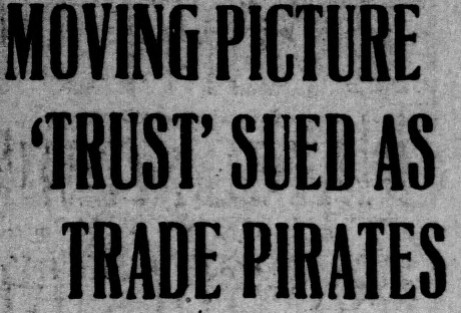
The independents weren’t infringing on any patents themselves, they were violating the license and tie-in agreements that came with the MPPC’s equipment. The MPPC did enjoy some early success with its litigation efforts,  convincing several courts that illegal restraint of trade was not a defense to patent infringement. 4Michael Conant, Antitrust in the Motion Picture Industry, pg. 20 (1960).

But the MPPC didn’t rely solely on the law — Edison enforced the Trust’s domination with violence. Hired thugs would smash cameras and raid the independents’ places of business. 5Jane Chapman, Comparative Media History: An Introduction: 1789 to the Present, pg. 132 (2005). Historian Thaddeus Rockwell notes the extent of the violence perpetuated by the Trust: “They seized film, beat up directors and actors, forced audiences out of theaters, smashed the nickelodeon arcades and set fire to entire city blocks where they were concentrated.”

The organization’s anti-competitive tactics caught the attention of the US government, which took action against them. In 1916, the Eastern District Court of Pennsylvania entered a decree against the Motion Picture Patents Co. The judge found that the MPPC, the General Film Company, and the individual companies involved had “attempted to monopolize and have monopolized and have combined and conspired … to monopolize a part of the trade or commerce … consisting of the trade in films, cameras, and projecting machines” in violation of the Sherman Antitrust Act. It declared all the contracts, patent licenses, and patent assignments used by the MPPC illegal.

The trust also began suffering setbacks in the courts, and in 1917, the US Supreme Court unequiovically struck down one of the license agreements that the MPPC had used to extend its monopoly. 6Motion Picture Patents Co. v. Universal Film Manufacturing Co., 243 US 502. In that case, the MPPC had sued Universal Film Manufacturing Company for patent infringement pursuant to its license agreement which restricted use of the MPPC’s film projectors to only exhibiting or projecting films licensed by the MPPC. (Imagine if a company like Apple claimed that it was patent infringement to play digital music legally acquired somewhere other than iTunes on an iPod.)

The Court recognized that a patent grant is limited “to the mechanism described in the patent as necessary to produce the described results. It is not concerned with and has nothing to do with the materials with which or on which the machine operates. The grant is of the exclusive right to use the mechanism to produce the result with any appropriate material, and the materials with which the machine is operated are no part of the patented machine or of the combination which produces the patented result. The difference is clear and vital between the exclusive right to use the machine, which the law gives to the inventor, and the right to use it exclusively with prescribed materials to which such a license notice as we have here seeks to restrict it.”

The Supreme Court concluded:

A restriction which would give to the plaintiff such a potential power for evil over an industry which must be recognized as an important element in the amusement life of the nation, under the conclusions we have stated in this opinion, is plainly void, because wholly without the scope and purpose of our patent laws, and because, if sustained, it would be gravely injurious to that public interest, which we have seen is more a favorite of the law than is the promotion of private fortunes. [Emphasis added.]

Why Did the Studios Move to Hollywood

Not only is the story that Hollywood was built on “piracy”, the claim that the independent studios ran to Hollywood to get away from Edison and his legal threats is greatly overstated. Southern California offered many advantages over the established filmmaking centers of New York and Chicago that provide stronger reasons for the migration.

Geography, for one. California offered a wide variety of scenery that was useful as substitutes for all sorts of locations, as this 1927 Paramount Studios map illustrates perfectly.

The landscape of Southern California:

was not only spectacular but extraordinarily varied. Summer greenery and winter snow, sunny beaches, barren deserts and rocky mountains were all with a short distance of each other. Florida and Texas could supply the climate for year-round outdoor filming, but they did not have quite the range of scenic choices within a day’s trip from the studios. Even the light of California was different, gently diffused by morning mists rolling in from the Pacific or by dust clouds blowing off the sandy hills. The rugged western landscape and the wide-open spaces were felt as enormous attractions in the rest of the world. 7Eileen Bowser, The Transformation of Cinema, 1907-1915 (History of the American Cinema), pg 151 (1994).

Weather played a huge role too — LA offers 70 degree year-round weather as opposed to winters in New York or, worse, Chicago. 8“Bad weather in Chicago was the primary reason the movies first turned toward the West, and eventually migrated to Hollywood.” Paul Zollo, Hollywood Remembered: An Oral History of Its Golden Age, pg. 12 (2002). Peter Ediden of the New York Times notes, “This wasn’t merely a matter of comfort; even the brightest electric lights of the time were too dim to  expose film properly, so a run of cloudy days could halt production at, say, the Edison studios in East Orange, N.J.”

In fact, nearly everything about the area was an improvement. Land was cheaper and more available and the costs of labor were lower.

Former Curator of Film at the Museum of Modern Art in New York Eileen Bowser points out that the hiding from Edison factor makes little sense:

[T]he New York Motion Picture Company had already managed to escape the Patents Company’s pursuit just by going to Neversink in the Catskills that summer. Furthermore, by Balshofer’s own account, they were easily found by Patents Company spies in California a short time after they got there. At the same time, the Trust companies, which had nothing to hide, were also discovering the great California winter sunshine. 9Transformation of Cinema, pg. 150.

What it means

The proponents of this myth seem to want to suggest an analogy: Hollywood was built by “outlaws”; now Hollywood has become the incumbent, seeking to stop the next generation of “outlaws”. But this is a false equivalence. The Pirate Bay (or Megaupload, etc.) isn’t producing its own movies. Recognizing exclusive rights to a creative work doesn’t prohibit anyone from creating their own works. Stopping someone from offering copies, especially complete, verbatim copies, of a work is not anti-competitive.

The Trust’s actions against the independents were found illegal; the agreements were declared “plainly void” by the Supreme Court. Contrast that to the Court’s more recent decision in MGM v. Grokster, where even the dissent said, in reference to the P2P service Grokster, “deliberate unlawful copying is no less an unlawful taking of property than garden-variety theft.”

References

References
1 This seems a common theme when looking at copyright criticims. See Remix Without Romance: What Free Culture Gets Wrong for another recent example.
2 Robert Sklar, Movie-Made America: A Cultural History of American Movies, pg 13 (1994).
3 Robert Sklar has said, “The roots of the motion-picture monopoly lay in Thomas A. Edison’s greed and dissimulation; and the results of it were a complete debacle for the Wizard, his leadership and social class.”
4 Michael Conant, Antitrust in the Motion Picture Industry, pg. 20 (1960).
5 Jane Chapman, Comparative Media History: An Introduction: 1789 to the Present, pg. 132 (2005).
6 Motion Picture Patents Co. v. Universal Film Manufacturing Co., 243 US 502.
7 Eileen Bowser, The Transformation of Cinema, 1907-1915 (History of the American Cinema), pg 151 (1994).
8 “Bad weather in Chicago was the primary reason the movies first turned toward the West, and eventually migrated to Hollywood.” Paul Zollo, Hollywood Remembered: An Oral History of Its Golden Age, pg. 12 (2002).
9 Transformation of Cinema, pg. 150.
By , October 19, 2011.

David Post responds, in his article Why Should We Care What Jefferson Thought about Copyright, to my earlier post on the subject regarding Jefferson’s letter to Isaac McPherson.

My answer was “Sure”, we should care what he thought about copyright, as long as we understand what he thought about it and place it in the correct context. His letter to McPherson sheds no light on the former; Jefferson was writing about patents, not copyright.

So whether or not you agree that “Jefferson had more interesting thoughts about a more diverse range of subjects than any other person in history” or that “he was smarter than you, or I, or anyone else currently commenting on intellectual property matters”, it doesn’t change the fact that this particular letter was addressing a separate (and different) topic.

I also respectfully disagree with the following reason given by Post:

“3. Because he was the first person in history to articulate, in one document (and a short one, at that) the foundational theory of intellectual property.”

Accepting for the sake of argument that the nature of ideas is “the foundational theory of intellectual property”, this is just incorrect. Again, Jefferson was talking about patents, not copyright. The two are distinct, and copyright lays no claim to ideas.

I think it could fairly be said that a consensus on (1) the divergence of patent and copyright, (2) the distinction between ideas and expression within copyright, and (3) the basis of copyright protection as statutory rather than through common law had emerged by the mid to late 18th century. In Authors and Owners: The Invention of Copyright, Mark Rose writes that “By 1774, the year in which the Donaldson decision resolved the issue of the perpetuity, all the essential elements of modern Anglo-American copyright law were in place.”

Certainly these and other debates concerning copyright weren’t over and continue today. 1Adrian Johns notes in Piracy: The Intellectual Property Wars from Gutenberg to Gates that opposition to the Donaldson decision emerged “quite soon” but has “never been definitively defeated.” But the “non-exclusive” and “non-rivalrous” nature of ideas was recognized by then, decades before Jefferson wrote to McPherson.

Some examples —

William Warburton, An Enquiry into the Nature and Origin of Literary Property, 1762:

Neither hath it any tendency to confine the powers of genius: for he who obtaineth my copy may appropriate my stock of ideas, and, by opposing my sentiments, may give birth to a new doctrine or he may coincide with my notions, and, by employing different illustrations, may place my doctrine in another point of view : and either case he acquireth an exclusive title to his copy, without invading my property : for though he may be said to build on my foundation, yet he rears a different superstructure. An inconsiderable addition or improvement however, will not support his claim: the supplying literal or verbal omissions, or the correcting of literal or verbal errors, for instance, will not be sufficient to found a new right in him : and a jury endued with the slightest degree of common understanding may, be the subject what it will, distinguish, or be taught to distinguish, where the difference is essential, and where it is evasive.

Francis Hargrave, An Argument in Defence of Literary Property, 1774:

I Have only one other objection to encounter, so far as the claim of literary property depends on general reasoning. It is an objection, founded on a supposed resemblance between the case of an inventor of a machine, and that of the author of a book. I claim the full benefit of all the ingenious reasons, which others have made use of to distinguish the two cases; but instead of repeating them, I will add one to their number. In my own opinion, the principal distinction is, that in one case the claim really is to an appropriation of the use of ideas; that in the other the claim leaves the use of the ideas common to the whole world. There are not any bounds to the extent of such a claim. It would be impracticable to receive it; because it could never be fairly decided, when an idea was new and original, when it was old and borrowed. The title of the supposed inventor of the machine to the sole making of it, cannot be allowed, without excluding all others, not only from the use of their borrowed ideas; but even from the use of ideas, which may be as original in them, as in the person who first publishes the invention. The same ideas will arise in different minds, and it is impossible to establish precisely, in whom an idea is really original; and perhaps most ideas may in fact be equally original in the greater part of mankind; and priority in the publication of an idea is a most insufficient proof of its originality. This shews, that the perpetual appropriation of the use of an idea to the real or supposed inventor of a machine, would be as inconsistent with the rights of others, as it would be impracticable. But these are not the only arguments against perpetually appropriating the use of knowledge and inventions, It is impossible to sustain the claim consistently with the laws of any country, in which the policy of disallowing monopolies prevails. Every article of trade, every branch of manufacture and commerce, would be affected clogged, if not totally stopped. Such a perpetual appropriation of the use of inventions and ideas would be the most unlimited kind of monopoly ever yet heard of—a monopoly, not of one trade or manufacture, but such, that if it bad ever been endured, it would have ended in a monopoly of almost all trades, and manufactures collectively. I have already shewn, that the appropriation of the right of printing, to an author, is not liable to any of these objections that the claim has its limits and bounds; that the use of ideas and knowledge is as common as it would be, if the right of printing was not appropriated; that the author’s title to the sole sight of printing, is quite consistent with the rights of others; and that his appropriation of his copies, is so far from falling within the true idea of a monopoly, that the appropriation of copies, independently of the author’s right, is even essential to the carrying on the trade; cf. printing in a manner beneficial to the public.

Johann Gottlieb Fichte, Proof of the Illegality of Reprinting, 1793:

We can distinguish two aspects of a book: its physical aspect, the printed paper, and its ideational aspect. The ownership of the former passes indisputably to the buyer upon purchase of the book. He can read it and lend it as often as he likes; he can re-sell it to whomever he wishes, and for as much or as little as he wants or can get; he can tear it to pieces or burn it — and who could quarrel with him? But since people seldom buy a book for such purposes, and most seldom of all simply to display its paper and printing and cover the walls with it, they must assume that when they buy a book they are also acquiring a right to its ideational aspect. This ideational aspect is in turn divisible into a material aspect, the content of the book, the ideas it presents; and the form of these ideas, the way in which, the combination in which, the phrasing and wording in which they are presented. It is apparent that simple transfer of the book to us does not yet confer ownership of the former, for ideas cannot simply be handed over or bought for cash. They do not become ours just by our picking up a book, carrying it home, and putting it in our bookcase. In order to appropriate the ideas a further activity is necessary. We must read the book, think through its content — insofar as it goes beyond common knowledge — look at it from various points of view, and in this way assimilate it into our own pattern of thought. However, since we would not be able to do this without possessing the book, and since we did not purchase it just for the sake of the paper it contains, buying it must accordingly also confer on us the right to appropriate its content as well. By purchasing the book, that is, we acquire the possibility of appropriating the author’s ideas; but to transform this possibility into reality, we must invest our own effort. Before the publication of his notable works, then, and for a considerable time thereafter, the ideas of the originating thinker, whether of this or past centuries, and most probably of all to come, are the exclusive property of the author. No one has ever acquired the ideas of the Critique of Pure Reason in exchange for the money he paid for it. There are some clear-sighted men now who have appropriated these ideas, but most certainly not just by buying the book, but rather through assiduous and rational study. And, be it said in passing, this process of reflection is the only fitting recompense for instruction of the mind, whether oral or written. The human mind has an inborn propensity to produce agreement with its own pattern of thought and every sign of satisfying this propensity is the sweetest of rewards for all effort expended. For who would want to teach to bare walls, or write books that nobody read? It would be absurd to consider the money paid for such instruction as equivalent in value. It is simply compensation for the sums the teacher must pay to those who, while he is thinking for others, hunt, fish, sow, and harvest for him.

What is certainly offered for sale through the publication of a book, then, is first of all the printed paper, to anyone, that is, who has the money to buy it, or a friend who will lend it to him; and secondly, the content of the book, namely to anyone who has enough brains and diligence to appropriate it. As soon as the book is sold, the former ceases to be the property of the author (whom we can still consider here as the seller) and passes exclusively to the buyer, since it cannot have more than one lord and master. The latter, however, which on account of its ideational nature can be the common property of many, and in such a manner that each can possess it entirely, clearly ceases upon the publication of a book to be the exclusive property of its first proprietor (if indeed it was so prior to publication, which is not always the case with some books nowadays), but does continue to be his property in common with many others. What, on the other hand, can absolutely never be appropriated by anyone else, because this is physically impossible, is the form of the ideas, the combination in which, and the signs through which they are presented.

By the time Jefferson wrote this letter on patents, then, few would find any relevance to copyright. It was well-established that copyright protection did not extend to the ideas in a particular work, and I do not know of anyone who seriously argued that it should, let alone that it should as a matter of natural right.

So, in my opinion, even if we look to this letter for principles to apply to copyright law, there is little we can take away. Post mentions concerns over tension between copyright law and free speech, a relatively recent debate. 2As I note in Copyright and Censorship, it wasn’t until 1969 — nearly 200 years after the first colonies passed copyright acts — that this tension began to receive attention from scholars and courts. But the freedom of ideas from copyright protection is one of the “free speech safeguards” baked into copyright doctrine; “Due to this distinction,” said the Supreme Court in 2003, “every idea, theory, and fact in a copyrighted work becomes instantly available for public exploitation at the moment of publication.” 3Eldred v. Ashcroft, 537 US 186, 219-221 (2003). This sounds like something Thomas Jefferson would encourage.

References

References
1 Adrian Johns notes in Piracy: The Intellectual Property Wars from Gutenberg to Gates that opposition to the Donaldson decision emerged “quite soon” but has “never been definitively defeated.”
2 As I note in Copyright and Censorship, it wasn’t until 1969 — nearly 200 years after the first colonies passed copyright acts — that this tension began to receive attention from scholars and courts.
3 Eldred v. Ashcroft, 537 US 186, 219-221 (2003).