By , November 04, 2010.

In my previous post about the Copyright Principles Project, I highlighted those proposals that recommend a greater role for the US Copyright Office. Whether or not the Copyright Office should take on a greater role is a subject that undoubtedly can generate plenty of discussion. But today, I want to look at a different issue:

Can the Copyright Office take on a greater role?

Certainly, Congress could easily add new positions to the Copyright Office to bolster its expertise, or the Office can be more active in its advisory role; I’m not talking about that. The question I’m asking relates to those recommendations that contemplate the Office exercising substantive agency powers — creating regulations (rulemaking) and  resolving disputes in a quasi-judicial manner (adjudication). And the question is not whether taking on these powers is practical or worthwhile, but whether taking on these powers is constitutional. 1This article is largely adapted from a section I wrote in Copyright Reform Step Zero.

It’s kind of an odd question; after all, the Office currently does exercise rulemaking powers — creating exceptions to the prohibition against circumventing DRM and technological protections 2Technically, it is the Library of Congress which creates these regulations, after consulting with the Copyright Office, but for this article, I will be referring to the rulemaking authority of the Copyright Office regardless of which department ultimately promulgates the regulations. — and its sister department within the Library of Congress, the Copyright Royalty Board, exercises adjudicatory powers — determining certain compulsory license rates in a court-like setting. But unlike administrative agencies that were specifically created to exercise these types of powers, the Copyright Office began as a “paper-pushing” department and only over time “grew into” a more robust agency.

This unusual path from ministerial department to something approaching a full-fledged administrative agency has given rise to lingering concerns about the consitutionality of the Copyright Office’s authority to engage in rulemaking and adjudication. To understand these concerns, let’s first take a quick look at how federal agencies in general can exercise these powers in a constitutional manner and then trace the growth of the Copyright Office’s authority since its humble beginnings.

Agencies and Separation of Powers

Today, much of federal law is executed through administrative agencies. Congress passes a law, and then agencies — the EPA, the FCC, the IRS, etc. — create regulations to fill in the details of the law. Agencies might also engage in adjudication, resolving disputes or adjusting regulatory benchmarks within their purview through judicial-esque proceedings. The basic idea behind this system is that agencies have greater expertise and flexibility than Congress to address these details.

In one sense, administrative agencies act like mini-versions of a three-branch government: combining legislative (creating regulations), judicial (adjudication), and executive (enforcing regulations) functions. The Constitution, however, establishes a federal government based on separation of powers. Since the New Deal, Congress and Presidents have increasingly relied on administrative agencies to carry out many government functions, so the courts have had to figure out ways to fit this “fourth branch” of government within the constitutional framework while maintaining checks and balances.

The Constitution prohibits Congress from delegating legislative power to another body. But since 1825, courts have recognized a distinction between general, “important” legislative provisions and mere details. 3Wayman v. Southard (1825): “The line has not been exactly drawn which separates those important subjects, which must be entirely regulated by the legislature itself, from those of less interest, in which a general provision may be made, and power given to those who are to act under such general provisions to fill up the details.” Today, agencies can create regulations to “fill up the details” when “Congress clearly delineates the general policy, the public agency which is to apply it, and the boundaries of this delegated authority.” 4Mistretta v. US, 488 US 361 (1989).

A second requirement to maintain constitutionally sufficient delegation is that the authority must go to an independent or executive branch agency; Congress cannot delegate quasi-legislative authority to a legislative agency. 5Buckley v. Valeo, 424 U.S. 1, 138-41 (1976). True legislation requires passage by both houses of Congress (bicameralism) and the President’s signature (presentment). 6INS v. Chadha, 462 U.S. 919, 946 (1983). If Congress retains any sort of control over the agency it delegates quasi-legislative authority to, courts view the delegation as a constitutionally improper circumvention of those two requirements. By control, I don’t mean mere influence. The control must be meaningful, like the ability to appoint or remove agency officers 7Bowsher v. Synar, 478 U.S. 714, 726 (1986). or the power to veto agency decisions. 8INS v. Chadha at 954-59.

Growing into a Regulatory Agency

Many of the federal agencies today began during the New Deal, and were expressly authorized by Congress to regulate specific areas of the law. The Copyright Office, however, began a few decades earlier, without any substantive regulatory purpose as the goal. Under the first Copyright Act of 1790, copyright registrations were handled by district courts. This continued until 1870, when copyright administration was centralized in the Library of Congress. Congress created the Copyright Office in 1897 as a department within the Library dedicated to copyright administration. For most of the Copyright Office’s history, its duties were limited to processing registrations and other “ministerial” tasks.

The Copyright Office has had the authority to issue regulations since its creation, but it has historically exercised that authority in a limited manner — rules governing interest on late payments to the Office, for example. 9MPAA v. Oman, 969 F.2d 1154, 1156 (DC Circ 1992). The triennial DRM exception rulemaking procedures set out in the DMCA in 1998 — 101 years after the Office was established — represents the first time the Copyright Office took on substantive rulemaking authority.

Perhaps because of the Copyright Office’s limited exercise of regulatory authority, little attention has been paid to whether that authority is constitutional. The notable exception is E. Fulton Brylawski’s 1976 article The Copyright Office: A Constitutional Confrontation, 1044 George Washington Law Review 12. written during the build up to the passage of the Copyright Act of 1976. Brylawski argued that the Copyright Office was a legislative agency and the Act would give the Copyright Office rulemaking authority that exceeds what the Constitution allows. As discussed earlier, Brylawski is right on the latter point: a legislative agency can’t make regulations. But is he right on his first point? Is the Copyright Office indeed a legislative agency?

Legislative or Executive?

At first glance, it might be difficult to see how anyone could say the Copyright Office is not a legislative agency. The Copyright Office is a department within the Library of Congress. The Library of Congress is, well, of Congress. Not surprisingly, then, the US government places the Library of Congress in the legislative branch. 11United States Government Manual, 2009-2010 p. v. Courts, too, have characterized the Library of Congress as legislative. 12See Harry Fox Agency v. Mills Music, 720 F.2d 733 (2d Cir. 1983) (“The Library of Congress … is a part of the legislative branch itself”); Barger v. Mumford, 265 F.2d 380, 382 (DC Cir. 1959) (“Library of Congress has long been treated as being in or under the jurisdiction of the legislative branch of the Government”). The Copyright Office’s own website states that it is “part of the legislative branch of government.” And if you look through the US Code, you’ll find repeated references to the Library of Congress being in the legislative branch 13Check out 5 USC § 5531(4), for example. — the Library itself is codified under Title 2, which governs the legislative branch.

Noted copyright expert William Patry considers the above conclusive evidence that the Library of Congress, and by extension the Copyright Office, is a legislative agency. Other scholars have found the need to address the characterization of the Copyright Office when discussing proposals to increase rulemaking or adjudicatory authority. Michael Carroll notes lingering concerns about this subject in Fixing Fair Use. 14Pp. 1131-32. I noted previously that the proposal he makes inspired one of the possibilities for advancing recommendation #4 in the Copyright Principles Project. Edward Lee cites the fact that the Copyright Office is a legislative agency as one of the reasons why it cannot be relied upon to fill in gaps in the law through rulemaking. 15Warming up to User-Generated Content, 2008 University of Illinois Law Review 1459, 1475 (2008).

So … case closed, right? Not quite. When it comes to separation of powers, labels are irrelevant. After all, if the Library of Congress was renamed the National Library, it would be silly to think the constitutional analysis would change. What matters is what branch of government the Copyright Office is an agency of, and agency is determined by control.

Let’s take a look at the two most popular indicators of control: appointment (and removal) power and veto authority over regulations. The legislature has neither when it comes to the Copyright Office. The Register of Copyrights is appointed by (and can be removed by) the Librarian of Congress, who in turn is appointed by the President. Congress does not retain any power to approve or veto Copyright Office rules. Brylawski’s assertion that the Library of Congress is under the control of the Joint Committee of Congress on the Library? — simply not true. 1629 Cong. Rec. 1947 (1896) (Rep. Dockery).

Most strikingly, Congress debated at some length about what branch of government held sway over the Library of Congress when the Copyright Office was being created and if the Office would constitutionally have authority to issue regulations. The final bill gave the Copyright Office rulemaking authority, reflecting the fact that Congress was satisfied that the setup they settled on was constitutionally sound. 17For a comprehensive list of citations to those debates, check out 1 William Patry, Patry on Copyright § 1:41 n.4, especially , e.g., 29 Cong. Rec. 318-19 (1896) (Rep. Dockery): “This Library of Congress is a department of the Government. It is an executive department and should be under the control of the executive branch”.

Settle it in the Courts

Brylawski got an opportunity to take his arguments to the courts. In 1978, he was the attorney for the plaintiff in Eltra v. Ringer, one of the few times the constitutionality of the Register of Copyright’s rulemaking authority was raised. The Fourth Circuit rejected the “label” argument, stating:

It is irrelevant that the Office of the Librarian of Congress is codified under the legislative branch or that it receives its appropriation as a part of the legislative appropriation. The Librarian performs certain functions which may be regarded as legislative (i. e., Congressional Research Service) and other functions (such as the Copyright Office) which are executive or administrative. Because of its hybrid character, it could have been grouped code-wise under either the legislative or executive department. But such code-grouping cannot determine whether a given function is executive or legislative.

The court noted that other courts, including the Supreme Court, had given weight to Copyright Office regulations for decades. “It seems incredible,” said the court, “that, if there were a constitutional infirmity” for that long, no one ever noticed it. In the end, the court concluded that the Copyright Office was an executive office, operating under an officer appointed by the President, not Congress.

The characterization of the Copyright Office as an executive office was reaffirmed in a March 2010 DC Circuit memorandum order. In Live365 v. Copyright Royalty Board, Live365 challenged the constitutionality of the appointment of Copyright Royalty Board Judges.

Wait, what? What does the appointment of Copyright Royalty Board Judges have to do with the rulemaking authority of the Copyright Office?

As it turns out, quite a bit. The question in Live365 boils down to: “is the Library of Congress an executive or legislative agency”: the same question involved in determining whether the Copyright Office has rulemaking authority.

The DC Circuit rejected the argument that the Library of Congress is a legislative agency. The President, not Congress, appoints the head of the department, so it is an executive agency. 18For a detailed look at this and the other issues raised in Live365 v. CRB, check out Department of the Inferiors? posted at CommLawBlog.

That, along with the fact that Congress doesn’t retain any veto authority over the Library’s (and Copyright Office’s) regulations, leads to the conclusion that the Copyright Office does have authority to issue substantive regulations. So yes, the Copyright Office can take on a greater role in the administration of copyright law. The Copyright Principles Project and other proposals have advanced various recommendations embracing a greater role for the Office, whether through Congress delegating additional regulatory arenas or through the creation of new adjudicatory bodies. The question remains whether the Office should be given a greater role. Given the benefits an agency may provide — flexibility and expertise — I think this question merits further exploration.

References

References
1 This article is largely adapted from a section I wrote in Copyright Reform Step Zero.
2 Technically, it is the Library of Congress which creates these regulations, after consulting with the Copyright Office, but for this article, I will be referring to the rulemaking authority of the Copyright Office regardless of which department ultimately promulgates the regulations.
3 Wayman v. Southard (1825): “The line has not been exactly drawn which separates those important subjects, which must be entirely regulated by the legislature itself, from those of less interest, in which a general provision may be made, and power given to those who are to act under such general provisions to fill up the details.”
4 Mistretta v. US, 488 US 361 (1989).
5 Buckley v. Valeo, 424 U.S. 1, 138-41 (1976).
6 INS v. Chadha, 462 U.S. 919, 946 (1983).
7 Bowsher v. Synar, 478 U.S. 714, 726 (1986).
8 INS v. Chadha at 954-59.
9 MPAA v. Oman, 969 F.2d 1154, 1156 (DC Circ 1992).
10 44 George Washington Law Review 12.
11 United States Government Manual, 2009-2010 p. v.
12 See Harry Fox Agency v. Mills Music, 720 F.2d 733 (2d Cir. 1983) (“The Library of Congress … is a part of the legislative branch itself”); Barger v. Mumford, 265 F.2d 380, 382 (DC Cir. 1959) (“Library of Congress has long been treated as being in or under the jurisdiction of the legislative branch of the Government”).
13 Check out 5 USC § 5531(4), for example.
14 Pp. 1131-32. I noted previously that the proposal he makes inspired one of the possibilities for advancing recommendation #4 in the Copyright Principles Project.
15 Warming up to User-Generated Content, 2008 University of Illinois Law Review 1459, 1475 (2008).
16 29 Cong. Rec. 1947 (1896) (Rep. Dockery).
17 For a comprehensive list of citations to those debates, check out 1 William Patry, Patry on Copyright § 1:41 n.4, especially , e.g., 29 Cong. Rec. 318-19 (1896) (Rep. Dockery): “This Library of Congress is a department of the Government. It is an executive department and should be under the control of the executive branch”.
18 For a detailed look at this and the other issues raised in Live365 v. CRB, check out Department of the Inferiors? posted at CommLawBlog.
By , November 01, 2010.

On September 28, a group of leading copyright academics and practitioners released the Copyright Principles Project: Directions for Reform (full report [pdf] available here). According to the press release, the Project “attempts to ignite an informed debate about how to best balance the interests of copyright owners and users” by examining “several ways to improve and update the law in an era of rapid technological change.”

The project is well worth a read. Participants in the project come from a variety of perspectives, including academics like project leader Pamela Samuelson, Jessica Litman, Michael Carroll, and Christopher Sprigman; copyright practitioners like Jon A. Baumgarten of Proskauer Rose LLP and Kate Spelman of Cobalt LLC; and corporate attorneys like Troy Dow of Walt Disney, Terry Ilardi of IBM, Jule Sigall of Microsoft, and Jeremy Williams of Warner Bros. Entertainment. Working together, they crafted twenty-five specific proposals that address “how current copyright law could be improved and how the law’s current problems could be mitigated.” 1Copyright Principles Project, pg. 2.

The Copyright Principles Project came about in part from Samuelson’s idea of creating a “model copyright law” — akin to projects like the American Law Institute’s Model Penal Code — which could provide “an inchoate vision of a ‘good’ copyright law”; “provide a platform from which to launch specific copyright reforms”; and “prove useful as a resource to courts and commentators as they try to interpret ambiguous provisions of the existing statutes” and apply the statute to novel and unforeseen circumstances. 2Pamela Samuelson, Preliminary Thoughts on Copyright Reform Project, 3 Utah L. Rev. 551 (2007). Samuelson discusses how the model copyright law project served as a genesis for the Copyright Principles Project during her remarks at Berkeley Law’s “Copyright @ 300” conference, audio available under Looking Forward: What Challenges Does Copyright Face in the Twenty-First Century.

Reaction to the report from the Copyright Principles Project has been generally positive. I haven’t been able to find too much analysis of the individual recommendations online, though there has been some. Copyright Chronicle’s Thomas Gulick, for example, points to recommendations that seem to “create imbalance for the sake of ease.”

Today, I want to look at those recommendations in the Project that call for an increased role for the US Copyright Office within copyright law. This topic is of special interest to me. In Copyright Reform Step Zero, I make the case for delegating substantive rulemaking authority to the Copyright Office as an important first step to maintaining an up-to-date and effective copyright law. Several of the recommendations in the Copyright Principles Project take the same approach while also envisioning adding adjudicatory functions to the Office.

Recommendation #3: The Copyright Office should develop additional policy expertise and research capability, particularly in the area of economics and technology.

The Copyright Principles Project specifically calls for two new positions to be created within the US Copyright Office: Chief Economist and Chief Technologist. These positions would help ensure that those areas of expertise which are most important for developing copyright policy in today’s world can be led by dedicated individuals. The Copyright Office already plays an important role preparing studies of specific copyright issues, advising Congress and other federal agencies on policy matters, and interacting with foreign and international organizations; so even if the Office didn’t take on a greater role in actual policymaking, it could still benefit by beefing up its expertise in these areas.

Recommendation #4: The Copyright Office should give serious consideration to developing some mechanism(s) through which users could receive guidance on “fair use.”

One of the mechanisms suggested by the Copyright Principles Project is the idea of a fair use “opinion letter,” likely inspired by an existing proposal from Project contributor Michael Carroll. In Fixing Fair Use, Carroll envisions as body within the Copyright Office that would hear from companies or individuals contemplating the use of a copyrighted work. The body would analyze if the contemplated use would legally be a fair use and issue an advisory letter with its opinion, similar to advisory letters that the IRS and SEC currently issue.

Recommendation #5: A small claims procedure should be available for resolving small-scale copyright disputes.

Interestingly, after orphan works, this recommendation may have the best chance for being adopted out of all the Copyright Principles Project’s recommendations. Although orphan works legislation failed to pass in 2006 and 2008 (and wasn’t even introduced in 2010), it is still considered by many to eventually become law. Both orphan works bills contained a provision commissioning the US Copyright Office to study the idea of a “small claims court” for copyright disputes which would otherwise stay out of courts because of legal costs. 3HR 5439 — Orphan Works Act of 2006, Sec. 4; HR 5889 — Orphan Works Act of 2008, Sec. 6.

Recommendation #23: Contributions to computer programs should be considered as a new category of specially commissioned work eligible for treatment as works made for hire.

The Copyright Principles Project discussion of this recommendation included the following: “We considered, for instance, whether the U.S. Copyright Office should be given rule-making authority to add computer software contributions or other types of works to the specially commissioned work for hire rule. We did not reach consensus on this approach.” This statement describes an example of how substantive rulemaking authority would be exercised by the US Copyright Office as I contemplate it in my paper. Congress incorporates a doctrine like “work for hire” into the Copyright Act. It lays out the broad strokes of the purpose and principles behind the doctrine. But it then delegates the nuts and bolts to the Copyright Office. In this example, the Copyright Office would have the authority to add additional categories to types of works eligible for treatment as works made for hire — within the limits of the statute and guided by the principles expressed by Congress.

References

References
1 Copyright Principles Project, pg. 2.
2 Pamela Samuelson, Preliminary Thoughts on Copyright Reform Project, 3 Utah L. Rev. 551 (2007). Samuelson discusses how the model copyright law project served as a genesis for the Copyright Principles Project during her remarks at Berkeley Law’s “Copyright @ 300” conference, audio available under Looking Forward: What Challenges Does Copyright Face in the Twenty-First Century.
3 HR 5439 — Orphan Works Act of 2006, Sec. 4; HR 5889 — Orphan Works Act of 2008, Sec. 6.
By , October 13, 2010.

Many critics of current copyright doctrine believe its problems stem largely from an infusion of “property talk” into policy discussions. William Patry writes in Moral Panics and the Copyright Wars, “By describing copyright as a private property right, proponents of the description hope to get policy makers and courts to believe that only private, and not public rights are implicated.”1Moral Panics, pg. 107 (Oxford University Press, 2009). Later, he adds, “The effort to describe copyright as property is intended to invoke ancient entitlement to powerful rights of exclusion, rights granted automatically as a member of the oldest families.”2Moral Panics, pg. 113 (Oxford University Press, 2009).

A similar argument is made by Steve Collins in “‘Property Talk’ and the Revival of Blackstonian Copyright“:

The possessiveness and exclusion that accompany “property talk” are difficult to reconcile with the utilitarian foundations of copyright. Transformative uses of copyrighted materials such as mashing, sampling and appropriative art are incompatible with a propertarian approach, subjecting freedom of creativity to arbitary licensing fees that often extend beyond the budget of creators (Collins). “Property talk” risks making transformative works an elitist form of creativity, available only to those with the financial resources necessary to meet the demands for licences.

This view is shared by many copyright critics online. Mike Masnick, at TechDirt, consistently argues that copyright is not property, and can in fact be viewed as “anti-property.” Boingboing blogger Cory Doctorow says,

Trying to shoehorn knowledge into the ‘property’ metaphor leaves us without the flexibility and nuance that a true knowledge rights regime would have.

Copyright – with all its quirks, exceptions and carve outs – was, for centuries, a legal regime that attempted to address the unique characteristics of knowledge, rather than pretending to be just another set of rules for the governance of property. The legacy of 40 years of “property talk” is an endless war between intractable positions of ownership, theft and fair dealing.

But is this necessarily true?

Transformation in Property and Copyright

Legal Theory Blog points to a new paper by Christopher M. Newman that argues many of the problems in current copyright doctrine – specifically relating to how it treats creative uses rather than consumptive uses of existing works – may be better addressed by treating copyright more like property rather than less.

Transformation in Property and Copyright is available at SSRN, and I second Legal Theory Blog’s recommendation. The abstract reads:

Copyright requires us to distinguish between two different ways of transforming a “work of authorship”: “derivative works” and “transformative fair uses.” The absence of a clear line results in a tendency to assign all value arising proximately from a work to copyright owners. Many people blame this expansionist tendency on a “propertarian” understanding of copyright, and argue that the solution is to abandon any notion of copyright as property. I agree that current copyright doctrine often gives excessively broad scope to the exclusive rights of copyright owners, but argue that this may be a result of copyright not being “propertarian” enough. Property is an attempt to coordinate resource use through a system of in rem rights whose content can be understood by third parties without reference to the subjective use preferences of others. Traditional property law dealing with the transformation of mundane objects uses objective, socially intelligible tests of identity to determine when an owner’s rights in a thing have been extinguished, thus preventing owners from asserting subjective use preferences as a means of extracting value from transformed objects created by others.

Far from implying “absolutist” authorial rights, an in rem approach to copyright requires that we place clear boundaries around the identity of the “work of authorship.” This means moving away from the notion that disembodied fragments of “protected expression” can be owned separately from the “work of authorship” of which they are a part. I show how this might be done, proposing to define a “work of authorship” in terms of a coherent expressive experience designed by an author. Putative “copies” that are not tailored to facilitate beneficial use of the work as conceived by the author, but rather to communicate second-order information, or to give rise to expressive experiences radically discontinuous from the ones the author designed, therefore fall outside the author’s right to exclude altogether. Such a “propertarian” approach could be both clearer and more protective of free speech than current doctrine, because limits on the scope of the author’s rights would be defined intrinsically, obviating the need to resort to fair use doctrine with its value-laden weighing of social worth.

Essentially, Newman argues that copyright doctrine needs a better theory to sort out the age-old question of “which ‘further purposes’ authors should control, and which they shouldn’t.” Along the way, he touches on a number of situations in which current copyright doctrine finds infringing use where many would argue noninfringing use: unauthorized sequels (like The Wind Done Gone), “fictional facts” (at issue in the lawsuit against the Seinfeld Aptitude Test), and uses of a work to convey second order information (for example, incidental captures of copyrighted works in film scenes). Newman convincingly argues that his “propertarian” approach would sort out infringing and noninfringing uses that are better aligned to the underlying goals of copyright law.

It’s definitely worth a read. Those outside the legal and academic fields may find it long (it’s just under 80 pages) and technical at times, but there’s plenty of good stuff inside.

Newman’s article builds upon a number of previous works, but I wanted to specifically point out two that are worth reading if you’re interested in this area of the copyright debates. The first is Adam Mossoff’s Is Copyright Property? and the second is Richard Epstein’s Liberty versus Property? Cracks in the Foundations of Copyright Law, both available at SSRN.

Upon reading Newman’s article, I was reminded of an earlier article by David Fagundes, Crystals in the Public Domain. Newman argues along much the same lines as Fagundes, as you can see in the abstract:

The law increasingly treats copyright as if it were any other form of property, and numerous writers decry this trend. In particular, scholars who express solicitude for the public domain fear that the propertization of copyright means an inevitable accretion of private rights in information at the expense of the public domain. This Article critiques this conventional view, arguing that the propertization of copyright has unappreciated advantages for users of public information goods. The conventional view relies on an overly narrow view of what propertization means. The treatment of copyright as a form of property generally entails not only reduction of entitlements to private ownership, but also the bounding of those entitlements with clearly demarcated, or crystalline, borders. Although many writers prefer muddy entitlements that create fluidity regarding the extent of the public domain, this Article argues instead that it is this very fluidity that is at fault for excessive accretion of private rights in information. Uncertainty about the extent of public entitlements in information allows well-capitalized private actors lay claim to resources whose public/private status is at all ambiguous, and then deter the public’s claims through threats of litigation. By contrast, a public domain characterized by crystalline rule structures would benefit users, not only owners, by allowing them to better comprehend the extent of their entitlements and thus exploit common resources without fear of suit. By way of illustration, this Article provides three examples of how copyright law could be reformed to create user-friendly crystalline entitlement structures. It then concludes by situating the propertization of copyright law, and this critique of the dominant narrative about that trend, in the context of current debates in property law more generally.

Fagundes’s article includes several specific proposals to copyright law as a way of incorporating his arguments.

The cries that “copyright is not property!” embrace not only a simplistic idea of “property” but also ignore the benefits that taking a more “propertarian” approach to copyright doctrine may provide. The idea that “property talk” is a pretext for exerting “sole and despotic dominion” over all uses of a copyright does not hold weight upon closer examination. Newman’s article provides one such examination, and I highly recommend giving it a read.

References

References
1 Moral Panics, pg. 107 (Oxford University Press, 2009).
2 Moral Panics, pg. 113 (Oxford University Press, 2009).
By , October 04, 2010.

Copyright protection vests automatically when a work is created and currently lasts for the life of the author plus 70 years. The duration of copyright protection is frequently cited as one of the major problems in current law – one critic says “copyright protection lasts absurdly long,” a not uncommon view. 1See, eg, New York Times, Free That Tenor Sax, editorial, August 21, 2010: “That time period has been criticized as too long;” Techdirt, The Economist on Why Copyright Needs to Return to its Roots, April 20, 2010. Concerns over the length of protection are not universally held, however; see, eg, Mark Helprin, A Great Idea Lasts Forever. Shouldn’t its Copyright? New York Times, May 20, 2007.

Most commonly, arguments against copyright’s duration stem from the fact that all creative works, to some extent, build upon existing works. Too long of a time keeps new works from entering in the public domain, where they can be used without risking liability. There are also concerns that less-popular works may be lost forever due to the ravishes of time – archivists and librarians wary of preserving or displaying them without permission.

It would seem, then, that the length of copyright protection is an easy target for reform – indeed, many proponents of copyright reform address duration. However, several factors make copyright duration resistant to simple solutions. It’s easy to say “copyright lasts too long, make it shorter.” Taking on the subject is challenging; today, all I want to do, is give a broad introduction to copyright duration. I want to give a sense of the law as it stands now, then briefly survey some of the research and proposals regarding copyright duration.

Copyright Duration and the Law

The US Constitution gives Congress the power

To promote the progress of science and useful arts, by securing for limited times to authors and inventors the exclusive right to their respective writings and discoveries [emphasis added] 2Article I, section 8.

The Constitution adopts the utilitarian model of copyright: government grants a limited monopoly in expressive works to authors that eventually expires, placing the works in the public domain. This is in contrast to the perpetual, “natural rights” model of copyright. The idea is that society and future creators benefit the most when expressive works aren’t locked up forever. But there’s a long time between now and forever; how long is a “limited time”?

History shows a gradual expansion of the limited time of copyright protection. The first copyright law, the Copyright Act of 1790, set the duration of protection at 14 years, dependent upon registration, with an optional renewal of 14 additional years. The initial period of protection was increased to 28 years in 1831. The renewal period was increased to 28 years in 1909, for a possible total of 56 years of protection (28 + 28). The Copyright Act of 1976 dispensed with the need for formalities in securing copyright protection (as well as the need for renewal) and set the term of protection to the life of the author plus 50 years. Finally, the Copyright Term Extension Act of 1998 (CTEA) increased the term to the life of the author plus 70 years. 3Anonymous works, pseudonymous works, and works made for hire received protection for 100 years after creation or 75 years after publication, whichever occurs first, under the 1976 Act; that increased to 120 years after creation or 95 years after publication under the CTEA. In addition, the 1976 Act extended the renewal period for works created under the 1909 Act from 28 to 47 years, increased to 67 years under the CTEA.

The Supreme Court has only once addressed whether the Constitution places limits on copyright’s term, in the 2003 case Eldred v. Ashcroft (537 US 186). 4Craig Dallon, Original Intent and the Copyright Clause: Eldred v. Ashcroft Gets it Right, 50 St. Louis Univ. Law Journal 307 (2006).  Even then, it did not answer “how long is too long.” In a constitutional challenge to the CTEA, both sides conceded that “life plus 70” is a “limited time.” 5Eldred at 199. The question the Court answered was far narrower – whether the Constitution’s “limited time” language prohibited Congress from extending the term of protection for existing copyrighted works. The Court said there was no such prohibition, despite the argument that Congress could effectively create an unlimited copyright term by repeatedly passing extensions.

Lawrence Lessig, who argued against the CTEA in Eldred, subsequently tried direct challenges against the constitutionality of the “life plus 70” term itself. The argument was raised and rejected by both the 9th Circuit – in Kahle v. Gonzales – and the 10th Circuit – in Golan v. Gonzales. Both courts accepted that Eldred did not directly address whether “life plus 70” was outside the bounds of the Copyright Clause’s “limited times,” but ultimately held that the Supreme Court had implied that it was not, foreclosing Lessig from succeeding in his claim.

International agreements also govern copyright duration. The Berne Convention – of which currently there are 164 member nations – mandates a minimum term of life of the author plus 50 years. 6Berne Convention, Article 7. TRIPs, an international agreement administered by the World Trade Organization, requires member parties to adhere to those provisions of Berne that include minimum copyright duration. 7TRIPs, Article 9.

Copyright Duration and Economics

Given the economic justification that US copyright law subscribes to, it follows that we would use economics to see how well the law is meeting its goal. An “optimal” term of copyright protection should be one that best balances all the costs and benefits to creators and society. But, economists have struggled with answering the question of what constitutes the “optimal” term of copyright protection.

Justice Breyer cites an amicus brief filed by 17 economists in his argument in his dissent in Eldred that the CTEA’s “life plus 70” was unconstitutional. 8Eldred at 255. Those economists conclude that the costs of the CTEA’s copyright duration outweighed any benefits realized by creators. However, economists Stan Liebowitz and Stephen Margolis, in a direct response to the 17 economists’ brief, note that existing empirical research doesn’t definitively conclude what length of protection provides the maximum benefit proportional to creators and society. 9Liebowitz & Margolis, Seventeen Famous Economists Weigh in on Copyright: The Role of Theory, Empirics, and Network Effects, 18 Harvard Journal of Law and Technology 435 (2005).

In light of these arguments, a few researchers have attempted to tackle the question of optimal copyright duration. One example is Rufus Pollock, who concludes that the optimal copyright term is 15 years. 10Forever Minus a Day? Some Theory and Empirics of Optimal Copyright (2007). Others have examined what effect term extensions have had, such as Png and Wang, who found an 8.5-10% increase in movie production in 19 countries which had extended copyright protection from “life plus 50” to “life plus 70.” 11I.P.L. Png & Qiu-Hong Wang, Copyright Duration and the Supply of Creative Work (2006).

Proposals

Many people have proposed shortening copyright term from its current length. The proposals vary in length but are typically a set number of years. Also common are proposals that reintroduce registration formalities to copyright, tied in to a fixed initial term and combined with optional renewal periods.

The best known example of this type of proposal is Lessig’s Public Domain Enhancement Act, introduced in Congress in 2003 and 2005 with little success. The bill would have set an initial period of 50 years of protection, with a fee of $1 every ten years to maintain copyright protection afterward. Failure to pay the maintenance fee would result in the expiration of copyright protection.

Joseph Liu proposes an alternative to reducing the length of copyright protection that addresses some of the concerns of its critics. 12Joseph Liu, Copyright and Time: A Proposal (2002). He argues that courts should expressly consider how old a copyright is in their fair use analyses – giving more latitude to creators who make transformative use of older copyrighted works than newer ones. He notes:

[O]ver the course of the copyright term, the impact of protection on copyright incentives wanes, as does an author’s moral claim to the fruits of his or her labor. At the same time, the societal interest in ensuring widespread access to works and in encouraging re-use and adaptation of copyrighted works increases. By considering time in fair use analysis, courts can adjust the scope of copyright protection to respond more dynamically to these changes in copyright interests over the length of the copyright term. 13Liu at 412

While not directly related to the issue of copyright duration, I would include proposed legislation regarding “orphan works” here. Orphan works are those works where the creator is difficult or impossible to find – foreclosing even authorized use of a work without risking liability. Libraries and archives especially confront the problem of orphan works. The current length of copyright protection (and the removal of formalities) has resulted in a vast number of older works which cannot be utilized by these institutions. Orphan works legislation had been highly anticipated to pass through Congress in 2006 and 2008 but ultimately failed. The US Copyright Office has a comprehensive report detailing the problem and outlining its proposal.

Drawbacks to Proposals

As noted above, copyright duration is governed not only by US law, but through several international agreements. In addition, the Berne Convention prohibits formalities as a prerequisite for copyright protection, a feature numerous proposals share. Any proposals to reduce the copyright term below the minimums of these treaties would either require (1) amending the treaty, (2) withdrawing from the treaty, or (3) running afoul of the treaty and accepting the consequences. Patrick Ross of the Progress & Freedom Foundation notes that these proposals tend to fail to consider the implications any of these courses of action would entail.

Besides the complexities of international law, many of the proposals also ignore the complexities of economics. Copyright is a lightening rod for outrage, and copyright duration seems an easy target for reform, so it’s natural that a simple solution like “copyright is too long, make it shorter” would be attractive. The 14 year term of the first Copyright Act operates as a model. After all, the Framers were smart enough to make the Constitution, so it follows that they would be smart enough to make a copyright law that works in today’s world.

Professor Thomas Nachbar advises caution when following this logic though, saying it would be a mistake to assume “the Framers faced the same copyright-related problems that we face today.” 14Thomas B. Nachbar, Constructing Copyright’s Mythology (2002). “Given how profoundly the markets for intellectual property have changed since the time of the framing, we should be wary of historically based arguments that the Constitution speaks to the modern problems of intellectual property law,” he notes. “It would be nice if the Framers had possessed the super-human prescience and intelligence to do so, but we shouldn’t rush to embrace myths that tell the story of how they did.”

Conclusion

No doubt, the duration of copyright protection will continue to occupy a central place in the copyright debates. I will most likely explore the topic in more detail in future posts, with this article serving as merely an introduction. Arguments and proposals concerning term length touch on many different areas and involve a complex array of factors. For now, I can only say that I share Nachbar’s cautionary approach – addressing copyright duration doesn’t provide any “easy answers” to the multitude of criticisms aimed at copyright law in general.

References

References
1 See, eg, New York Times, Free That Tenor Sax, editorial, August 21, 2010: “That time period has been criticized as too long;” Techdirt, The Economist on Why Copyright Needs to Return to its Roots, April 20, 2010. Concerns over the length of protection are not universally held, however; see, eg, Mark Helprin, A Great Idea Lasts Forever. Shouldn’t its Copyright? New York Times, May 20, 2007.
2 Article I, section 8.
3 Anonymous works, pseudonymous works, and works made for hire received protection for 100 years after creation or 75 years after publication, whichever occurs first, under the 1976 Act; that increased to 120 years after creation or 95 years after publication under the CTEA. In addition, the 1976 Act extended the renewal period for works created under the 1909 Act from 28 to 47 years, increased to 67 years under the CTEA.
4 Craig Dallon, Original Intent and the Copyright Clause: Eldred v. Ashcroft Gets it Right, 50 St. Louis Univ. Law Journal 307 (2006).
5 Eldred at 199.
6 Berne Convention, Article 7.
7 TRIPs, Article 9.
8 Eldred at 255.
9 Liebowitz & Margolis, Seventeen Famous Economists Weigh in on Copyright: The Role of Theory, Empirics, and Network Effects, 18 Harvard Journal of Law and Technology 435 (2005).
10 Forever Minus a Day? Some Theory and Empirics of Optimal Copyright (2007).
11 I.P.L. Png & Qiu-Hong Wang, Copyright Duration and the Supply of Creative Work (2006).
12 Joseph Liu, Copyright and Time: A Proposal (2002).
13 Liu at 412
14 Thomas B. Nachbar, Constructing Copyright’s Mythology (2002).
By , October 01, 2010.

Proposed anti-piracy legislation is currently making its way through Congress and causing quite a stir online. Called the Combating Online Infringement and Counterfeits Act (COICA), the bill, like nearly every proposed IP legislation in the last decade, will, according to its opponents, surely result in a 1984-style government where all of our rights are harshly crushed by a freedom-hating police state. It has been described as “fundamentally a censorship bill” by the president of the Computer and Communications Industry Association. It “will risk fragmenting the Internet’s global domain name system,” according to a group of 80 internet engineers, and “create an environment of tremendous fear and uncertainty for technological innovation.”1 HuffPo warns it “would be a tremendous blow to free speech on the Internet.” The EFF agrees: “This is a censorship bill that runs roughshod over freedom of speech on the Internet” and “is designed to undermine basic Internet infrastructure.”

Maybe I’m not cynical enough to accept these apocalyptic predictions at face value. Maybe I don’t think the government is hellbent on shredding the Constitution at any opportunity it gets. And maybe, just maybe, I don’t think the creators who devote their lives to entertaining, enlightening, and enriching us, the millions of technical and administrative workers who help them, and the businesses that aid in disseminating their works around the world are ready to destroy the Internet to get a couple more bucks.

Let’s take a closer look at this bill and see if we can’t separate the rhetoric from the reality.

COICA

The Combating Online Infringements and Counterfeits Act was introduced in the Senate on September 20, 2010, by Patrick Leahy, along with six Republican and nine Democratic cosponsers. The bill was subsequently amended, but debate was postponed until after Congress’s current recess.

Supporters of the bill include the US Chamber of Commerce, IATSE, Screen Actors Guild, Directors Guild of America, American Federation of Television and Radio Artists, Viacom, and the Motion Picture Association of America. This past week, Jeff Price, Founder and CEO of TuneCore – a service dedicated to providing digital distribution to independent artists – publicly added his support to COICA.

COICA, as its name suggests, addresses the challenge of managing widespread piracy online. It creates a streamlined procedure for in rem actions against the domain names of sites “dedicated to infringing activities.” When first introduced, the bill provided for the creation of a list of infringing sites by the Attorney General; that provision has been removed from the most recent amended version.

Domain Names

I’m hardly a computer expert, so what follows is the first-grade version of domain names. Domain names are those website addresses we’re all familiar with: www.facebook.com, www.youtube.com, www.copyhype.com, etc. – what you type into your browser to get to a particular site. Every computer that connects to the Internet is given a numerical IP address. Domain names make it easier to connect to the site you want without having to know the specific IP address of the server or computer that the site is hosted on at the moment. This is made possible by domain name registries, which keep a database of domain names and their corresponding IP addresses.

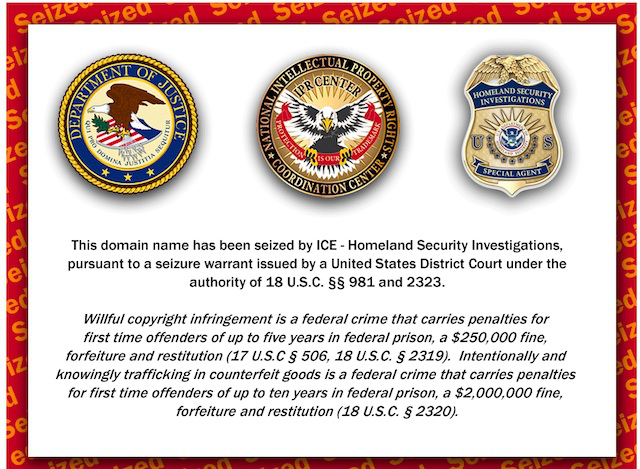
Remove the domain name from the registry and anyone who tries to go to the site gets an error message, or something that looks like this:

Civil Forfeiture

As the illustration above indicates, domain names are treated as any other property that can be seized and forfeited as a matter of law. Asset forfeiture is an important tool in law enforcement. A bank robber can, as part of his sentence, be required to hand over his loot. This type of forfeiture can be referred to as an in personam order – the order to forfeit the assets is a result of a case against a specific person. Less familiar, but perhaps equally as important, is civil forfeiture.

In a civil forfeiture case, the objectives are the same: to recover the proceeds of the crime and the property used to facilitate it; but the procedure is different. Instead of bringing an action against a person (in personam) as part of a criminal case, the action is brought against the property (in rem). In other words, it is a civil case in which the Government is the plaintiff, the property is the defendant, and the persons objecting to the forfeiture are intervenors called “claimants.” This is why civil forfeiture cases — in the United States at least — have such unusual names, such as United States v. $160,000 in U.S. Currency, or United States v. Contents of Account Number 12345 at XYZ Bank Held in the Name of Jones.2

Civil forfeiture against domain names makes sense in addressing online piracy. In many cases, the owner of the domain may be unclear due to the ease of falsifying registration information, or the owner may be difficult to find. Criminal prosecution against the site owners may not be in the interests of justice. And often, these sites are nothing more than their domain name and a collection of links – quick to setup and easy to operate. Traditional criminal prosecution is too costly and ineffective against this widespread digital piracy.

Old Dog, New Tricks

The most ironic part of the complaints that this bill will censor or break the Internet is that in rem procedures against domain names are nothing new. The image above shows one example of a domain name being removed. The in rem action this bill describes is not something the DoJ could not do before. All this bill does is streamline the process. It specifies how to determine issues like the situs of a domain name, the proper jurisdiction for bringing these actions, and appropriate venue – issues that have largely developed through case law.3

Contrary to fears that this bill will result in the takedown of YouTube4 or any number of other sites,5 COICA is aimed only at the most egregious pirate websites, like the ones taken down during this past summer’s anti-piracy initiative Operation In Our Sites – sites which were replaced with the graphic shown above. Fears that the MPAA or RIAA could muscle the DoJ into expanding the definition of sites “dedicated to infringing activity” past the plain meaning of the statute’s text are unfounded; one need only look at the history of criminal copyright prosecution to see there is no evidence that this bill would be used against anything other than the most clearly infringing sites.

In short, the ease and scale of online piracy requires more effective legal tools to manage. The rhetoric against COICA is overblown; the reality is that it offers improvements on one such tool that may better protect the rights of creators.

By , August 23, 2010.

I’m happy to announce that my article, Copyright Reform Step Zero, has just been published in volume 19, issue 2, of the journal Information & Communications Technology Law. I’m especially happy since this is my first published article. You can find the article at http://www.informaworld.com/openurl?genre=article&issn=1360-0834&volume=19&issue=2&spage=147; I have a pre-print version on my ‘about me’ page for those who don’t have access to the journal.

Take a moment to think of all the purposes copyrighted works fulfill: entertainment, art, culture, knowledge, teaching, information, communications, etc. Now factor in how rapid technological changes can shift the balance of power between stakeholders almost over night. Crafting copyright policy that takes all that into consideration is a huge challenge. My article proposes one way which may more effectively meet that challenge.

The abstract reads:

‘A reasonable person might well think it’s a fool’s errand to contemplate a [copyright] reform project of any sort.’ The US Copyright Act of 1976 and its subsequent amendments is contained in over 200 pages of incomprehensible, sometimes inconsistent, and highly technical provisions. Attempts to reform this law are doomed from the start. They are doomed not because they lack merit, but because of the way copyright law is made. This article argues that before any meaningful copyright reform is passed, the institutional framework that makes copyright law must be changed. It proposes delegating substantive rulemaking authority to the US Copyright Office as part of that change. The article explores the benefits and drawbacks to this approach and concludes that without the type of institutional reform envisioned by this proposal, copyright law will continue to become increasingly unable to keep up with technological and other challenges while also becoming increasingly resistant to reform efforts.

Since finishing the article several months ago, I’ve noted a few developments that continue this theme of a movement toward wholesale copyright reform and the challenges any reform effort faces. For starters, in June 2010, IP Czar Victoria Espinel released the first Joint Strategic Plan on Intellectual Property Enforcement, as directed by the PRO-IP Act – illustrating the priority that the federal government has placed on coordinating agency efforts to enforce intellectual property. Outside groups continue to push for their own versions of reform; in February 2010, Public Knowledge announced the start of its Copyright Reform Act project. Finally, Copyrights and Campaigns author Ben Sheffner asked, Is it time to completely reform US copyright law? – getting to the heart of the institutional roadblocks of copyright reform efforts that I address in my article.