By , June 13, 2013.

In the prologue of his 2004 book, Free Culture, Lawrence Lessig writes:

A free culture supports and protects creators and innovators. It does this directly by granting intellectual property rights. But it does so indirectly by limiting the reach of those rights, to guarantee that follow-on creators and innovators remain as free as possible from the control of the past. A free culture is not a culture without property, just as a free market is not a market in which everything is free. The opposite of a free culture is a “permission culture”—a culture in which creators get to create only with the permission of the powerful, or of creators from the past.

Lessig starts out well enough with his observation that intellectual property rights are part of a free culture, but things go quickly downhill after that, and the remainder of the book does nothing to rehabilitate this descent.

Although Lessig was not the first to use the term “free culture” as an antithesis to “overly restrictive” copyright laws, he did play a major role in developing and popularizing the concept.

The problem with this description of a “free culture” is that it is placed opposite of “permission culture.” This could not be more wrong. Permission, or consent, is not the opposite of freedom, it is a necessary part of freedom.

In Western philosophy at least, consent is considered one of the foundations of a democratic society. 1See, for example, The Ethics of Consent, pp. 45-51 (Oxford University Press 2010), citing Thomas Hobbes, Adam Smith, Immanuel Kant, and John Stuart Mill. Not only does legitimate authority derive solely from the “consent of the governed”, but one of the ends of government is the preservation of property — which, essentially, is a framework for organizing consent. As John Locke wrote:

Men therefore in society having property, they have such a right to the goods, which by the law of the community are their’s, that no body hath a right to take their substance or any part of it from them, without their own consent: without this they have no property at all; for I have truly no property in that, which another can by right take from me, when he pleases, against my consent.

In addition, property has long been considered integral to the maintenance of a free society. 2See, for example, Lynch v. Household Finance Corp., 405 US 538, 552 (1972).,  Noah Webster—who, coincidentally, considered an author’s copyright equivalent to, and deserving of, the same protection as all other species of property, see Letter to Daniel Webster, Sept. 30, 1826— once wrote, “Let the people have property, and they will have power — a power that will for ever be exerted to prevent a restriction of the press, and abolition of trial by jury, or the abridgement of any other privilege.”

Lessig’s conception of a “free culture” is fatally flawed. The opposite of consent, of permission, is not freedom, but force. Freedom requires consent, property is built on consent, and the two are inextricably intertwined.

This holds true whether we are talking about the species of property governing tangible items or the species of property governing intellectual items.

I would argue that the nature of the works protected by copyright—expressive, cultural, scientific, etc.—makes it more, not less, important to fit them within this liberty/property paradigm. For in addition to the freedom and self-realization creators gain when they are able to reap what their labor has sown, the works they create enrich the general public, allowing society itself to flourish.

The necessity of this to a free culture was recognized most recently by a federal court less than three months ago:

Paraphrasing James Madison, the world is indebted to the press for triumphs which have been gained by reason and humanity over error and oppression. Investigating and writing about newsworthy events occurring around the globe is an expensive undertaking and enforcement of the copyright laws permits AP to earn the revenue that underwrites that work. Permitting Meltwater to take the fruit of AP’s labor for its own profit, without compensating AP, injures AP’s ability to perform this essential function of democracy. (Emphasis added). 3The Associated Press v. Meltwater US Holdings, Dist. Court, No. 12 Civ. 1087 (DLC) (SDNY March 21, 2013).

Journalism’s role in fostering democracy may be somewhat obvious, but the fine arts play their role as well.

It has not been customary to include the arts, the fine arts, as an important part of the social conditions that bear upon democratic institutions and personal freedom. Even after the influence of the state of industry and of natural science has been admitted, we still tend to draw the line at the idea that literature, music, painting, the drama, architecture, have any intimate connection with the cultural bases of democracy. Even those who call themselves good democrats are often content to look upon the fruits of these arts as adornments of culture rather than as things in whose enjoyment all should partake, if democracy is to be a reality. The state of things in totalitarian countries may induce us to revise this opinion. For it proves that no matter what may be the case with the impulses and powers that lead the creative artist to do his work, works of art once brought into existence are the most compelling of the means of communication by which emotions are stirred and opinions formed. The theater, the movie and music hall, even the picture gallery, eloquence, popular parades, common sports and recreative agencies, have all been brought under regulation as part of the propaganda agencies by which dictatorship is kept in power without being regarded by the masses as oppressive. We are beginning to realize that emotions and imagination are more potent in shaping public sentiment and opinion than information and reason. 4John Dewey, Freedom and Culture, pp. 9-10 (Capricorn Books 1963) (1939).

Now, what copyright brings to the table is not a necessary condition for creating expressive works; surely we will still have writers and artists without these rights. Instead, it brings a type of creativity that is separate from government, whether such sponsorship is benign or “part of the propaganda agencies by which dictatorship is kept in power”, and separate from the whims of the wealthy elite, such as you might find under a patronage system. It is the freedom to create independently, facilitated by copyright, that has long been recognized as essential to a free press, a free society, and a free culture. Just a few examples from a diverse array of sources over the past two centuries that speak to this recognition include…

…this passage from a journal article in 1844:

If the public desire a really free press, they must not look to it as a source of taxation; and if they are anxious for truth, for elevated and elevating sentiments, for ideas matured by study and reflection, and an honest exposition of grievances, they must recognise original articles as property, and secure them against a plundering appropriation by a copyright. 5Impediments to Knowledge“, The Reasoner No. 17, 264 (1844).

…British lawyer James Paterson in 1880:

When any person is free to publish whatever he deems interesting or valuable either as a mode of procuring profit to himself or as a means of influencing the minds and will of his fellow-citizens on matters on which union and combination can effect great results, this is the highest mark of freedom. 6The Liberty of the Press, Speech, and Public Worship, pg 14. (Macmillian 1880).

…historian Edward Bloom in 1949:

Recognition of proprietary rights of authors under the Copyright Act of 1709 was an extremely important step in liberating the press. Copyright security helped to stimulate private initiative by providing authors of books some measure of financial independence. By at least partially obviating the economic function of political patrons, the Act of 1709 aided immeasurably in the freedom of the press. 7Edward Bloom, Johnson on a Free Press: A Study in Liberty and Subordination, A Journal of English Literary History (Dec. 1949).

…former Register of Copyrights Barbara Ringer in 1974:

[T]he concept of copyright changed radically as a result of the revolutionary political movements of the late 18th and 19th centuries, and the first copyright statutes were based on a rejection of autocratic repression and monopoly control and upon a new recognition of individual liberty and the human rights of authors. … Freedom of speech and freedom of the press are meaningless unless authors are able to create independently from control by anyone, and to find a way to put their works before the public. 8The Demonology of Copyright, R.R. Bowker Memorial Lecture, 1974.

…or copyright scholar Neil Netanel in 1996:

By according authors and their assigns a proprietary entitlement, copyright fosters the development of an independent sector for the creation and dissemination of original expression, a sector composed of creators and publishers who earn financial support for their activities by reaching paying audiences rather than by depending on state or elite largess. 9Copyright and a Democratic Civil Society, 106 Yale Law Journal 283, 347 (1996).

So I think it is no stretch to say that property in expressive works, built on consent, plays a vital role in the maintenance of a free culture. The modern definition of “free culture” to mean a permissionless culture — one that calls for a regressive weakening of creators’ rights — is a dramatic reversal of longstanding conceptions of property and freedom. And, ironically, it achieves the opposite of what it purports to address. As legal scholar Guy Pessach observed in a forthcoming article (which I wrote about on Monday), weak copyright protection increases media concentration and decreases cultural diversity. In addition, Thomas Joo has argued that more permissive rules toward “remix” also reinforce dominant culture, contrary to what proponents of such rules (including Lessig) have claimed.

In a recent commentary, Lawrence Lessig stated the need to “learn how liberty can live in the digital age.” Just last month, Ethernet inventor Bob Metcalfe said, “The Internet needs to deal with property properly.” I would suggest the two are interdependent, which is clear once we start with a better definition of “free culture.”

References

References
1 See, for example, The Ethics of Consent, pp. 45-51 (Oxford University Press 2010), citing Thomas Hobbes, Adam Smith, Immanuel Kant, and John Stuart Mill.
2 See, for example, Lynch v. Household Finance Corp., 405 US 538, 552 (1972).
3 The Associated Press v. Meltwater US Holdings, Dist. Court, No. 12 Civ. 1087 (DLC) (SDNY March 21, 2013).
4 John Dewey, Freedom and Culture, pp. 9-10 (Capricorn Books 1963) (1939).
5 Impediments to Knowledge“, The Reasoner No. 17, 264 (1844).
6 The Liberty of the Press, Speech, and Public Worship, pg 14. (Macmillian 1880).
7 Edward Bloom, Johnson on a Free Press: A Study in Liberty and Subordination, A Journal of English Literary History (Dec. 1949).
8 The Demonology of Copyright, R.R. Bowker Memorial Lecture, 1974.
9 Copyright and a Democratic Civil Society, 106 Yale Law Journal 283, 347 (1996).
By , June 10, 2013.

Skeptics of copyright are generally not too fond of “gatekeepers.”

Prior to the widescale adoption of the internet, these “gatekeepers”, the typical narrative goes, controlled what the masses read, watched, and listened to, reinforcing a dominant culture and creating the concept of media “consumers.” But the networked, one-to-one nature of the internet challenged this one-to-many model. It allowed creators to bypass “gatekeepers” and connect directly with fans, supporting more diverse and decentralized culture.

To many proponents of this view, current copyright law facilitates the former, broadcast model. Legal professor Guy Pessach thinks this is wrong.

In his forthcoming article, Deconstructing Disintermediation — A Skeptical Copyright Perspective, Pessach examines the effects that disintermediation has had in the copyright realm and comes to the conclusion that it has decreased cultural diversity, decentralization, and artist welfare.

Deconstructing Disintermediation

As Pessach notes, the conventional wisdom of disintermediation and copyright has been championed by many over the past decade, including academics like Jessica Litman, Neil Netanel, William Fisher, and Yochai Benkler. The basic premise is that copyright law has evolved to primarily benefit corporate media at the expense of users and individual creators. This system is criticized for undermining cultural diversity, making amateur and “civic-engaged activity” that involves the use of copyrighted cultural materials more difficult, and eroding the ability of creators to get a fair return for their work.

By focusing on cutting out the middleman, copyright law reformers hope to decrease corporate media’s influence on culture and make it easier for creators to reach audiences and for readers to enjoy a more diverse range of creative works. This would be achieved in part by enhancing existing provisions in copyright law like termination and work-for-hire rules to be more favorable to creators and in part by shielding some peer-to-peer activities from infringement liability and broadening safe harbors for online intermediaries.

Pessach is skeptical of this argument, and his article advances this skepticism on three grounds. First, the new intermediaries, like YouTube and Facebook, are not as different from traditional media as disintermediation proponents might think and may, in fact, be worse in many ways. As Pessach notes, “the creative destruction of traditional corporate media and its replacement by mega networked intermediaries may generate realms that are more concentrated, homogeneous and exploitive of creators.” Related to this is Pessach’s next argument that as new intermediaries gain power over audiences, the preservation of “traditional” media may have an increasingly important role mitigating that dominance. Finally, Pessach shows that incorporating disintermediation provisions in copyright law tends to have the opposite effect than intended, resulting more often in centralization of media, less cultural diversity, and less leverage for creators.

In short, argues Pessach, when you recognize that copyright law regulates power relationships between different actors in creative markets, you recognize that “extreme concentration of media power could derive not only from excessive copyright protection, but also from excessive ability to freely utilize content.” Pessach concludes,

Once this aspect is acknowledged, a novel and hidden role of copyright law is unveiled. Copyright law is a dynamic mechanism for regulating power relationships in media and information markets. It does so both by acknowledging copyright protection and by exempting from copyright liability. Hence, under certain economic and social conditions, copyright protection may have a legitimate role in mitigating media and market powers of copyrightless intermediaries that leverage copyright exemptions and limitations as their gateway to control over audience attention.

Money for Nothing

Pessach next turns to exploring these ideas in greater detail. First up: the nature of the new intermediaries. Pessach writes that

the bargaining position of originating authors and creators, versus a handful of Internet intermediaries, may be weaker than it was for traditional distributors and corporate media. The more concentrated the layer of effective networked distribution is, the weaker the bargaining position and economic welfare of authors and creators becomes. Seemingly, the Internet and networked communication platforms provide almost an unlimited range of distribution platforms. Nevertheless, if one adds the parameter of effective audience attention and the ability to effectively reach audiences, in realms of information overflow, reality appears different.

YouTube is used as a case study here. The sheer size and popularity of the site makes it a must for video creators to distribute their content online. But YouTube invests very little in producing the works available on its site1Pessach states that “YouTube does not finance or invest in the production of the content,” though in the past year, the site has begun at least advancing ad revenues for some original production. and only pays about 5% in ad revenues to creators.

When compared to traditional creative industries, this state of affairs does not seem encouraging. For example, within the audio-visual creative industries, the guilds’ collective agreements between authors, directors and performers, on the one hand, and motion picture/television studios, on the other, seem to provide authors, creators and performers with financial conditions that are much better than the YouTube scenario, particularly because the financial investment and risk are born entirely by corporate media. As for the music industry, indeed, there are many reports and evidence regarding the imbalanced allocation of revenues between most artists and record companies. However, even in this regard, revenues from the “bad” old record company seem higher than the new digital distribution system. If one takes into account elements such as advances, coverage of production costs and even percentages of revenue share, the new boss might be worse than the old bad boss at the end of the day.2Pessach cites here to David Lowery’s seminal article, Meet the New Boss, Worse than the Old Boss.

Other examples of how the new intermediaries have not resulted in better conditions for authors and creators. Pessach cites to the purchase of the Huffington Post by AOL in 2011 by $300 million, value created by its thousands of unpaid bloggers who received no benefit from the sale as well as the Instagram flap earlier this year. Both cases demonstrate the enormous bargaining and negotiating power new intermediaries have over authors and creators.

Be Sure to Drink Your Ovaltine

In addition to reintermediation of expressive works, Pessach examines the monetization of these works online. Advertising has become the dominant method of monetization for online works, further exacerbating the negative effects to creators and culture. Pessach explains that an ad based model places emphasis on creating the most popular content in order to attract the most “eyeballs.” “Traditional” media has relied in part on advertising, of course, but disintermediation offers a more extreme version of this model. The former found the pressure to deliver eyeballs on the traditional intermediary. But the latter places that pressure on the creator himself. Pessach says the difference is that “as opposed to corporate media, individual creators and authors lack the financial resources required to spread risks between different types of cultural products or seek and develop other distribution platforms.”

Thus, Pessach concludes, disintermediation has not improved creators’ welfare, it has not increased cultural diversity, and it has amplified media concentration. One of the takeaways from this conclusion is that the internet has made “corporate” media more relevant, not less. Pessach notes the many essential roles that record labels, movie studios, book publishers, broadcasters and other traditional media have as social networks, search engines, and user-generated content platforms increase their dominance. First, their size puts them in a better negotiating position against digital distribution channels, getting, in many cases, a better “deal” for the creators of works in their portfolio than individual creators could likely get on their own. Second, these institutions carry “a cultural legacy of commitment to the creative industries”, which Pessach says is “currently absent in the commitments and cultural DNA of networked intermediaries.” Finally, the financial investment, risk allocating, and filtering functions of these companies help facilitate a broad range of cultural production that is highly unlikely to appear in a disintermediated digital environment.

Disintermediation and Copyright

So what does this all of this have to do with copyright?

To answer this question, Pessach next discusses two “themes” that have emerged from efforts to increase disintermediation through copyright law. The irony is that the actual effect appears to be contrary to the purported goals.

The first of these relates to the protection of online service providers through DMCA safe harbors, most notably the § 512(c) safe harbor for user-uploaded material. Part of the hope of this safe harbor was to support the development of new, decentralized distribution platforms. Reality tells a different story, which Pessach demonstrates by using the example of YouTube once again:

The dominant and unprecedented market and power position that YouTube has managed to obtain is… mostly due to § 512(c)’s safe harbor regime. It is the safe harbor regime that enabled the hosting and public provision of endless amounts of popular copyrighted cultural materials, and it is this ability that made the platform so dominant in terms of its market share. The growing popularity of the platform was largely based on its ability to cover entire portfolios of content (“full repertoire”) under one umbrella and highly demanded (copyrighted) content. The ability to do so without any need to obtain ex-ante authorizations from copyright owners and with the safe harbor’s limited legal risk is what facilitated the economic and cultural conditions for the current market domination of YouTube, particularly due to elements of network economics. Practically, the fact that under § 512(c)’s safe harbor regime, YouTube was obliged to remove (ex-post) infringing materials, based on a takedown notice by copyright owners, was not a real obstacle in establishing the platform’s dominance. By itself, such an obligation did not prevent the rapid growth in the platform’s popularity and the immense portfolio of popular copyrighted content that it hosted.

Once this dominant market position was achieved, however, it was also the stage to move toward business models, which are based on collaboration and revenue-sharing with creators and rights owners, only now from a completely different negotiation (or one may say, coercive) position. At this stage, authors, creators and rights owners were faced with a highly dominant and popular intermediary, which attracts a significant portion of audience attention and which is already partially shielded from legal liability for the hosting of their materials. Under such conditions, YouTube’s ability to launder its content activities under its own terms was considerable. Authors, creators and performers have very few options other than agreeing to YouTube’s terms and conditions or vanishing from audiences’ awareness.

The second theme Pessach looks at are proposals to vest more rights, particularly initial ownership rights, in creators. Though at times inelegantly phrased, the argument here is essentially that a focus on initial ownership rights takes the focus off the more important mechanisms that can provide meaningful bargaining power to decentralized and diffused creators. One self-published author is going to get whatever deal Amazon gives her, but a publisher that can negotiate on behalf of many authors could get a better deal.

The entire article is worth a read. Though astute observers may not find much surprising within, Pessach does an admirable job tying together various themes — “maybe the internet only wants one of everything”, the continuing importance of “traditional” intermediaries, the sharp decrease in creator welfare caused by disintermediation — and adds to a growing academic literature that highlights the flaws in the arguments of copyright’s skeptics.3See, for example, Randolph May & Seth Cooper, The Constitutional Foundations of Intellectual Property, 8 Perspectives from FSF Scholars, Free State Foundation (May 10, 2013); Ronald Cass & Keith Hylton, Laws of Creation: Property Rights in the World of Ideas (Harvard Univ. Press 2012); Thomas Joo, Remix Without Romance, 44 Conn. L. Rev. 415 (2011); Marc H. Greenberg, Reason or Madness: A Defense of Copyright’s Growing Pains, 7 John Marshall Review of Intellectual Property Law 1 (2007); Justin Hughes, Copyright and Incomplete Historiographies — of Piracy, Propertization, and Thomas Jefferson, 79 Southern California Law Review 993 (2006); Stan Liebowitz, Economists’ Topsy-Turvy View of Piracy, 2 Review of Economic Research on Copyright Issues 5 (2005); Thomas Nachbar, Constructing Copyright’s Mythology, The Green Bag, Vol. 6 (2002). It is tragic that the erosion of creators’ rights has had the opposite effect than those responsible had intended. Disintermediation has benefitted few but a handful of giant internet firms. Hopefully, Pessach’s article shines a light on the fact that meaningful copyright protection remains just as vital to the public interest, if not more so, in the digital age.
References

References
1 Pessach states that “YouTube does not finance or invest in the production of the content,” though in the past year, the site has begun at least advancing ad revenues for some original production.
2 Pessach cites here to David Lowery’s seminal article, Meet the New Boss, Worse than the Old Boss.
3 See, for example, Randolph May & Seth Cooper, The Constitutional Foundations of Intellectual Property, 8 Perspectives from FSF Scholars, Free State Foundation (May 10, 2013); Ronald Cass & Keith Hylton, Laws of Creation: Property Rights in the World of Ideas (Harvard Univ. Press 2012); Thomas Joo, Remix Without Romance, 44 Conn. L. Rev. 415 (2011); Marc H. Greenberg, Reason or Madness: A Defense of Copyright’s Growing Pains, 7 John Marshall Review of Intellectual Property Law 1 (2007); Justin Hughes, Copyright and Incomplete Historiographies — of Piracy, Propertization, and Thomas Jefferson, 79 Southern California Law Review 993 (2006); Stan Liebowitz, Economists’ Topsy-Turvy View of Piracy, 2 Review of Economic Research on Copyright Issues 5 (2005); Thomas Nachbar, Constructing Copyright’s Mythology, The Green Bag, Vol. 6 (2002).
By , April 04, 2013.

“Innovation” is one of the Internet’s favorite words (along with “disruption”). 1Its overuse by some borders on unintentional parody; for example, this recent article on Techdirt features an amazing four instances of some form of “disrupt” and three instances of some form of “innovate” in the first paragraph alone.  It’s a glittery word — who can be against innovation! — and seems to be used to express just about any concept that is needed. The word was once a pejorative; “A spirit of innovation is generally the result of a selfish temper, and confined views,” wrote Edmund Burke. Its normative meaning has since flipped. 2A 2009 literature review found that only 1 in 1,000 social science articles discussing innovation studied the undesirable consequences of innovation, suggesting a strong pro-innovation bias in recent decades.

On April 1st, the Second Circuit affirmed the denial of an injunction against Aereo. The company had been sued by several television broadcasters alleging copyright infringement for retransmitting programs without permission. Last year, a district court refused to grant a preliminary injunction after finding that the broadcasters had been unable to distinguish Aereo’s system from a system held not infringing in the earlier Second Circuit decision in Cartoon Network v. CSC Holdings (“Cablevision“). On appeal, the Second Circuit agreed with the lower court, holding “Plaintiffs have provided us with no adequate basis to distinguish Cablevision from the Aereo system.”

Technology advocates celebrated the decision. The Disruptive Competition Project wrote that it considers Aereo a perfect example of the type of “disruptive innovation” it champions. Consumer Electronics Association CEO Gary Shapiro called the decision a “big victory for innovation.” Public Knowledge hailed the decision as a victory for “video innovation.” The EFF proclaimed the court decision as a Victory for Aereo, TV Watchers, and Innovation Without Permission 3One might find it telling how consistently internet focused civil society groups are aligned with the consumer electronics industry. Even Aereo itself has proudly proclaimed that it is on the side of innovation, progress, and consumer choice.

But how innovative is Aereo? From a viewer’s perspective, the system is largely indistinguishable from cable TV, which has been around for decades. Pay a monthly fee, watch television.

At least one of the Second Circuit judges didn’t see anything particularly innovative about the company. In a dissenting opinion, Judge Chin called Aereo’s “technology platform” a “sham”, describing it as “a Rube Goldberg-like contrivance, over-engineered in an attempt to avoid the reach of the Copyright Act and to take advantage of a perceived loophole in the law.”

Aereo is doing precisely what cable companies, satellite television companies, and authorized Internet streaming companies do — they capture over-the-air broadcasts and retransmit them to customers — except that those entities are doing it legally, pursuant to statutory or negotiated licenses, for a fee. By accepting Aereo’s argument that it may do so without authorization and without paying a fee, the majority elevates form over substance. Its decision, in my view, conflicts with the text of the Copyright Act, its legislative history, and our case law.

The decision also seems to conflict with the idea, as expressed above, that Aereo is innovative.

To put it another way: imagine the reaction to Aereo if it was in all respects identical — e.g., same channel lineup, same price — except it was licensed to retransmit programming. Would we still be hearing about how innovative the service is? I don’t think it would be too far off to imagine such a service being greeted by yawns, or even derided as outdated. That is, it seems plausible that the primary feature that makes Aereo lauded as an innovation is the fact that it is unlicensed.

It is heartening to see that others besides Judge Chin recognize this. In When copyright leads to wasted innovation, Alex Hern observes, “All of this innovation – the tiny antennas, better transcoding technology, and office placed with line-of-sight to the Empire State Building for perfect reception – isn’t being focused towards making life better for customers, or even just making money for Aereo. Instead, it’s just being used to get around the law.” I disagree with Hern, however, when he concludes that “The government could render all that effort useless overnight by just allowing Aereo to stream signal from one aerial to all its users at once.” Aereo is allowed to do this under current law, it just doesn’t want to bother seeking the necessary permission from the owners of the programs it wants to retransmit or pay the necessary licenses.

So how is it that so many celebrate this type of free-riding as innovation?

Part of the blame may be the vague definition of “innovation” itself by those who employ it the most. Author Evgeny Morozov recently wrote of this phenomenon

While the brightest minds of Silicon Valley are “disrupting” whatever industry is too crippled to fend off their advances, something odd is happening to our language. Old, trusted words no longer mean what they used to mean; often, they don’t mean anything at all. Our language, much like everything these days, has been hacked. Fuzzy, contentious, and complex ideas have been stripped of their subversive connotations and replaced by cleaner, shinier, and emptier alternatives; long-running debates about politics, rights, and freedoms have been recast in the seemingly natural language of economics, innovation, and efficiency. Complexity, as it turns out, is not particularly viral.

Part may also be the embrace of “permissionless innovation” as a norm. The idea was once defined rather narrowly, referring to the fact that one could deploy an online service or website without needing any sort of prior approval by any central governing body. 4See, for example, Vint Cerf in 2009: “Many now-successful companies have deployed their services on the Internet without the need to negotiate special arrangements with Internet Service Providers, and it’s crucial that future innovators have the same opportunity. We are advocates for “permissionless innovation” that does not impede entrepreneurial enterprise.” Since then it has been expanded to include an absence any sort of obstacles to Innovation, both online and off.

An unqualified endorsement of such a broad definition of permissionless innovation is troublesome, not least of which because it contradicts the centrality of consent and rule of law in any free society. But to the concept’s proponents, permission is simply an obstacle to Innovation that must be torn down. “Permission” can be required by governments in the form of regulations and laws. These are often described solely as rent-seeking by incumbent firms, holding no legitimate purpose on their own and existing only to keep “disruptive innovators” out of the market. 5Larry Downes, for example, said in a recent article, Ready to Innovate? Get a Lawyer, “But more often the imposition of legal constraints comes indirectly, the maneuverings of incumbents caught off-guard by something dramatically better and often cheaper than their core products and services. Performing a bit of regulatory judo, they often respond to such threats by pressuring regulators who oversee their own activities to declare the innovator illegal or otherwise in violation of rules that were never designed to cover it.” But permission can also be required from other individuals. Copyright and other forms of intellectual property, held by individuals or other entities, are characterized as the quintessential obstacle to innovation. This is essentially the core thesis in Lawrence Lessig’s 2003 book, Free Culture: The Nature and Future of Creativity: copyright is a restriction that creates a “permission culture“, as opposed to a free one.

Is copyright a restriction that blocks innovation? I say no. As Ronald Cass and Keith Hylton note in their new book, Laws of Creation: Property Rights in the World of Ideas this view is premised on the erroneous “zero sum” view of intellectual property that has become engrained in copyright skeptic thinking.

[T]he modern academic view treats intellectual property law as a set of rules determined in a zero-sum conflict between rights-holders and members of the public. Beyond some modest realm, for one side to gain, the other side must lose. The individual is encouraged y this view to choose a side: either you are with the public or with the rights-holders. For some writers, the choice is put in even more loaded terms: either you side with those who are rooted in the past or line up with the vanguard of the future, freed of entangling rights. 6Pp. 209-10.

But copyright is not a zero sum game. Cass and Hylton explain that IP protection, including copyright, comes with static costs, but it produces dynamic benefits. IP protection benefits society when those dynamic benefits are greater than the static costs, leading Cass and Hylton to conclude that, while not perfect, “existing legal rules are generally defensible within an analysis of their costs and benefits.” 7Pg. 220.

George Mason law professor Adam Mossoff has recently provided a real world example of this equation in action. In his latest article, How Copyright Drives Innovation in Scholarly Publishing, Mossoff looks at an area that has been especially fertile to charges of copyright as an obstacle. In his abstract, Mossoff writes

Today, copyright policy is framed solely in terms of a trade off between the benefits of incentivizing authors to create new works and the losses from restricting access to those works. This is a mistake that has distorted the policy and legal debates concerning the fundamental role of copyright within scholarly publishing, as the incentive-to-create conventional wisdom asserts that copyright is unnecessary for researchers who are motivated for non-pecuniary reasons. As a result, commentators and legal decision-makers dismiss the substantial investments and productive labors of scholarly publishers as irrelevant to copyright policy. Furthermore, widespread misinformation about the allegedly “zero cost” of digital publication exacerbates this policy distortion.

This paper fills a gap in the literature by providing the more complete policy, legal and economic context for evaluating scholarly publishing. It details for the first time the $100s millions in ex ante investments in infrastructure, skilled labor, and other resources required to create, publish, distribute and maintain scholarly articles on the Internet and in other digital formats. Based on interviews with representatives from scholarly publishers, it reveals publishers’ extensive and innovative development of digital distribution mechanisms since the advent of the World Wide Web in 1993. Even more important, this paper explains how these investments in private-ordering mechanisms reflect fundamental copyright policy, as copyright secures to both authors and publishers the fruits of their productive labors. In sum, copyright spurs both authors to invest in new works and publishers to invest in innovative, private-ordering mechanisms. Both of these fundamental copyright policies are as important today in our fast-changing digital world as they were in yesteryear’s world in which publishers distributed scholarly articles in dead-tree format.

True innovation grows the entire pie. The type of false innovation of services like Aereo simply shift the pieces around — and, if such a service negatively affects those providing the television programs that Aereo relies on to attract subscribers, then, in the long run, nobody wins.

References

References
1 Its overuse by some borders on unintentional parody; for example, this recent article on Techdirt features an amazing four instances of some form of “disrupt” and three instances of some form of “innovate” in the first paragraph alone.
2 A 2009 literature review found that only 1 in 1,000 social science articles discussing innovation studied the undesirable consequences of innovation, suggesting a strong pro-innovation bias in recent decades.
3 One might find it telling how consistently internet focused civil society groups are aligned with the consumer electronics industry.
4 See, for example, Vint Cerf in 2009: “Many now-successful companies have deployed their services on the Internet without the need to negotiate special arrangements with Internet Service Providers, and it’s crucial that future innovators have the same opportunity. We are advocates for “permissionless innovation” that does not impede entrepreneurial enterprise.”
5 Larry Downes, for example, said in a recent article, Ready to Innovate? Get a Lawyer, “But more often the imposition of legal constraints comes indirectly, the maneuverings of incumbents caught off-guard by something dramatically better and often cheaper than their core products and services. Performing a bit of regulatory judo, they often respond to such threats by pressuring regulators who oversee their own activities to declare the innovator illegal or otherwise in violation of rules that were never designed to cover it.”
6 Pp. 209-10.
7 Pg. 220.
By , February 21, 2013.

This past weekend, my parents came to visit me in my new place in Washington, DC. They wanted the “grand tour” of the city, and, as I myself had yet to do the tourist thing, I asked around for recommendations beyond the obvious drive past monuments. At the top of the list: the Library of Congress, which had the added bonus of being open to the public on Presidents’ Day.

Located next to the U.S. Capitol building at the top of the Hill, the Library actually consists of three primary buildings: the original building (renamed the Thomas Jefferson Building in 1980), the John Adams Building, and the James Madison Building. The Library itself was established in 1800 and was initially, well, a library for the use of Congress. Most of the library’s collection was burned by the British in 1814, but was replenished after Thomas Jefferson offered to sell the Library books from his own extensive collection. Beginning in the 1850s, there was a push to create a National Library in the U.S., and the Library of Congress grew (unofficially) into that role under the leadership of Ainsworth Spofford, who directed the Library — and pushed its expansion — from 1865 until 1897. Today, the Library is the largest in the world, with over 150 million items in its collection, including over 20 million books. It’s also worth noting (since this is a copyright blog) that since 1897, the Library of Congress has housed the U.S. Copyright Office.

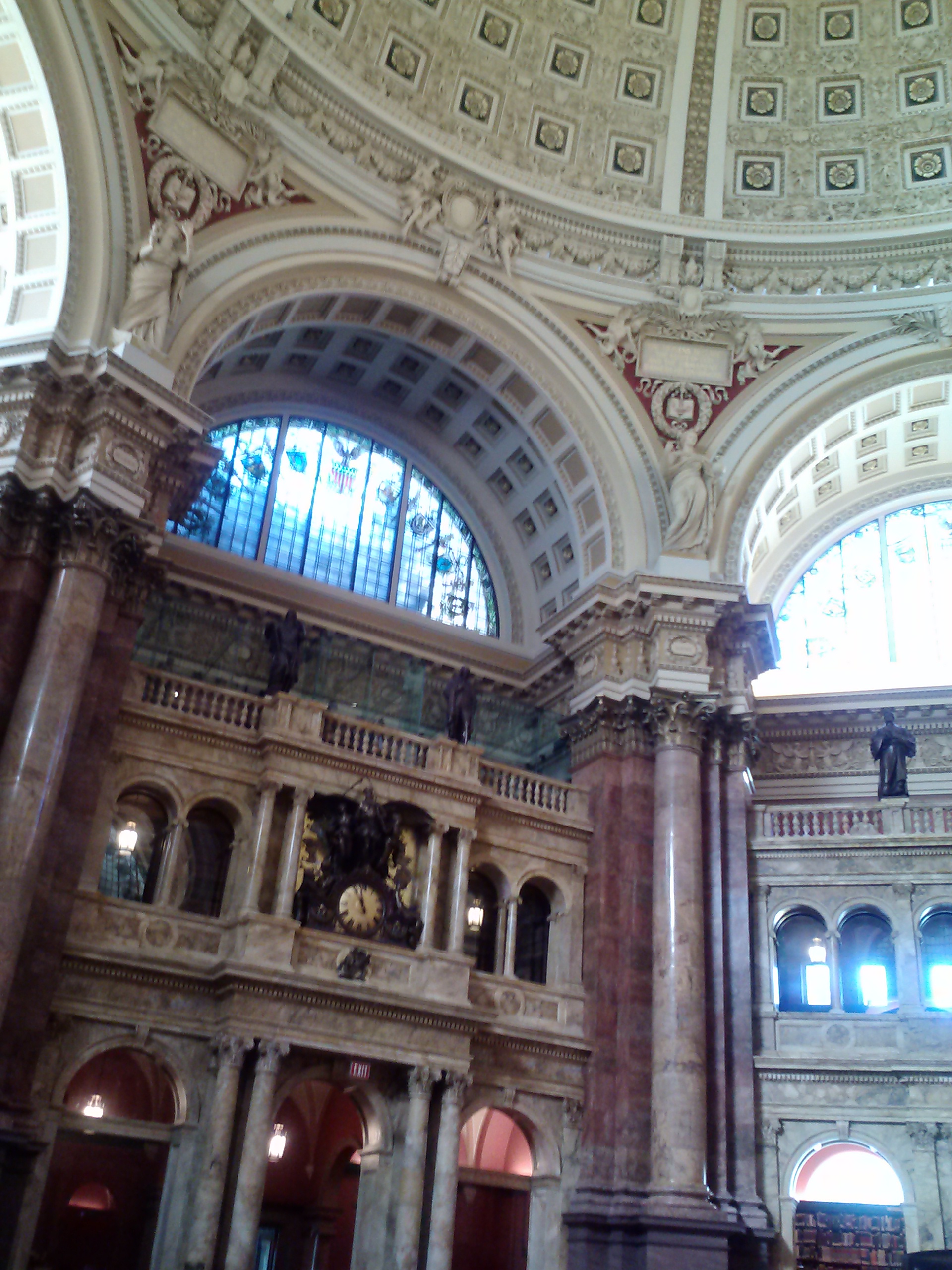
Library of Congress, Great HallThe Great Hall and exhibition areas of the Thomas Jefferson Building are open to the public Monday through Saturday, with guided tours led by Library of Congress docents several times throughout the day. I’d highly recommend a visit and a tour, as this is one of the most remarkable buildings ever built. If you would build a cathedral for science and useful arts, it would look like this. Every inch of the walls and ceilings are covered with murals and sculptures, created by over 40 individual artists. Amazingly, this artwork was possible because as the building was being constructed, it was under-budget — not something typically associated with government work. And even with the additional cost of commissioning artwork, the final cost of the Thomas Jefferson Building was less than planned. For a complete description of all the works one can see in the building, see the Library’s On These Walls pages.

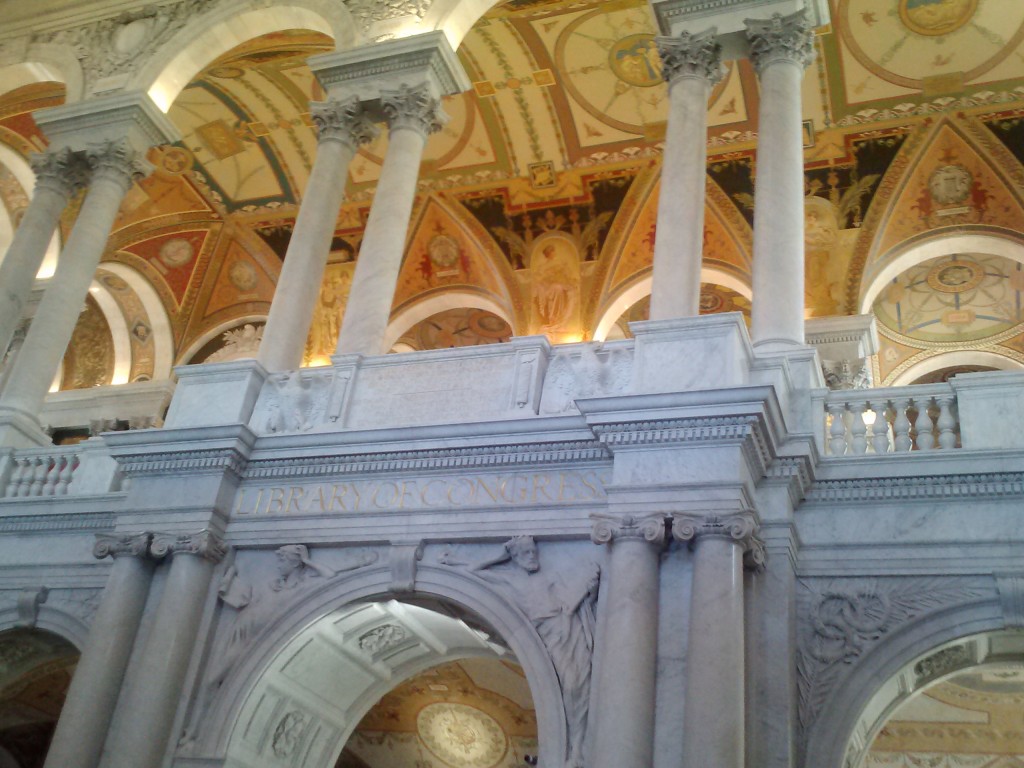
Library of Congress East Mosaic Corridor Ceiling - LawFor example, in the East Mosaic Corridor, murals on the wall and ceilings depict 13 fields of knowledge — including, as shown in the photo, law — as well as native-born Americans celebrated in those fields (for law, these Americans are Shaw, Taney, Marshall, Story, Gibson, Pinckney, Kent, Hamilton, Webster, and Curtis).

Monday was also one of only two days each year that the Main Reading Room is open to the general public — and photography is permitted.

The Main Reading Room

Library of Congress Main Reading RoomFeatured in the 2008 film National Treasure: Book of Secrets (a major driver of awareness about the room, judging by comments I overheard), the magnitude of the Main Reading Room is difficult to convey in photos — though the Library of Congress does offer a virtual tour if you can’t make it in person. Capped by a dome 125 feet in the air, surrounded by marble Corinthian columns (decorated with American tobacco leaves instead of the traditional acanthus) and 11-foot bronze statues, the Main Reading Room does a good job of inspiring awe.

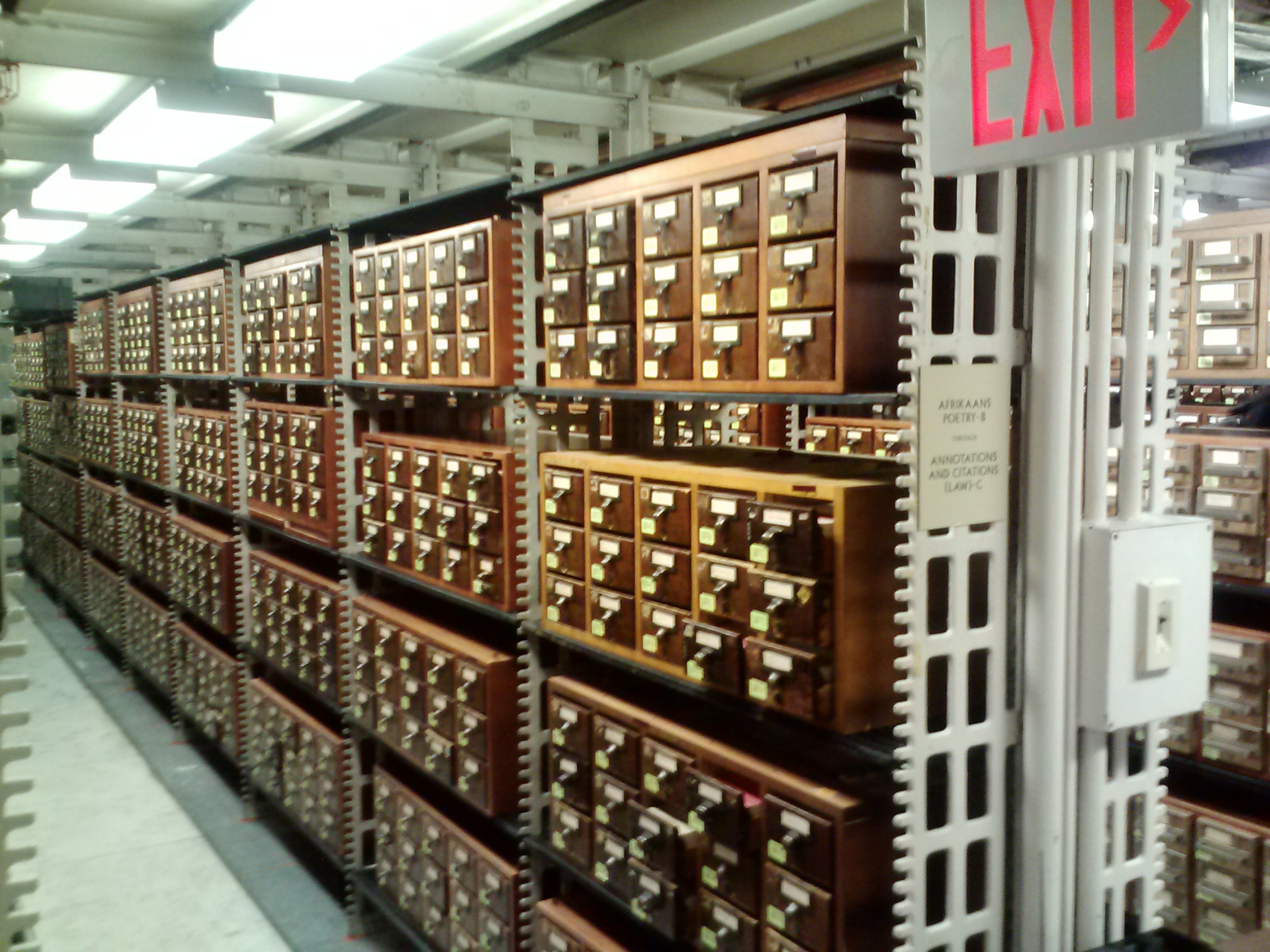
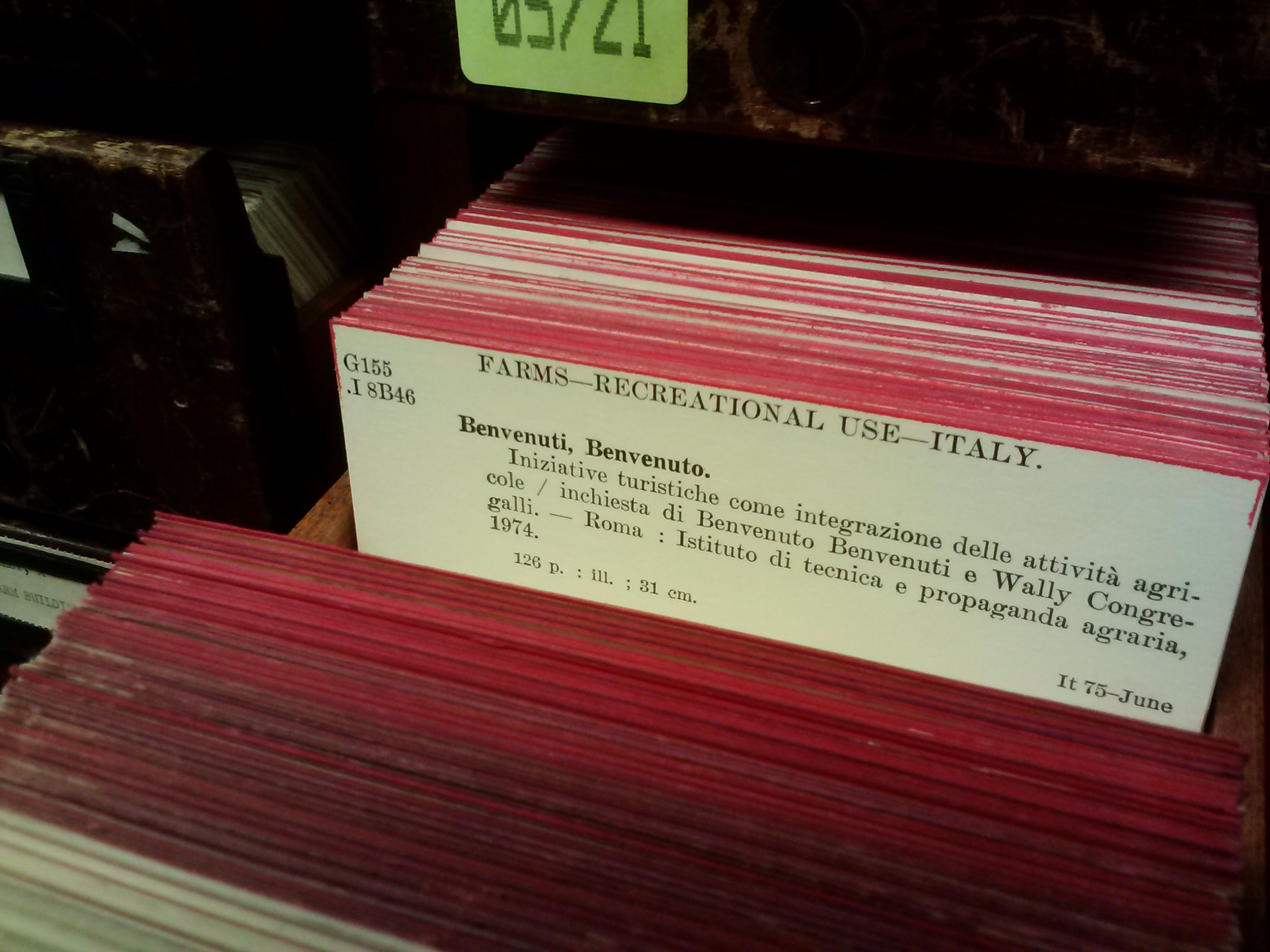
Library of Congress card catalogAlso open to the public and adjacent to the Main Reading Room is the Main Card Catalog, which houses part of the Library’s old card catalog. No, the Library does not still maintain this. The Library had long ago moved to a computerized catalog — no new cards have been added since 1980, but it has kept the old system around.

To the left is an example of an individual card. A card from the Library of Congress card catalog The Library’s catalog is available online, with a newer version at catalog2.loc.gov that also includes links to resources where you can search other collections and archives beyond books. Here, by the way, is the digital version of the card in the photo.

The Library is a monument to knowledge, the artwork in the Thomas Jefferson Building practically consecrates the book. And since this is a site dedicated to copyright, I’d like to point out the pivotal role copyright law has played in creating the world’s largest library.

Copyright Deposit

Two provisions in the Copyright Act have provided the Library of Congress with many of the materials in its collection.

First, the US Copyright Act allows for voluntary registration of copyrighted works with the Copyright Office. Registration is not a prerequisite for protection, but it does confer a number of benefits, including the ability to file a civil suit for infringement and the ability to seek certain remedies, such as statutory damages. 1See 17 U.S.C. § 408(a), 411, 412. Registration requires the submission of two copies of the work; 217 U.S.C. § 408(b). this serves to provide a record of exactly what work a specific registration covers. The Copyright Office forwards one copy of works acquired here to the Library of Congress to use in its collection.

Separately, under 17 U.S.C. § 407, the owner of a copyright is required to deposit two copies of a work with the Library of Congress within three months of publication. While deposit is not a prerequisite for copyright protection (that is, if you fail to deposit, you do not lose your copyright), the Register of Copyrights may demand compliance from any copyright owner who fails to deposit, and the law provides for fines for non-compliance. And, perhaps a bit surprisingly, the Copyright Office does exercise this authority; in 2010, it made over 4,000 demands for certain titles. 3U.S. Copyright Office, Fiscal 2010 Annual Report, pg. 32.

In 2011, over 700,000 works were added to the Library of Congress under the first provision, over 300,000 under the second. 4Library of Congress Annual Report 2011. It would have cost the Library over $30 million to acquire these works if it had to purchase them.

Laws of the latter kind — which might be called “legal deposit” laws and are distinct from any copyright system — first appeared in Western Europe during the Renaissance. 5Elizabeth K. Dunne, Deposit of Copyrighted Works, Copyright Law Revision Study 20, pg. 1 (US Copyright Office, 1960). The earliest is from France — the Ordonnance de Montpellier, 1537. Similar laws spread throughout Europe, and England enacted a legal deposit system in 1662.

In the US, the 1790 Copyright Act provided for deposit only for copyright registration purposes, which was handled by the District Court nearest an author. A copy of each book registered was to be sent to the Secretary of State. The first attempt at legal deposit was made when the Smithsonian Institute was created in 1846, which provided that copies of each book registered under the copyright law be sent to both the Smithsonian and the Library of Congress. Few authors and publishers complied with this provision, however, and the requirement was repealed in 1859.

When Spofford took charge of the Library of Congress, he set his sights on legal deposit rules that would actually work. After a few unsuccessful attempts, Congress achieved that goal in its 1870 general revision of the copyright laws. The effect was immediate and substantial. In a 1960 study on legal deposit, the U.S. Copyright Office noted, “By 1875, copyright had become the Library’s largest source of acquisition for books and almost the only source for some other materials.” 6Id. at 14.

The great value of the copyright deposit to the collections of the Library of Congress since 1870 has been recognized many times. In the past it has materially assisted the Library in building its collections on all aspects of American history, literature, law, music, and social culture. 7Id. at 30.

References

References
1 See 17 U.S.C. § 408(a), 411, 412.
2 17 U.S.C. § 408(b).
3 U.S. Copyright Office, Fiscal 2010 Annual Report, pg. 32.
4 Library of Congress Annual Report 2011.
5 Elizabeth K. Dunne, Deposit of Copyrighted Works, Copyright Law Revision Study 20, pg. 1 (US Copyright Office, 1960).
6 Id. at 14.
7 Id. at 30.
By , August 08, 2012.

On Friday, the Cynical Musician posted an article titled Demystifying Creativity, in which he asks the question, “What is creativity?” It’s an interesting post, worth a read, and it got me thinking.

I find myself in agreement with much of what Faza says, but I wanted to look at the question through the lens of copyright law. To do so, I’ll eventually get to The Hunger Games. But first, I’d like to look at the concept of “genius.”

Genius and Generation

Copyright, at its dawn in the US, was often spoken of in terms of “genius.” In March 1783, the US Continental Congress appointed a committee to “consider the most proper means of cherishing genius and useful arts through the United States by securing to authors or publishers of new books their property in such works.” 124 Journals of the Continental Congress 180. In May, the committee issued its report, stating that it was “persuaded that nothing is more properly a man’s own than the fruit of his study, and that the protection and security of literary property would greatly tend to encourage genius.” 224 Journals of the Continental Congress 326. The pre-constitutional state copyright statutes of Connecticut, Georgia, and New Hampshire were titled Acts “for the encouragement of literature and genius.” The acts of New York and North Carolina both adopted the Continental Congress’s language that securing the rights of literary property would encourage genius and “persons of learning and genius”. During the ratification of the Constitution, future Supreme Court Justice James Iredell also referred to the Copyright Clause as an encouragement to genius. 3Answers to Mr. Mason’s Objections to the New Constitution Recommended by the Late Convention at Philadelphia, in Pamphlets on the Constitution of the United States, pg. 361 (1788).

Nowadays, we often think of a “genius” as someone with exceptional intelligence. But at the time, the term was broader: “a man endowed with superior faculties; mental power or faculties; disposition of nature by which any one is qualified for some peculiar employment.” 4Thomas Sheridan, A General Dictionary of the English Language (1780). The word comes from the Latin genius, an aspect of ancient Roman religion. It was used both to describe the “guardian deity or spirit which watches over each person from birth” 5Genius“, Online Etymology Dictionary. and the “rational soul of every one.” 6St. Augustine, City of God, VII.13 (trans. Marcus Dods, 1887).

The latin term itself is derived from the Proto-Indo-European root “*gen-“, meaning “to produce” or “to beget”, and it shares a common heritage with words like “generate”. I mention this because it is interesting how the purpose of copyright, to encourage genius, and the scope of copyright, protection over what a creator generates, share an etymological relationship.

Genius and Copyright

Interesting because the exclusive rights only extend to what an author personally creates. “The sine qua non of copyright is originality.” 7Feist Publications, Inc. v. Rural Telephone Service Co., 499 US 340, 345 (1991).

To qualify for copyright protection, a work must be original to the author. Original, as the term is used in copyright, means only that the work was independently created by the author (as opposed to copied from other works), and that it possesses at least some minimal degree of creativity. …

Originality is a constitutional requirement. The source of Congress’ power to enact copyright laws is Article I, § 8, cl. 8, of the Constitution, which authorizes Congress to “secur[e] for limited Times to Authors . . . the exclusive Right to their respective Writings.” In two decisions from the late 19th century—The Trade-Mark Cases, 100 U. S. 82 (1879); and Burrow-Giles Lithographic Co. v. Sarony, 111 U. S. 53 (1884)—this Court defined the crucial terms “authors” and “writings.” In so doing, the Court made it unmistakably clear that these terms presuppose a degree of originality.

In The Trade-Mark Cases, the Court addressed the constitutional scope of “writings.” For a particular work to be classified “under the head of writings of authors,” the Court determined, “originality is required.” The Court explained that originality requires independent creation plus a modicum of creativity: “[W]hile the word writings may be liberally construed, as it has been, to include original designs for engraving, prints, &c., it is only such as are original, and are founded in the creative powers of the mind. The writings which are to be protected are the fruits of intellectual labor, embodied in the form of books, prints, engravings, and the like.”

In Burrow-Giles, the Court distilled the same requirement from the Constitution’s use of the word “authors.” The Court defined “author,” in a constitutional sense, to mean “he to whom anything owes its origin; originator; maker.” 8Id. at 345-46.

The idea/expression distinction is derived from this same reasoning. Facts and ideas do not owe their origin to any individual.

The author of a book comes to the great ocean of human thought which belongs to all; he dips up a portion of the brine, evaporates it, causes it to crystallize, purifies the crystals from unpleasant ingredients, and presents it in a new form, a form by which it is made his own. He enters the great forest of ideas, which is common ground, hews down trees, shapes them into articles of furniture, or builds a house with them, and he who takes from him that furniture is a thief, and he who breaks into that house is a burglar. The author clothes ideas in words of his own selection, forms the words into sentences of his own construction, gives the ideas his own arrangement, combines and illustrates them in his own manner, and in this state they are his own, made so by his labor, skill and invention, and they belong as properly to him as the product of salt-works on the edge of the sea belongs to the manufacturer. 9Speech of William Cullen Bryant, International Copyright: Meeting of Authors and Publishers, at the rooms of the New York Historical Society, pg. 14 (1868).

“No Man Writes Exclusively”

Above, we see recognition of the fact that creators always build on the works of the past. No creator creates in isolation, but instead “stands on the shoulders of giants.” And progress in the arts and sciences is made by encouraging genius: the originality that a creator generates.

Justice Story said as much in 1845:

In truth, in literature, in science and in art, there are, and can be, few, if any, things, which, in an abstract sense, are strictly new and original throughout. Every book in literature, science and art, borrows, and must necessarily borrow, and use much which was well known and used before. No man creates a new language for himself, at least if he be a wise man, in writing a book. He contents himself with the use of language already known and used and understood by others. No man writes exclusively from his own thoughts, unaided and uninstructed by the thoughts of others. The thoughts of every man are, more or less, a combination of what other men have thought and expressed, although they may be modified, exalted, or improved by his own genius or reflection. If no book could be the subject of copy-right which was not new and original in the elements of which it is composed, there could be no ground for any copy-right in modern times, and we should be obliged to ascend very high, even in antiquity, to find a work entitled to such eminence. Virgil borrowed much from Homer; Bacon drew from earlier as well as contemporary minds; Coke exhausted all the known learning of his profession; and even Shakespeare and Milton, so justly and proudly our boast as the brightest originals would be found to have gathered much from the abundant stores of current knowledge and classical studies in their days. [Emphasis added.] 10Emerson v. Davies, 8 F.Cas. 615 (D. Mass. 1845).

Even classical fair use can be said to embrace these ideas. “From the infancy of copyright protection, some opportunity for fair use of copyrighted materials has been thought necessary to fulfill copyright’s very purpose, “[t]o promote the Progress of Science and useful Arts.” 11Campbell v. Acuff-Rose Music, 510 US 569, 575 (1994).

[T]he author’s consent to a reasonable use of his copyrighted works ha[d] always been implied by the courts as a necessary incident of the constitutional policy of promoting the progress of science and the useful arts, since a prohibition of such use would inhibit subsequent writers from attempting to improve upon prior works and thus . . . frustrate the very ends sought to be attained. 12Harper & Row, Publishers v. Nation Enterprises, 471 US 539, 549 (1985), quoting H. Ball, Law of Copyright and Literary Property 260 (1944).

It’s a misnomer, then, to claim that the idea that “everything is a remix” somehow negates the basis for copyright.

But there are those who do indeed claim that the idea that creativity is built on the past is foreign to a legal framework that protects specific expression. There are those who say copyright “stifles” creativity, or those who say, “our system of law doesn’t acknowledge the derivative nature of creativity”, or academics who quote Michel Foulcault and speak of the notion of “Romantic authorship” — even though the cumulative nature of creativity is baked into copyright law.

The Genius of The Hunger Games

With that, let’s turn to The Hunger Games as an example.

Suzanne Collins’ hit trilogy (and now feature film) tells the tale of a dystopian future where children are forced to battle to the death. Since it was published, a few have compared it to the 2000 Japanese film Battle Royale, about a dystopian future where children are forced to battle to the death. Some have even asked if the former was a rip-off of the latter. Collins, however, has said in interviews that she had never watched Battle Royale before writing her books, 13In order to copy a work, one must have seen the work. In a copyright infringement case, access to the work is one of the elements the plaintiff must prove, see, e.g., Ferguson v. National Broadcasting, 584 F.2d 111 (5th Cir. 1978). and aside from the central conceit, both stories differ substantially.

In other interviews, though, Collins admits that she had drawn inspiration from another, existing story: the ancient Greek myth of Theseus and the Minotaur. Says Collins, “In her own way, Katniss [the heroine of The Hunger Games] is a futuristic Theseus.” And in its own way, Hunger Games is a “remix” of the ancient Greek myth.

But would it be copyright infringement? Obviously, the myth of Theseus was written thousands of years before copyright even existed, but let’s say it wasn’t. And obviously, as with most myths, there is no single, definative version of the story, but let’s say there was (for example, Plutarch’s version, 75 A.D., trans. John Dryden). Even then, there wouldn’t be any verbatim copying between the two. And you’d be hard-pressed to make the case for nonliteral substantial similarity between the stories. 14As the Second Circuit has stated, substantial similarity “requires that the copying [be] quantitatively and qualitatively sufficient to support the legal conclusion that infringement (actionable copying) has occurred. The qualitative component concerns the copying of expression, rather than ideas [, facts, works in the public domain, or any other non-protectable elements]…. The quantitative component generally concerns the amount of the copyrighted work that is copied.” Castle Rock Entertainment v. Carol Publishing Group, 150 F.3d 132, 138 (1998), quoting Ringgold v. Black Entertainment Television, Inc., 126 F.3d 70, 75 (2d Cir. 1997). Though the two may share some plot elements and stock characters, the differences far surpass any similarities.

The Hunger Games, in other words, though it builds on existing works, is decidedly original in the copyright sense; it is a product of Collins’ genius in the classical sense.

References

References
1 24 Journals of the Continental Congress 180.
2 24 Journals of the Continental Congress 326.
3 Answers to Mr. Mason’s Objections to the New Constitution Recommended by the Late Convention at Philadelphia, in Pamphlets on the Constitution of the United States, pg. 361 (1788).
4 Thomas Sheridan, A General Dictionary of the English Language (1780).
5 Genius“, Online Etymology Dictionary.
6 St. Augustine, City of God, VII.13 (trans. Marcus Dods, 1887).
7 Feist Publications, Inc. v. Rural Telephone Service Co., 499 US 340, 345 (1991).
8 Id. at 345-46.
9 Speech of William Cullen Bryant, International Copyright: Meeting of Authors and Publishers, at the rooms of the New York Historical Society, pg. 14 (1868).
10 Emerson v. Davies, 8 F.Cas. 615 (D. Mass. 1845).
11 Campbell v. Acuff-Rose Music, 510 US 569, 575 (1994).
12 Harper & Row, Publishers v. Nation Enterprises, 471 US 539, 549 (1985), quoting H. Ball, Law of Copyright and Literary Property 260 (1944).
13 In order to copy a work, one must have seen the work. In a copyright infringement case, access to the work is one of the elements the plaintiff must prove, see, e.g., Ferguson v. National Broadcasting, 584 F.2d 111 (5th Cir. 1978).
14 As the Second Circuit has stated, substantial similarity “requires that the copying [be] quantitatively and qualitatively sufficient to support the legal conclusion that infringement (actionable copying) has occurred. The qualitative component concerns the copying of expression, rather than ideas [, facts, works in the public domain, or any other non-protectable elements]…. The quantitative component generally concerns the amount of the copyrighted work that is copied.” Castle Rock Entertainment v. Carol Publishing Group, 150 F.3d 132, 138 (1998), quoting Ringgold v. Black Entertainment Television, Inc., 126 F.3d 70, 75 (2d Cir. 1997).
By , June 11, 2012.

The Harvard Law Review recently conducted a symposium on The New Private Law (an admittedly academic area that I haven’t yet delved into too deeply). I was attracted by contributions by Abraham Drassinower and Richard Epstein on copyright law. But what really caught my attention was law professor Henry E. Smith’s paper, Property As a Law of Things.

In it, Smith challenges the prevailing view of property as a “bundle of rights,” criticizing it as not offering a complete theory of property law. What I found interesting is how Smith at several times notes that much of property law is centered around the concept of “exclusion” — if something is considered yours, you can prevent others from using it.

Property has purposes and employs various means to serve them. The purposes of property relate to our interest in using things. Desirable features of a system of property — stability, promotion of investment, autonomy, efficiency, fairness — relate to the interest in use. There is no interest in exclusion per se. Instead, exclusion strategies, including the right to exclude, serve the interest in use; by enjoying the right to exclude through torts like trespass, an owner can pursue her interest in a wide range of uses that usually need not be legally specified.

The “right to say no” is central to property law, but it is not the goal of property law. This is, perhaps, an obvious point, but, as Smith explains, it causes much confusion when we think about the means and ends of property:

The architecture of property emerges from the process of solving the problem of how to serve use interests in a roughly cost-effective way. In modern societies, the solution usually involves first the application of a use-neutral exclusion strategy, and then refinement through contracts, regulations, common law doctrine, and norms. Exclusion is at the core of this architecture because it is a default, a convenient starting point. Exclusion is not the most important or “core” value because it is not a value at all. Thinking that exclusion is a value usually reflects the confusion of means and ends in property law: exclusion is a rough first cut — and only that — at serving the purposes of property. It is true that exclusion piggybacks on the everyday morality of “thou shalt not steal,” whereas governance reflects a more refined Golden-Rule, “do unto others” type of morality in more personal contexts. It may be the case that our morality itself is shaped to a certain extent by the ease with which it can be communicated and enforced in more impersonal settings. I leave that question for another day. But the point here is that the exclusion-governance architecture is compatible with a wide range of purposes for property.

The same is true for copyright law. At its heart, copyright law secures exclusive rights to creators of original expressive works: the right to copy and distribute, the right to publicly perform and display, and the right to make derivative works. Though some commentators grow squicky at the mention of “property talk” in copyright discussions, 1For example: Bill Patry, Copyright and the Why of Property Talk (2009); Steve Collins, ‘Property Talk’ and the Revival of Blackstonian Copyright (2006); Siva Vaidhyanathan, Copyrights and Copywrongs, pg 11-15 (2001). the exclusive right of an author to copy her work is functionally the same as the exclusive right of a landowner to occupy her land or the exclusive right of a property owner to possess whatever the thing may be.

The confusion Smith refers to, over exclusion as a value, is very much present in copyright discussions. Many suggest that “relying on copyright” is the same as “preserving outdated business models.” What use is copyright if, for example, creators can raise funds on Kickstarter, or release their work online freely and seek remuneration through ancillary avenues?

These are valid choices for any creator, but it is vital to remember that they remain just that: the creator’s choice. Those values Smith refers to — “stability, promotion of investment, autonomy, efficiency, fairness” — are served by this. The “right to say no” that copyright secures is merely shorthand for ensuring a meaningful “right to say yes” to uses that are valuable to both the creator and the general public. To say that new business models refute the need for copyright is to confuse exclusion as a framework for furthering copyright’s goals with exclusion as a value in and of itself.

That’s not to say “exclusion” is the be all and end all of any property system. As Smith explains:

The exclusion strategy implemented as a right to exclude is at the core of the mechanism property uses to serve owners’ and society’s real interests. The right to exclude does not require an owner, whether it be an individual, a group, or the state, to actually exclude others; the gatekeeper can decide to include. Nor does the fact that a right to exclude follows automatically from the organization of modular things through an exclusion strategy mean that the right to exclude is absolute.

This is a strategy that has served copyright’s purpose well, especially when new technologies become popular. In 1909, Congress recognized that songwriters have the exclusive right to make mechanical reproductions of their works onto phonorecords and other mechanical devices, and recorded music has since become an integral part of many of our lives. US courts began to recognize an exclusive right to perform songs via broadcast radio in the 1920s. 2William Henslee, What’s Wrong with U.S.?: Why the United States Should Have a Public Performance Right for Sound Recordings, 13 Vanderbilt Journal of Entertainment and Technology Law 739, 754 (2011). Today, radio is a multibillion dollar industry that penetrates nearly every US household. Cable television providers were at first exempt from copyright law for retransmitting broadcast shows, but Congress changed that in 1976 3Niels Schaumann, Copyright Protection in the Cable Television Industry: Satellite Retransmission and the Passive Carrier Exemption, 51 Fordham L. Rev. 637 (1983). — this industry too has grown in size and reach since then, and original cable programming has progressed from endearingly awkward cable access shows to programs like Breaking Bad, Louie, and Burn Notice.

Granted, in the case of mechanical reproductions and cable retransmission of broadcast programs, US law has created compulsory licenses that allow certain uses, coupled with compensation set by statute, without requiring permission from the copyright holder. The existence of such compulsory licenses doesn’t negate what I’m saying. As mentioned above, there is no value in exclusion itself, and the right doesn’t require actual exclusion; compulsory licenses demonstrate that there are times when there are certain values — e.g., lowered transaction costs, 4Copyrighted Broadcast Programming on the Internet, Statement of Marybeth Peters, The Register of Copyrights, before the Subcommittee on Courts and Intellectual Property Committee on the Judiciary, US House of Representatives, 106th Congress (June 15, 2000): “For the cable license, Congress believed that the transaction costs associated with a cable operator and copyright owners bargaining for separate licenses to all television broadcast programs retransmitted by the cable operator were too high to make the operation of the cable system practical.” concerns about monopoly 5Music Licensing Reform, Statement of Marybeth Peters, The Register of Copyrights, before the Subcommittee on Intellectual Property, Committee on the Judiciary, US Senate, 109th Congress (July 12, 2005): “due to concerns about potential monopolistic behavior, Congress also created a compulsory license to allow anyone to make and distribute a mechanical reproduction of a nondramatic musical work without the consent of the copyright owner .” — that are better served through alternatives to exclusion.

Creators, technology companies, and the general public have all benefitted from this framework that starts with exclusivity. Continuing to secure copyright’s exclusive rights is important to further the goals of copyright. In the words of the US Copyright Clause’s author James Madison, “[t]he public good fully coincides … with the claims of individuals” 6The Federalist No. 43. — or, as Register of Copyrights Maria Pallante stated recently, copyright is “for the author first and the nation second.” To say otherwise is to confuse copyright’s exclusivity as an ends rather than a means, setting it up as a strawman to strike down in an underdeveloped view of the nature of copyright.

References

References
1 For example: Bill Patry, Copyright and the Why of Property Talk (2009); Steve Collins, ‘Property Talk’ and the Revival of Blackstonian Copyright (2006); Siva Vaidhyanathan, Copyrights and Copywrongs, pg 11-15 (2001).
2 William Henslee, What’s Wrong with U.S.?: Why the United States Should Have a Public Performance Right for Sound Recordings, 13 Vanderbilt Journal of Entertainment and Technology Law 739, 754 (2011).
3 Niels Schaumann, Copyright Protection in the Cable Television Industry: Satellite Retransmission and the Passive Carrier Exemption, 51 Fordham L. Rev. 637 (1983).
4 Copyrighted Broadcast Programming on the Internet, Statement of Marybeth Peters, The Register of Copyrights, before the Subcommittee on Courts and Intellectual Property Committee on the Judiciary, US House of Representatives, 106th Congress (June 15, 2000): “For the cable license, Congress believed that the transaction costs associated with a cable operator and copyright owners bargaining for separate licenses to all television broadcast programs retransmitted by the cable operator were too high to make the operation of the cable system practical.”
5 Music Licensing Reform, Statement of Marybeth Peters, The Register of Copyrights, before the Subcommittee on Intellectual Property, Committee on the Judiciary, US Senate, 109th Congress (July 12, 2005): “due to concerns about potential monopolistic behavior, Congress also created a compulsory license to allow anyone to make and distribute a mechanical reproduction of a nondramatic musical work without the consent of the copyright owner .”
6 The Federalist No. 43.
By , July 18, 2011.

“The law needs to keep pace with technology. There’s no point in talking about broader copyright policy if exclusive rights can’t be enforced. … I always start with the enforcement issues online because if there isn’t effective enforcement possibility, then there is no meaningful exclusive right and then copyright doesn’t work.”

That was new US Register of Copyrights Maria Pallante, speaking with Ars Technica last week. Artists and creators recognize her words as common sense. But there are those among the critics of copyright law who would argue every point she mentions.

Why should we worry about enforcement, they might ask. There are groups who express concern about the rights of creators but oppose any attempts at enforcement, whether through new legislation that attempts to keep pace with technology, voluntary agreements that attempt to make existing law work more effectively, or even individuals who attempt to assert their core rights granted by copyright law.

There are those who go even further and question the need for a broader copyright policy at all. Surely the internet and digital technology has rendered copyright obsolete.

I agree, however, with Pallante. It’s important, during these times when the ways in which art, media, and content are produced and accessed are rapidly changing, to ensure that the concept of copyright remains vital. That’s not to suggest that the focus should only be on enforcement. There are numerous factors that play a role — from pricing, to building sustainable business models, reducing the complexity of licensing, and many others.

But at the core of the “copyright question,” if you will, is a choice: a choice between what end results a society wants to encourage.

Copyright as a Choice

Nobel Prize winning economist Douglass North discusses this choice in his Prize Lecture:

The organizations that come into existence will reflect the opportunities provided by the institutional matrix. That is, if the institutional framework rewards piracy then piratical organizations will come into existence; and if the institutional framework rewards productive activities then organizations – firms – will come into existence to engage in productive activities. 1Douglass C. North – Prize Lecture“. Nobelprize.org. December 9, 1993.

In their seminal work on the economics of copyright law, William Landes and Richard Posner talk plainly about how these two different incentive choices would play out:

Without copyright protection, authors, publishers, and copiers would have inefficient incentives with regard to the timing of various decisions. Publishers, to lengthen their head start, would have a disincentive to engage in prepublication advertising and even to announce publication dates in advance, and copiers would have an incentive to install excessively speedy production lines. There would be increased incentives to create faddish, ephemeral, and otherwise transitory works because the gains from being first in the market for such works would be likely to exceed the losses from absence of copyright protection. There would be a shift toward the production of works that are difficult to copy; authors would be more likely to circulate their works privately rather than widely, to lessen the risk of copying; and contractual restrictions on copying would multiply. 2Landes and Posner, An Economic Analysis of Copyright Law, 18 J.Leg.Stud. 325 (1989).

It really is as simple as that. Yet one will hear a whole host of ills supposedly caused by copyright. Obviously, copyright is not perfect; nothing is. But it’s wrong to think that weakening copyright protection will, as if by magic, cure this host of ills.

The Choice for Emerging Economies

Earlier this year, the Social Science Research Council released a report on Media Piracy in Emerging Economies (MPEE). 3Some have hailed the report as effectively establishing that enforcement of IPR’s in emerging economies doesn’t work, but that is an overly superficial reading of the report. The report describes, using media reports, informal interviews, and focus groups, the accessibility and consumption of pirated works in several countries. What conclusions it can derive from these observations point toward the idea that these issues are multifaceted.

Without any context, a reader could readily assume that the choice of piracy over copyright would be far more beneficial. In the short run, they may be correct in a strictly economic sense — though in a strictly economic sense, natural disasters are beneficial in the short run since they lead to lots of new building projects afterward.

But in the long term? Choosing to incentivize piracy over copyright is detrimental, not only to creators, but the general public as well.

When it comes to emerging economies, it’s especially important to make note of this. Encouraging the development of copyright in these economies often comes from foreign countries with established cultural and media production. It’s often assumed that this encouragement is a one-way street: foreign entities are the only ones to benefit from stronger copyright regimes in emerging economies.

Not so. In fact, piracy usually has the effect of stalling the development of local artistic and creative firms.

The US was once an emerging economy, and its history provides an example of this effect. George Haven Putnam describes one common pattern of cultural development in emerging economies like the US, and ancient Rome before that:

The literary life of the American Republic has, of course, during a large portion of its independent existence, as in the old colonial days, drawn its inspiration from the literature of its parent state, Great Britain. There has been, in this instance, as in the relation between Rome and Greece, on the part of the younger community, first, an entire acceptance of and dependence upon the literary productions of the older state; later, a very general appropriation and adaptation of such productions; still later (and in part pari passu with such appropriation), a large use of the older literature as the model and standard for the literary compositions of the writers of the younger people; while, finally, there has come in the latter half of the nineteenth century for America, as in the second half of the first century for Rome, the development, in the face of these special difficulties, of a truly national literature. For America, as for Rome, this development was in certain ways furthered by the knowledge and the influence of the great literary works of an older civilization, while for America, as for Rome, the overshadowing literary prestige of these older works, and the commercial difficulties in the way of securing public attention and a remunerative sale for books by native authors in competition with the easily “appropriated” volumes of older writers of recognized authority, may possibly have fully offset the advantage of the inspiration. 4Authors and their public in ancient times: a sketch of literary conditions and of the relations with the public of literary producers, from the earliest times to the invention of printing, George Haven Putnam, pg. 68 (1893).

James David Hart, in his own history of American publishing, describes the same effect of piracy on American authors:

Samuel Goodrich, the Boston publisher, estimated in 1820 that three-quarters of the books Americans bought were of English origin. In the early years of the century, bookdealers opposed a tariff on printed matter because America could not furnish enough books for the expanded reading public. As printing became a big business, they fought against the importation of English books but still clamored for the works of English writers because, without copyright and royalties, they could be sold at better profit. Either way, English authors were favored. 5The popular book: a history of America’s literary taste, James David Hart, pp. 67-68 (Univ. of Cali. Press 1950).

Basically, foreign books are better, both in quality and desirability, and because of piracy, they are as cheap or cheaper to purchase than domestic books.

Hart goes on to show how US publishers finally gained the upper hand:

More authors came to public attention with the growth of interest in the novel, many of them Americans after the International Copyright Law of 1891 for the first time made their works no more expensive to issue than those by foreigners. After 1894 more novels, though not always more popular novels, came from Americans than from Europeans. 6Hart pg. 185.

The US experience from 100-200 years ago is not an isolated one. The same holds true if we’re talking about a country on the other side of the world in modern times. Scholar Jiarui Liu recently examined the effects of piracy on domestic musicians in China:

[T]he findings here suggest that a high level of piracy could have profound effects on the profitability, applied business models, and creative processes of domestic musicians. In many cases, piracy of foreign works could be more devastating to domestic companies than to foreign companies. Because the competition from low-priced pirated works both online and offline undercuts stable income from royalties, Chinese musicians have witnessed the entire music industry becoming increasingly dependent on alternative revenue streams such as advertising, merchandizing, and live performance. The pressures of paid appearances and extended tours have started to squeeze the time that artists need to spend on music production. The alternative revenue streams also force many music companies to abandon traditional album contracts and operate in a way more like talent agencies that control all aspects of an artist’s career. Music companies are inclined to sign talents at a very young age with a long-term agency deal in order to exploit the full value of artists in the advertising market. In addition, the need to attract sponsorship opportunities puts more emphasis on non-musical qualities, such as a fresh appearance and healthy public image, which to some extent marginalizes “pure” musicians who have less value in those alternative markets.

Most importantly, as copyright piracy obstructs the communication of consumer preferences to musicians, an increasing number of musical works are created to accommodate the tastes of entrepreneurs (e.g., sponsors and advertisers) rather than those of average consumers, and this has caused a fundamental shift in the creative process of the Chinese music industry. Although entrepreneurs should arguably be willing to take whatever is popular among music fans as a draw to their own products, the expectations of entrepreneurs and consumers do not always meet in a dynamic market setting. For this reason, the interests of less commercial artists and new artists are more likely to be compromised. 7Jiarui Liu, The Tough Reality of Copyright Piracy: A Case Study of the Music Industry in China, 27 Cardozo Arts & Entertainment 621, 623-24 (2010).

It’s not only local creators who are harmed by the piracy of foreign works; open-source software suffers from the piracy of commercial software.

The MPEE report notes that in South Africa, where local music production revolves around a small handful of professional software packages:

Because the production community is relatively small and interconnected, shared production techniques and training introduce strong network effects in the choice of products. Producers tend to use software that has been ‘vetted’ in their communities, and these choices tend to self-reinforce as producers and musicians exchange knowledge. In our interviews, open-source alternatives, such as Audacity, did not even register. 8Pg. 122.

In emerging economies, the problems piracy causes for open-source alternatives are magnified. Louis Suarez-Potts, the community manager at Sun Microsystems Inc. for the OpenOffice.org open-source project, was asked about these problems:

“Piracy hurts open source because open source asks people to help give back and contribute code, but they say, ‘Why should I help? I have Microsoft Office for free,'” Suarez-Potts said.

Around the world, he said, many national governments are realizing that this hurts them, too, because their citizens are then consumers of stolen technology rather than active participants in open-source communities that can help people gain technology skills that benefit workforces and nations.

By cracking down on software piracy, nations around the globe are starting to see that they can help themselves dramatically by encouraging innovation and creativity — as well as job growth and richer economies — through open-source development, he said. 9Todd Weiss, Software Piracy Hurts the Open-source Community, Too, ComputerWorld, July 23, 2008.

As these examples show, the effects of piracy are felt by more than just those whose works are pirated. When it comes to debates about copyright and piracy, it’s important to keep in mind the core of the “copyright question” — the choice between what activities we want to encourage.

With that in mind, Maria Pallante is entirely correct. There are many questions concerning broader copyright policy, but without effective enforcement, copyright simply doesn’t work.

References

References
1 Douglass C. North – Prize Lecture“. Nobelprize.org. December 9, 1993.
2 Landes and Posner, An Economic Analysis of Copyright Law, 18 J.Leg.Stud. 325 (1989).
3 Some have hailed the report as effectively establishing that enforcement of IPR’s in emerging economies doesn’t work, but that is an overly superficial reading of the report.
4 Authors and their public in ancient times: a sketch of literary conditions and of the relations with the public of literary producers, from the earliest times to the invention of printing, George Haven Putnam, pg. 68 (1893).
5 The popular book: a history of America’s literary taste, James David Hart, pp. 67-68 (Univ. of Cali. Press 1950).
6 Hart pg. 185.
7 Jiarui Liu, The Tough Reality of Copyright Piracy: A Case Study of the Music Industry in China, 27 Cardozo Arts & Entertainment 621, 623-24 (2010).
8 Pg. 122.
9 Todd Weiss, Software Piracy Hurts the Open-source Community, Too, ComputerWorld, July 23, 2008.
By , April 28, 2011.

Ishkur’s Guide to Electronic Music has long recognized by fans of electronic music for its comprehensive and irreverent descriptions of the numerous and protean sub-genres of the musical form. Kenneth John Taylor, the author of Ishkur’s Guide, makes this observation about Miami bass:

Every few years, like clockwork, a Miami Bass track will come out of nowhere and get REALLY big on the Top40 charts. It happened with Tag Team’s “Whoomp there it is”. It happened with 69 Boyz’ “Tootsee Roll”. And it happened (unfortunately) again with Baha Men’s “Who Let the Dogs Out.” For such a fun genre, I’m still trying to figure out why this happens with only a select few songs, and not all of them. Like, for instance, why did Tag Team’s “Whoomp! There it is” make it big and not 95 South’s “Woot! There it is”, when they are practically the same song?

One of the Miami bass groups that did get really big on the charts was 2 Live Crew — the group had seven studio albums that entered the Billboard 200 during the 80’s and 90’s. Sometimes called the “godfathers” of Miami bass, 1John Leland, Singles column, Spin Magazine, pg 76 (February 1989). the Crew was also notorious for writing lyrics that, to say the least, would make a sailor blush.

In 1989, the group released their third album, As Nasty as They Want to Be. At the same time, a “sanitized” version of the album, As Clean as They Want to Be, was released. 2I’m relying primarily on Mathieu Deflem’s Rap, Rock, and Censorship: Popular Culture and the Technologies of Justice, Paper presented at the annual meeting of the Law and Society Association, Chicago, May 27-30, 1993, for details about 2 Live Crew and the Parents Music Resource Center in the discussion that follows. In a curious stroke of circumstance, both of these albums resulted in the band going to court, but for entirely different reasons.

Prurient Interests and Parody

As Nasty as They Want to Be was almost immediately criticized for its objectionable lyrics. Several record store employees in various parts of the country were even arrested for selling the album to minors. 2 Live Crew fought back in Broward County, Florida, in response to actions taken by the Sheriff’s Department to discourage sale of the album.

The ensuing case made its way to the 11th Circuit Court of Appeals, which had to determine whether the album was considered “obscene” under the test laid out by the Supreme Court in Miller v. California. 3413 US 15 (1973). Under the Miller test, obscenity is determined by asking “(a) whether ‘the average person, applying contemporary community standards’ would find that the work, taken as a whole, appeals to the prurient interest … ; (b) whether the work depicts or describes, in a patently offensive way, sexual conduct specifically defined by the applicable state law; and (c) whether the work, taken as a whole, lacks serious literary, artistic, political, or scientific value.” In Luke Records v. Navarro, noting that this was “apparently the first time that a court of appeals has been asked to apply the Miller test to a musical composition,” the 11th Circuit concluded that, since there was no evidence presented that the work lacked “serious artistic value,” the album was not obscene. 4960 F.3d 134 (1992).

Just eight days after the 11th Circuit’s decision in Luke Records was handed down, 2 Live Crew’s lawyers were in front of the 6th Circuit for oral arguments in a separate case.

Along with cleaned-up versions of songs, As Clean as They Want to Be included the song “Pretty Woman”, not present on As Nasty as They Want to Be. The song was a raunchy take on Roy Orbison’s rock ballad, “Oh, Pretty Woman.” Music publisher Acuff-Rose Music had denied 2 Live Crew a license to parody the song; 2 Live Crew recorded and released it anyway, and Acuff-Rose sued for copyright infringement.

The 6th Circuit reversed the District Court’s holding that 2 Live Crew’s version of the song was a fair use, 5Acuff-Rose Music v. Campbell, 972 F.2d 1429 (1992). and the decision was appealed to the Supreme Court. In one of copyright’s seminal decisions, the Supreme Court reversed the 6th Circuit and held that 2 Live Crew’s parody was a fair use, despite its commercial nature and the amount of expression borrowed from the original. 6Campbell v. Acuff-Rose Music, 510 US 569 (1994).

As the Court pointed out in Campbell, fair use often serves the same function of copyright protection itself — to promote the progress of the useful arts. Twenty years earlier, a different court had noted that “the development of ‘fair use’ has been influenced by some tension between the direct aim of the copyright privilege to grant the owner a right from which he can reap financial benefit and the more fundamental purpose of the protection ‘To promote the Progress of Science and the useful Arts.'” 7Williams & Wilkins Company v. U.S., 487 F.2d 1345, 1352 (Ct. of Claims 1973). This promotion of the progress, said the Court in Campbell, is “generally furthered by the creation of transformative works” — works that include parody, which “can provide social benefit, by shedding light on an earlier work, and, in the process, creating a new one.”

Had either case gone the other way, we would have had some interesting results. 2 Live Crew’s music could have been found to be both lacking “serious literary, artistic, political, or scientific value” yet promoting the progress of the useful arts, or vice versa.

Content Industries’ Defense of Free Speech

While 2 Live Crew’s coinciding legal battles involving free expression and copyright are interesting trivia, they lead me to a broader point about connections between the two issues. Copyright is sometimes criticized as stifling creativity — yet 2 Live Crew’s success at the Supreme Court shows otherwise. And if we dig deeper into the Crew’s obscenity case, we can begin to see, perhaps, that copyright law even played some part in the favorable outcome for the group there.

In the past decade or so, there has been increasing academic interest in the relationship between the First Amendment and copyright law. 8I previously listed a number of articles on this subject in Copyright and Censorship, see especially footnotes 15, 16, and 17. Additionally, as content industries look for more effective methods of addressing online piracy, critics have ratcheted up their attempts to equate copyright protection with censorship. 9See, for example, ICE Seizures Criticism: Magic Words for examples of the criticism surrounding the seizure of domain names as property facilitating copyright infringement.

But what’s often ignored is the contributions of content industries to the protection and expansion of first amendment rights.

Artistic expression, political dissidence, and religious heterodoxy form a sort of free speech triumvirate that has been the target of content regulation most frequently by most societies throughout history. I previously discussed the proclivity for regulating creativity in Artistic Expression, the First Amendment, and Copyright. As the RIAA states, “The history of our nation’s music is also a history of those who would censor that creative expression, afraid of what it explores and exposes.” For a closer look at how pop music in particular has been targeted, check out The History of Banned Rock ‘n’ Roll by blogger Nikkieg23, which includes such anecdotes as this one from 1955: “Police in Bridgeport, Connecticut cancel a dance at the Ritz ballroom featuring Fats Domino. Authorities say the cancellation is because they discovered that ‘rock and roll dances might be featured'”.

2 Live Crew’s brush with obscenity resulted in a flood of academic attention. 10See Deflem’s article linked above. But the tension between ‘obscene’ music and the law had been increasing for some time before the 11th Circuit’s decision.

In 1985, the Parents Music Resource Center (PMRC) was formed to confront what was seen as a problem with pop music lyrics that were sexually suggestive or glorified violence. The Center’s founding members included several wives of politicians, including Tipper Gore, so it was able to quickly gain traction in Washington. Its goal was to pressure the music industry into taking a number of steps to prevent children from being exposed to explicit music, though some of the Center’s husbands wanted the government to step in.

Senator Hollings, whose wife was affiliated with the PMRC, said at a Senate Committee hearing on Contents of Music and the Lyrics of Records, “I will be looking from the Senator’s standpoint, not just to bring pressures to try to see if there is some constitutional provisions to tax, but an approach that can be used by the Congress to limit this outrageous filth, suggestive violence, suicide, and everything else in the Lord’s world that you would not think of. Certainly the writers and framers of our first amendment never perhaps heard this music in their time, never considered the broadcast airwaves and certainly that being piped into people’s homes willy nilly over the air.”

The RIAA strenuously opposed the PMRC’s efforts. It did agree to place warning labels on records with explicit content after initially resisting the idea, but refused the other steps suggested by the Center, seeing them as an affront to its members’ expressive integrity. In a letter to the PMRC, the RIAA said, “the music industry refuses to take the first step toward a censorship mode to create a master bank of ‘good/bad’ words or phrases or thoughts or concepts”.

The parental advisory labels adopted by the RIAA were inspired in part by the movie rating system which the MPAA uses.

Since practically the beginning of the movie industry, the medium was subject to censorship. By the 1920’s, encouraged in part by a Supreme Court decision that the First Amendment did not protect motion pictures, 11Mutual Film Corporation v. Industrial Commission of Ohio, 236 US 230 (1916). numerous states and local governments had censorship boards — administrative bodies whose job was to determine what individuals were allowed to see. But as the film industry grew in size and importance, it began to make moves against the outright censorship of motion pictures.

The forerunner of today’s MPAA, the Motion Pictures Producers and Distributors Association, was formed in 1922 as an industry trade and lobbying organization. It began self-regulating the content of its members, fearing that censorship might make it to the federal level. From 1930 until 1968, the Motion Picture Production Code (commonly referred to as the “Hays Code” when it began) set guidelines for film studios about what type of content was appropriate. It was eventually replaced by the movie ratings system that we’re familiar with today, a voluntary system that describes rather than proscribes the content of films.

Attitudes about the legitimacy of motion pictures as expression also changed during this time. The Supreme Court went from considering films as “spectacles”, not a “part of the press of the country”  or an “[organ] of public opinion”, as stated in Mutual Film Corporation, to having “no doubt that moving pictures, like newspapers and radio, are included in the press whose freedom is guaranteed by the First Amendment” in 1948. 12US v. Paramount Pictures, 334 US 131, 166. In 1952, the Supreme Court overturned the holding in Mutual Film Corp. and recognized that the First Amendment extends to motion pictures. 13Joseph Burstyn v. Wilson, 343 US 495. The Court declared a number of movie censorship laws unconstitutional in the years that followed. 14See Superior Films v. Department of Education of Ohio, 346 US 587 (1954); Kingsley Int’l Pictures v. Regents of the Univ of NY, 360 US 684 (1959); Freedman v. Maryland, 380 US 51 (1965); Interstate Circuit v. Dallas, 390 US 676 (1968).

Today, content industry groups like the MPAA and RIAA continue to work toward protecting the free expression rights of their mediums and members. For just one example, see the MPAA’s brief, joined by other trade groups and unions, in Schwarzenegger v. Entertainment Merchants Association, currently before the Supreme Court, arguing that California’s prohibition on the sale of violent video games to minors is unconstitutional.

Copyright’s Role in Protecting Rights

It’s fair to say that creators of all stripes today in the US are more free to express themselves than in decades past. Audiences too can access a wider range of ideas because of this freedom — making their own choices of what to experience rather than having those choices made for them.

And as discussed above, industry groups and trade organizations have undoubtedly played some role in the expansion of that freedom. That they have should not come as a surprise. True, they are motivated largely by self-interest. A company engaged in producing and distributing content wants the broadest latitude of what is acceptable content in a society as possible. Government limits on that latitude, like obscenity laws, increase the risks and costs of the company — either subjecting the company to liability after publication or increasing the time and money spent on ensuring compliance before publication. But self-interest is not a bad thing, as Adam Smith pointed out over 200 years ago. 15“It is not from the benevolence of the butcher the brewer, or the baker that we expect our dinner, but from their regard to their own interest.” An Inquiry Into the Nature and Causes of the Wealth of Nations (1776). And when self-interest coincides with expanding fundamental freedoms for everyone, that’s certainly a good thing.

It also seems evident that the expansion of these rights would not have been as quick or effective absent these groups. Groups have bigger influence than individuals on policy, especially when the interests at stake are diffuse, as is the case with freedom of speech.

Most importantly, however, is the fact that the existence of content industries, and the fact that they have been able to grow and develop to such an extent, owes a great deal to the existence of copyright. The law provides a stable rights system that has encouraged the development of industries devoted solely to the creation of content for content’s sake. The amount of investment in the creative industries would be greatly diminished absent such a system.

Copyright’s role in protecting free speech rights is just one of the values it has for society. It is just one of the reasons why, despite the challenges of the law posed by digital technology and the internet, copyright should continue to serve as the framework for producing and distributing creative works rather than be discarded or hamstrung.

It’s unlikely that James Madison had this concept in mind when he talked about the Copyright Clause of the Constitution in the Federalist Papers, but his words are just as applicable. When it comes to copyright, “The public good fully coincides … with the claims of individuals.” 16Federalist No. 43.

References

References
1 John Leland, Singles column, Spin Magazine, pg 76 (February 1989).
2 I’m relying primarily on Mathieu Deflem’s Rap, Rock, and Censorship: Popular Culture and the Technologies of Justice, Paper presented at the annual meeting of the Law and Society Association, Chicago, May 27-30, 1993, for details about 2 Live Crew and the Parents Music Resource Center in the discussion that follows.
3 413 US 15 (1973).
4 960 F.3d 134 (1992).
5 Acuff-Rose Music v. Campbell, 972 F.2d 1429 (1992).
6 Campbell v. Acuff-Rose Music, 510 US 569 (1994).
7 Williams & Wilkins Company v. U.S., 487 F.2d 1345, 1352 (Ct. of Claims 1973).
8 I previously listed a number of articles on this subject in Copyright and Censorship, see especially footnotes 15, 16, and 17.
9 See, for example, ICE Seizures Criticism: Magic Words for examples of the criticism surrounding the seizure of domain names as property facilitating copyright infringement.
10 See Deflem’s article linked above.
11 Mutual Film Corporation v. Industrial Commission of Ohio, 236 US 230 (1916).
12 US v. Paramount Pictures, 334 US 131, 166.
13 Joseph Burstyn v. Wilson, 343 US 495.
14 See Superior Films v. Department of Education of Ohio, 346 US 587 (1954); Kingsley Int’l Pictures v. Regents of the Univ of NY, 360 US 684 (1959); Freedman v. Maryland, 380 US 51 (1965); Interstate Circuit v. Dallas, 390 US 676 (1968).
15 “It is not from the benevolence of the butcher the brewer, or the baker that we expect our dinner, but from their regard to their own interest.” An Inquiry Into the Nature and Causes of the Wealth of Nations (1776).
16 Federalist No. 43.