By , April 21, 2023.

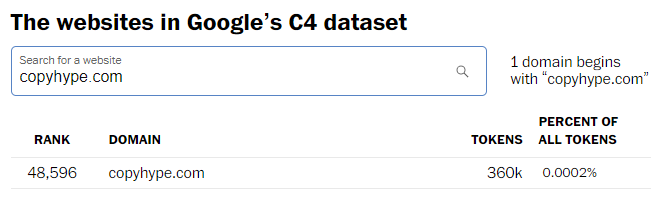
Inside the secret list of websites that make AI like ChatGPT sound smart — The Washington Post’s Kevin Schaul, Szu Yu Chen and Nitasha Tiku take a close and visual look at the sources of works used to train many high profile English-language large language models. Worth noting: “Also high on the list: b-ok.org No. 190, a notorious market for pirated e-books that has since been seized by the U.S. Justice Department. At least 27 other sites identified by the U.S. government as markets for piracy and counterfeits were present in the data set.” The article also includes a search function to see what individual websites were included in the dataset, so I had to check…

Search prompt for the websites in Google's C4 dataset with copyhype.com as input. Search results show 1 domain begins with "copyhype.com", with a rank of 48,596, 360k tokens, and 0.0002% of all tokens. Originally from https://www.washingtonpost.com/technology/interactive/2023/ai-chatbot-learning/?tid=ss_tw.

What the Online Piracy Data Tells Us About Copyright Policymaking — Researcher Michael D. Smith summarizes the peer-reviewed empirical literature on piracy in this article, which he says supports three broad conclusions: “digital piracy harms creators by reducing their ability to make money from their creative efforts”, “digital piracy harms society by reducing the economic incentives for investment in creative output,” and “legislative interventions implemented worldwide have been effective in reversing these harms.”

Update: 4 Copyright Claims Board Cases to Watch — PlagiarismToday’s Jonathan Bailey reviews four of the over 400 claims that have been filed at the newly created US copyright small claims tribunal, which is still under a year old. These cases present interesting or notable facts and parties.

At London Book Fair Tuesday: Copyright Under Attack — “Too many times, the best-intended publishing stalwarts—you may know some, yourself—have consoled themselves and others that no one in nearby industries (education, entertainment, communications) could possibly be willing to do anything that might undermine the essential value of copyright protection. What’s more, it’s easy to think that one market’s struggles with a rewritten piece of legislation or a foray into popular misconceptions about copyright will stay in that market.”

The US Supreme Court’s Warhol case; what is the fuss about? — Bill Patry on the anticipated decision: “In an era when partisan hyperbole passes for ordinary discussion, one must get used to headlines like ‘The Supreme Court may force us to rethink 500 years of art’. Given that the first American copyright law is from 1790 and did not even begin to take shape with respect to fair use until a judicial opinion in 1841, this seems a few centuries off even in hyperbole.”

By , February 09, 2018.

Focusing on Value — 102 Things Journal Publishers Do (2018 Update) — The internet has not rendered commercial journal publishers obsolete. Here’s a comprehensive list of things they do to add value to scientific, technical, and medical research.

The Faery Tale Adventure: A personal history — For someone who lived and breathed the video game Faery Tale Adventure as a kid, the even-more-wondrous-than-you-can-imagine story of its creation was a joy to read. It should be of interest to copyright fans too, given that the sprawling game was almost exclusively the work of a single individual—including programming, graphics, and music. It’s also fun to read about the creativity that went into coding around the Amiga’s technical limitations.

Can You Copyright a Pose? — Michael Risch takes a closer look at the Ninth Circuit’s recent decision in Folkens v Wyland Worldwide, concerning the protectability of a certain element of an image: the “pose” of two dolphins. Risch writes, “The idea that we ignore near identical poses with near identical subjects simply because the pose might occur in nature troubles me a bit.”

Cloudflare Terminates Service to Sci-Hub Domain Names — Perhaps a sign of progress, as the domain service provider, which had previously balked at disabling sites that have been found liable for infringement by courts, has terminated service to an infringing site after it received a court order.

What Does a Prop Master Do? A Conversation with Elisa Malona — The head of props for The Tonight Show With Jimmy Fallon discusses all the work that goes into creating those objects that actors hold, touch, or interact with.

By , April 12, 2013.

The Purpose of Copyright? Examining the Retracted Republican Study Committee Brief — From the Bolt, an online offshoot of the Berkeley Technology Law Journal, comes a look at Derek Khanna’s infamous copyright memo, and my response to it here last November.

Fair Use is Fair Game: MPAA Files Amicus Brief in NFL Intellectual Property Case — Earlier this week, the MPAA filed a brief in support of a filmmaker’s fair use of a Baltimore Ravens logo appearing on screen. That the MPAA would defend fair use in court surprised only those who have become convinced of their own caricature of the organization as being “copyright maximalists.”

MPAA and Fair Use: A Quick History — Ben Sheffner at the MPAA responds to “the suggestion in some of the commentary about our brief that the MPAA and its members somehow “oppose” fair use, or that our embrace of it in the Baltimore Ravens brief represents a  shift in our position. That’s simply false, a notion that doesn’t survive even a casual encounter with the facts. Our members rely on the fair use doctrine every day when producing their movies and television shows – especially those that involve parody and news and documentary programs. And it’s routine for our members to raise fair use – successfully – in court.”

WNET v. Aereo: Split Appellate Panel Rules That “Remote-Storage DVR” Decision Insulates Provider of Internet Streaming from Liability — Eleanor Lackman examines the recent Second Circuit decision involving internet TV rebroadcaster Aereo. Great analysis and timely, as a similar case with a different outcome (Aereokiller) is set to appear in front of the Ninth Circuit.

Mossoff on Copyright & Innovation in Scholarly Publishing — The Legal Theory Blog highlights Adam Mossoff’s latest, must-read article that details the investment and innovation that scholarly publishers provide to help disseminate academic works.

Jurassic Park is Frightening in the Dark — The best dinosaur movie ever is celebrating its 20th anniversary with a theatrical release in 3D. While the film incorporated stunning advances in computer generated imagery, it also featured equally groundbreaking “real-life” props by Stan Winston Studios. Here is a collection of videos showing a behind the scenes look at how some of these props were built.

Google’s Design Defect of Moral Hazard — “Just like the iconic exploding gas tank, it is clear that Google’s current product creates an unsafe environment for consumers.  From illegal drugs, to human trafficking to copyright infringement, Google is the leading source of criminals making their wares available to unsuspecting consumers. Not only does Google’s advertising of legitimate brands on illegal sites create the veneer of respectability, Google holds itself out to the public as a reliable source of information.”

 — Copyright infringement? Or just an incredibly inefficient way to print articles from the web?

By , September 05, 2012.

On September 5, 1787, New Jersey Delegate David Brearly submitted the final language of the Copyright Clause to the members of the US Constitutional Convention. Granting the new federal Congress the authority to issue copyrights had been proposed several weeks earlier by James Madison (and, separately, by Charles Pinckney).

The full language, which also gives Congress power to issue patents, reads, “The Congress shall have power… To promote the Progress of Science and useful Arts, by securing for limited Times to Authors and Inventors the exclusive Right to their respective Writings and Discoveries.” The US Constitution would not be finalized until September 17th, it would not be ratified for another year, and the first Copyright Act would not be signed into law until May 31, 1790. But it seems appropriate to mark this date as an important one in US copyright history.

The existence of copyright law in the United States is mainly the result of efforts by authors.

The Statute of Anne, Britain’s 1710 law establishing copyright in that country, did not apply in its American colonies. The colonies before independence did not have anything resembling a “publishing industry.” Attitudes toward printing in the 17th century were inherited from England; Legal professor Oren Bracha notes that, “In short, throughout the colonial period … the press was seen as an important but dangerous public resource to be encouraged and used by the government, but also to be restricted and regulated.” 1Oren Bracha, Commentary on John Usher’s Printing Privilege 1672, in Primary Sources on Copyright (1450-1900), eds L. Bently & M. Kretschmer (2008). Any book trade was small and unorganized, with only a handful of printers and presses in the colonies at the time. This reflected the less-industrially developed character of the colonies at this time.

Legal mechanisms were scarcely needed because printers faced little risk from reprinting. Printers faced little competition due to their scarcity and the lack of any ability to serve more than their local market. The existence of reprinting was further minimized by extra-legal mechanisms, described by Bracha as “private contractual agreements among booksellers not to print each other’s copies” and “an informal social norm within the trade against such behavior.” There were a few exclusive printing patents granted during this time, primarily for the exclusive right of printing compilations of a colony’s laws.

It was authors who primarily lobbied for general copyright laws in the colonies, and, eventually, the federal government. These authors include Joel Barlow, American politician and writer of Vision of Columbus and Hasty Pudding. Barlow played in important role in convincing the Continental Congress to pass its 1783 resolution encouraging the States to enact copyright legislation.

They also include Noah Webster, who would eventually write the dictionary that still bears his name today. Webster took it upon himself to lobby the individual state legislations, in person, to act on the Continental Congress’s resolution. (He would later play a role in the first major revision of the US Copyright Act in 1831). 2Oren Bracha, ‘Commentary on the U.S. Copyright Act 1831‘, in Primary Sources on Copyright (1450-1900), eds L. Bently & M. Kretschmer (2008).

Other authors who played a role include Jeremy Belknap, writer of the first modern history in America, the History of New Hampshire, and Thomas Paine, whose pamphlets proved indispensible to the American Revolution. 3William Patry, ‘The Colonies and Copyright’, in Copyright Law and Practice (2000).

But often overlooked is the part played by a lesser-known author — and a musician, to boot — in efforts to create American copyright law.

William Billings

The author is William Billings, the “father of American choral music.” Billings was born in Boston in 1746. He worked as a tanner but taught himself music, never receiving any formal training, and according to biographical reports, seemed to have been quite the character:

Billings was a mixture of ludicrous, eccentric, commonplace, smart, active, patriotic and religious elements, with a slight touch of musical and poetical talent. To this side of the tanner-composer’s moral nature his personal appearance and habit formed a harmonious sequel. He was somewhat deformed, blind of one eye, one leg shorter than the other, one arm somewhat withered; and he was given to the habit of continually taking snuff. He carried this precious article in his coat-pocket made of leather, and every few minutes would take a pinch, holding the snuff between the thumb and clinched hand. To this picture we must add his stentorian voice, made, no doubt, rough as a saw by the effects of the quantity of snuff that was continually rasping his throat. 4Frédéric Louis Ritter, Music in America, pg. 60 (Charles Scribner’s Sons 1884).

Critically panned 5Ritter, Id., says, “Nevertheless, Bill Billings remained an awkward harmonist and a worse contrapuntist … not to speak of hideous consecutive fifths and illogical progressions of octaves, motivi, without any inner aesthetic connection, chase each other, without rhyme and reason, from one end of the scale to the other; chords and harmonies tumble upon each other without order and euphony, playing carnival in the hearer’s ears.” but popular, Billing’s works seem to capture the quintessence of American spirit. Though “crude, unrefined, and even vulgar”, and “scarred with glaring imperfections”, they contained a “buoyancy of rhythm, originality, life and melodic fluency.” 6A Hundred Years of Music in America, ed. W.S.B. Mathews, pp 25-29 (Theodore Presser, 1900). His “lively and spirited” psalms were a welcome change from the old “slow isochronous” hymns, which aided in their wide acceptance. 7Musical Reporter, no. 1 vol. 7 (1841).

Not everyone welcomed Billings’ new style of music, however. Indeed, some accounts seem reminiscent of more modern day accounts of new trends in music:

These old bigots must have been paralyzed at the new style of psalm-singing which was invented and introduced by a Massachusetts tanner and singingmaster named Billings, and which was suggested, doubtless, by the English anthems. It spread through the choirs of colonial villages and towns like wild-fire, and was called “fuguing.” …

All public worshippers in the meetings one hundred years ago did not, however, regard fuguing as “something sweet everywhere,” nor did they agree with Billings and Byles as to its angelic and ecstatic properties. Some thought it ” heartless, tasteless, trivial, and irreverent jargon.” Others thought the tunes were written more for the absurd inflation of the singers than for the glory of God; and many fully sympathized with the man who hung two cats over Billings’s door to indicate his opinion of Billings’s caterwauling. An old inhabitant of Roxbury remembered that when fuguing tunes were introduced into his church “they produced a literally fuguing effect on the older people, who went out of the church as soon as the first verse was sung.” 8Alice Morse Earle, The Sabbath in Puritan New England, pp 218-221 (Charles Scribner’s Sons 1891).

Billings’ popularity grew as he turned to patriotism during the Revolutionary War. He penned the tune, “Chester“, which became known as the first unofficial National Anthem. The song was said to have been “frequently heard from every fife in the New England ranks” during the war. 9Musical Reporter, Id.

Let tyrants shake their iron rod,

And Slav’ry clank her galling chains,

We fear them not, we trust in God,

New England’s God forever reigns.

Billings’ Copyright Bill

William Billings hoped to have a successful career as a songwriter. In November 1770, Billings petitioned the Massachusetts House of Representatives, “praying that he may have the exclusive Privilege of selling a Book of Church-Musick compos’d by him self, for a certain Term of Years.” Over the next two years, Billings continued his petition until he was able to bring a bill in front of the legislature. Both the Massachusetts House of Representatives and the Council eventually passed the bill.

Bracha notes that this is “This was an important landmark in American copyright history.”

For the first time an author rather than a printer or a bookseller applied to receive exclusive privileges in his own work. Two and a half centuries after printing privileges were granted to authors in Venice, France, Germany and England, an American legislature was willing to bestow rights on an author as such. In Britain the Statute of Anne had formally conferred rights on authors since 1710 and during the eighteenth century authorship had become the dominant ideology of copyright law and discourse, but in America Billings’ petition and Bill constituted the first appearance of the author as a claimer of rights.

Unfortunately, Billings never got his bill. Massachusetts Governor Thomas Hutchinson vetoed it and several other bills without comment. Tensions between the Loyalist Governor and the more radical legislature were already growing, so it is likely that Billings’ bill was simply a victim of politics.

Also unfortunate: Billings never escaped poverty during his life. He was buried in an unmarked grave even though his music remained popular, reprinted freely without compensation throughout the States.

Two hundred twenty five years later

US copyright law has come a long way since Billings’ time. In the 225 years since the Copyright Clause was drafted, the law has expanded to include artistic and creative works beyond books and maps. The entry of the US into the international copyright realm in the nineteenth century allowed American creators to compete on a level playing field with foreign authors. 10“More authors came to public attention with the growth of interest in the novel, many of them Americans after the International Copyright Law of 1891 for the first time made their works no more expensive to issue than those by foreigners. After 1894 more novels, though not always more popular novels, came from Americans than from Europeans.” The popular book: a history of America’s literary taste, James David Hart, pg. 185 (Univ. of Cali. Press 1950). Today, US films, television shows, music, and books are enjoyed across the globe.

As with any legal doctrine, copyright will continue to face challenges in the face of societal and technological advancements. But securing the exclusive rights of authors remains a valuable and viable mechanism for promoting the progress of the arts and sciences.

References

References
1 Oren Bracha, Commentary on John Usher’s Printing Privilege 1672, in Primary Sources on Copyright (1450-1900), eds L. Bently & M. Kretschmer (2008).
2 Oren Bracha, ‘Commentary on the U.S. Copyright Act 1831‘, in Primary Sources on Copyright (1450-1900), eds L. Bently & M. Kretschmer (2008).
3 William Patry, ‘The Colonies and Copyright’, in Copyright Law and Practice (2000).
4 Frédéric Louis Ritter, Music in America, pg. 60 (Charles Scribner’s Sons 1884).
5 Ritter, Id., says, “Nevertheless, Bill Billings remained an awkward harmonist and a worse contrapuntist … not to speak of hideous consecutive fifths and illogical progressions of octaves, motivi, without any inner aesthetic connection, chase each other, without rhyme and reason, from one end of the scale to the other; chords and harmonies tumble upon each other without order and euphony, playing carnival in the hearer’s ears.”
6 A Hundred Years of Music in America, ed. W.S.B. Mathews, pp 25-29 (Theodore Presser, 1900).
7 Musical Reporter, no. 1 vol. 7 (1841).
8 Alice Morse Earle, The Sabbath in Puritan New England, pp 218-221 (Charles Scribner’s Sons 1891).
9 Musical Reporter, Id.
10 “More authors came to public attention with the growth of interest in the novel, many of them Americans after the International Copyright Law of 1891 for the first time made their works no more expensive to issue than those by foreigners. After 1894 more novels, though not always more popular novels, came from Americans than from Europeans.” The popular book: a history of America’s literary taste, James David Hart, pg. 185 (Univ. of Cali. Press 1950).
By , May 25, 2012.

3 Things I Learned When My Site’s Traffic Increased 25,000% in One Day — Self-published comics artist Lars Martinson reports on the results of blowing up on Reddit. 48,000 extra visitors led to 23 e-book sales.

Elliott v Google complaint — Is “Google” at risk of becoming generic? An individual had registered several domain names that included the word “google” in them. Google won a domain name dispute against the individual, so he has now filed a complaint in federal court seeking to have Google’s trademark cancelled, arguing that the term is generic. The claim is not entirely frivolous — here’s a 2006 article pondering the same issue. Also see the Wikipedia entry on google (verb).

It’s not the song, Stupid, it’s the right — Filmmaker David Newhoff on the reaction to the Supreme Court declining to hear Joel Tenenbaum’s latest appeal: “What the children of the digital age need to learn as they are now entering the world of grown-ups is that it’s not the song or the movie or the book they’re stealing, but the rights of the creator.  When a few million college kids copy and share a digital file of a creative work, they believe this is not stealing because 1) they’re focused on the file itself; and 2) they’re focused on what they want.  And it is always the folly of youth to confuse desire with rights while failing to recognize, to paraphrase Kant, that their rights end when they infringe on the rights of another.”

Amazon bans Kindle Store spam (finally) — Amazon appears to have a new policy of not accepting so-called “private-label rights content” and undifferentiated public domain content. Good move.

PA criticises ‘tawdry theft’ of copyright — Publishers Association chief executive Richard Mollet had strong words for organizations such as the Open Rights Group, saying they have “the temerity to appropriate the language of freedom of expression as a cloak for their tawdry theft” in a “a grotesque attempt to draw moral equivalence between stealing someone’s work and the struggle for political representation.”

It’s Broken: Google Is Now Fielding 300,000 Takedown Requests a Week… — Google released data on DMCA takedown notices it receives for its search engine this week. Paul Resnikoff at Digital Music News asks, “At what point do we admit that the DMCA just isn’t working? That diligent DMCA takedowns are great news for companies like Google, and a horrible cat-and-mouse reality for content owners?”

Op-ed: New digital music licenses good for fans, entrepreneurs — Cary Sherman, David Israelite, and Lee Knife announce new, easy to use “mechanical licenses” for five digital business models. Great news for artists, entrepreneurs, and fans.

New Study Confirms Benefits of Intellectual Property to State Economies — Creative America reports on a new study from the US Chamber of Commerce that breaks down the positive impact of IP state by state.

“Your Horses Seem to be Winning”: The European Commission’s Antitrust Case Against Google Matters to Artists and Songwriters — Chris Castle notes: “For artists, these cases are important because the central theme boils down to this:  If Google just offered search and sold its Adwords and Adsense products, the fact that the company had achieved at least a dominant position if not a monopoly over search on the Internet would not necessarily be bad.  It’s not illegal to be a monopolist. The harm comes with the almost inevitable hubris accompanying a monopoly position and the abuse of that monopoly position in one business line (or ‘vertical’) to extend the monopoly into other verticals.  This is particularly true when the monopoly profits from one vertical are used by the monopolist to subsidize another firm wholly owned by the monopolist that extends the monopoly to another vertical.”

GUEST POST: Enforcing Copyright is a Win for Both U.S. Media and the World’s Creative Upstarts — Prof. Mark F. Schultz talks about the importance of trade agreements like the TPP. They benefit not only US creators, but also its trading partners. Schultz points out especially the “Korean Wave” and Nollywood.

By , March 16, 2012.

A Question of Values — Barry Sookman compares traditional values enshrined in Canadian copyright law with the values pushed by Michael Geist, one of the leading opponents of copyright in the country. Sookman notes, “Geist’s ideological antagonism towards copyright is an extreme departure from traditional values about it… Mainstream thinking about copyright now recognizes that the law of copyright is concerned with finding an appropriate balance between promoting the public interest in the encouragement and dissemination of the works of the arts and intellect and obtaining a just reward for the creator or, more accurately, to prevent someone other than the creator from appropriating whatever benefits may be generated. Accordingly, owner rights and exceptions (sometimes called “user rights”) are given fair and balanced reading that befits remedial legislation.”

Internet con men ravage publishing — Harper’s Magazine publisher John R. MacArthur pens this must-read article:

as much as I object to free content, I am even more offended by the online sensibility and its anti-democratic, anti-emotional,  even anti-intellectual effect. Devotees of the Internet like to say that the Web is a bottom-up phenomenon that wondrously bypasses the traditional gatekeepers in publishing and politics who allegedly snuff out true debate.  But much of what I see is unedited, incoherent babble indicative of a herd mentality, not a true desire for self-government or fairness.

Can it be seriously argued that popular government in America – with our two-party oligarchy, 90 percent-plus re-election rates, and money-laundered politics – has progressed in the age of the Internet?  Have WikiLeak’s disclosures on Afghanistan moved us any closer to withdrawal from that country?  Would American be any less democratic without e-mail?

The Ruthless Overlords Of Silicon Valley — Another must read article; the Daily Beast’s Rob Cox notes how for all its “moralistic hubris”,  Silicon Valley more resembles the Robber Barons of the Gilded Age. He calls attention to some of the practices making this an apt comparison: exploitative manufacturing, indifference to copyright, disregard for privacy, and crony capitalism.

Hollywood’s Role In Innovation… And SOPA — Vivek Wadhwa looks at the sometimes strained but symbiotic relationship between Hollywood and Silicon Valley. Says Wadhwa, “Silicon Valley has yet to inspire great art, and Hollywood has yet to produce great technology. The two communities together, however, have powered the most important cultural movements of the past century.”

Rep. Adam Schiff Discusses the Importance of SOPA — Burbank N Beyond’s John Savageau talks with the Congressman from California on what comes after SOPA. Good discussion on what Schiff sees as “the three forms of opposition to the intellectual property legislation.”

Breaking the Internet, one absurd claim at a time — Dominic Young challenges the use of the phrase that has been “heard with increasing frequency. It is used as a dire threat, a prediction of doom, the ultimate and unimaginably awful unintended consequence of a terrible and naïve mistake.”

What kind of Internet freedom do we want?— Overreach? Helga Trüpel is MEP for the Greens in Europe and a staunch opponent of ACTA and legislation like SOPA, but even she has concerns over the rhetoric and goals of its opponents. She notes, “some elements within the Internet community seem to have a very one-sided concept of freedom. Theirs is the freedom of users who do not want to pay, who are unwilling to pay Web-based companies and Internet service providers a (fair) price for content they need. The campaign to dilute copyright law is not merely a politically motivated appeal for freedom:  it is also being driven by the strong commercial interests of major new Internet companies like Google and Facebook.”

Giving Credit (and Hat Tips) Where Credit is Due — The Copyright Alliance’s Sandra Aistars reports on several new initiatives for ensuring proper attribution of content online. Definitely worth checking out for creators.

By , July 18, 2011.

“The law needs to keep pace with technology. There’s no point in talking about broader copyright policy if exclusive rights can’t be enforced. … I always start with the enforcement issues online because if there isn’t effective enforcement possibility, then there is no meaningful exclusive right and then copyright doesn’t work.”

That was new US Register of Copyrights Maria Pallante, speaking with Ars Technica last week. Artists and creators recognize her words as common sense. But there are those among the critics of copyright law who would argue every point she mentions.

Why should we worry about enforcement, they might ask. There are groups who express concern about the rights of creators but oppose any attempts at enforcement, whether through new legislation that attempts to keep pace with technology, voluntary agreements that attempt to make existing law work more effectively, or even individuals who attempt to assert their core rights granted by copyright law.

There are those who go even further and question the need for a broader copyright policy at all. Surely the internet and digital technology has rendered copyright obsolete.

I agree, however, with Pallante. It’s important, during these times when the ways in which art, media, and content are produced and accessed are rapidly changing, to ensure that the concept of copyright remains vital. That’s not to suggest that the focus should only be on enforcement. There are numerous factors that play a role — from pricing, to building sustainable business models, reducing the complexity of licensing, and many others.

But at the core of the “copyright question,” if you will, is a choice: a choice between what end results a society wants to encourage.

Copyright as a Choice

Nobel Prize winning economist Douglass North discusses this choice in his Prize Lecture:

The organizations that come into existence will reflect the opportunities provided by the institutional matrix. That is, if the institutional framework rewards piracy then piratical organizations will come into existence; and if the institutional framework rewards productive activities then organizations – firms – will come into existence to engage in productive activities. 1Douglass C. North – Prize Lecture“. Nobelprize.org. December 9, 1993.

In their seminal work on the economics of copyright law, William Landes and Richard Posner talk plainly about how these two different incentive choices would play out:

Without copyright protection, authors, publishers, and copiers would have inefficient incentives with regard to the timing of various decisions. Publishers, to lengthen their head start, would have a disincentive to engage in prepublication advertising and even to announce publication dates in advance, and copiers would have an incentive to install excessively speedy production lines. There would be increased incentives to create faddish, ephemeral, and otherwise transitory works because the gains from being first in the market for such works would be likely to exceed the losses from absence of copyright protection. There would be a shift toward the production of works that are difficult to copy; authors would be more likely to circulate their works privately rather than widely, to lessen the risk of copying; and contractual restrictions on copying would multiply. 2Landes and Posner, An Economic Analysis of Copyright Law, 18 J.Leg.Stud. 325 (1989).

It really is as simple as that. Yet one will hear a whole host of ills supposedly caused by copyright. Obviously, copyright is not perfect; nothing is. But it’s wrong to think that weakening copyright protection will, as if by magic, cure this host of ills.

The Choice for Emerging Economies

Earlier this year, the Social Science Research Council released a report on Media Piracy in Emerging Economies (MPEE). 3Some have hailed the report as effectively establishing that enforcement of IPR’s in emerging economies doesn’t work, but that is an overly superficial reading of the report. The report describes, using media reports, informal interviews, and focus groups, the accessibility and consumption of pirated works in several countries. What conclusions it can derive from these observations point toward the idea that these issues are multifaceted.

Without any context, a reader could readily assume that the choice of piracy over copyright would be far more beneficial. In the short run, they may be correct in a strictly economic sense — though in a strictly economic sense, natural disasters are beneficial in the short run since they lead to lots of new building projects afterward.

But in the long term? Choosing to incentivize piracy over copyright is detrimental, not only to creators, but the general public as well.

When it comes to emerging economies, it’s especially important to make note of this. Encouraging the development of copyright in these economies often comes from foreign countries with established cultural and media production. It’s often assumed that this encouragement is a one-way street: foreign entities are the only ones to benefit from stronger copyright regimes in emerging economies.

Not so. In fact, piracy usually has the effect of stalling the development of local artistic and creative firms.

The US was once an emerging economy, and its history provides an example of this effect. George Haven Putnam describes one common pattern of cultural development in emerging economies like the US, and ancient Rome before that:

The literary life of the American Republic has, of course, during a large portion of its independent existence, as in the old colonial days, drawn its inspiration from the literature of its parent state, Great Britain. There has been, in this instance, as in the relation between Rome and Greece, on the part of the younger community, first, an entire acceptance of and dependence upon the literary productions of the older state; later, a very general appropriation and adaptation of such productions; still later (and in part pari passu with such appropriation), a large use of the older literature as the model and standard for the literary compositions of the writers of the younger people; while, finally, there has come in the latter half of the nineteenth century for America, as in the second half of the first century for Rome, the development, in the face of these special difficulties, of a truly national literature. For America, as for Rome, this development was in certain ways furthered by the knowledge and the influence of the great literary works of an older civilization, while for America, as for Rome, the overshadowing literary prestige of these older works, and the commercial difficulties in the way of securing public attention and a remunerative sale for books by native authors in competition with the easily “appropriated” volumes of older writers of recognized authority, may possibly have fully offset the advantage of the inspiration. 4Authors and their public in ancient times: a sketch of literary conditions and of the relations with the public of literary producers, from the earliest times to the invention of printing, George Haven Putnam, pg. 68 (1893).

James David Hart, in his own history of American publishing, describes the same effect of piracy on American authors:

Samuel Goodrich, the Boston publisher, estimated in 1820 that three-quarters of the books Americans bought were of English origin. In the early years of the century, bookdealers opposed a tariff on printed matter because America could not furnish enough books for the expanded reading public. As printing became a big business, they fought against the importation of English books but still clamored for the works of English writers because, without copyright and royalties, they could be sold at better profit. Either way, English authors were favored. 5The popular book: a history of America’s literary taste, James David Hart, pp. 67-68 (Univ. of Cali. Press 1950).

Basically, foreign books are better, both in quality and desirability, and because of piracy, they are as cheap or cheaper to purchase than domestic books.

Hart goes on to show how US publishers finally gained the upper hand:

More authors came to public attention with the growth of interest in the novel, many of them Americans after the International Copyright Law of 1891 for the first time made their works no more expensive to issue than those by foreigners. After 1894 more novels, though not always more popular novels, came from Americans than from Europeans. 6Hart pg. 185.

The US experience from 100-200 years ago is not an isolated one. The same holds true if we’re talking about a country on the other side of the world in modern times. Scholar Jiarui Liu recently examined the effects of piracy on domestic musicians in China:

[T]he findings here suggest that a high level of piracy could have profound effects on the profitability, applied business models, and creative processes of domestic musicians. In many cases, piracy of foreign works could be more devastating to domestic companies than to foreign companies. Because the competition from low-priced pirated works both online and offline undercuts stable income from royalties, Chinese musicians have witnessed the entire music industry becoming increasingly dependent on alternative revenue streams such as advertising, merchandizing, and live performance. The pressures of paid appearances and extended tours have started to squeeze the time that artists need to spend on music production. The alternative revenue streams also force many music companies to abandon traditional album contracts and operate in a way more like talent agencies that control all aspects of an artist’s career. Music companies are inclined to sign talents at a very young age with a long-term agency deal in order to exploit the full value of artists in the advertising market. In addition, the need to attract sponsorship opportunities puts more emphasis on non-musical qualities, such as a fresh appearance and healthy public image, which to some extent marginalizes “pure” musicians who have less value in those alternative markets.

Most importantly, as copyright piracy obstructs the communication of consumer preferences to musicians, an increasing number of musical works are created to accommodate the tastes of entrepreneurs (e.g., sponsors and advertisers) rather than those of average consumers, and this has caused a fundamental shift in the creative process of the Chinese music industry. Although entrepreneurs should arguably be willing to take whatever is popular among music fans as a draw to their own products, the expectations of entrepreneurs and consumers do not always meet in a dynamic market setting. For this reason, the interests of less commercial artists and new artists are more likely to be compromised. 7Jiarui Liu, The Tough Reality of Copyright Piracy: A Case Study of the Music Industry in China, 27 Cardozo Arts & Entertainment 621, 623-24 (2010).

It’s not only local creators who are harmed by the piracy of foreign works; open-source software suffers from the piracy of commercial software.

The MPEE report notes that in South Africa, where local music production revolves around a small handful of professional software packages:

Because the production community is relatively small and interconnected, shared production techniques and training introduce strong network effects in the choice of products. Producers tend to use software that has been ‘vetted’ in their communities, and these choices tend to self-reinforce as producers and musicians exchange knowledge. In our interviews, open-source alternatives, such as Audacity, did not even register. 8Pg. 122.

In emerging economies, the problems piracy causes for open-source alternatives are magnified. Louis Suarez-Potts, the community manager at Sun Microsystems Inc. for the OpenOffice.org open-source project, was asked about these problems:

“Piracy hurts open source because open source asks people to help give back and contribute code, but they say, ‘Why should I help? I have Microsoft Office for free,'” Suarez-Potts said.

Around the world, he said, many national governments are realizing that this hurts them, too, because their citizens are then consumers of stolen technology rather than active participants in open-source communities that can help people gain technology skills that benefit workforces and nations.

By cracking down on software piracy, nations around the globe are starting to see that they can help themselves dramatically by encouraging innovation and creativity — as well as job growth and richer economies — through open-source development, he said. 9Todd Weiss, Software Piracy Hurts the Open-source Community, Too, ComputerWorld, July 23, 2008.

As these examples show, the effects of piracy are felt by more than just those whose works are pirated. When it comes to debates about copyright and piracy, it’s important to keep in mind the core of the “copyright question” — the choice between what activities we want to encourage.

With that in mind, Maria Pallante is entirely correct. There are many questions concerning broader copyright policy, but without effective enforcement, copyright simply doesn’t work.
References

References
1 Douglass C. North – Prize Lecture“. Nobelprize.org. December 9, 1993.
2 Landes and Posner, An Economic Analysis of Copyright Law, 18 J.Leg.Stud. 325 (1989).
3 Some have hailed the report as effectively establishing that enforcement of IPR’s in emerging economies doesn’t work, but that is an overly superficial reading of the report.
4 Authors and their public in ancient times: a sketch of literary conditions and of the relations with the public of literary producers, from the earliest times to the invention of printing, George Haven Putnam, pg. 68 (1893).
5 The popular book: a history of America’s literary taste, James David Hart, pp. 67-68 (Univ. of Cali. Press 1950).
6 Hart pg. 185.
7 Jiarui Liu, The Tough Reality of Copyright Piracy: A Case Study of the Music Industry in China, 27 Cardozo Arts & Entertainment 621, 623-24 (2010).
8 Pg. 122.
9 Todd Weiss, Software Piracy Hurts the Open-source Community, Too, ComputerWorld, July 23, 2008.