By , January 17, 2011.

Earlier this month, Techdirt posted a rebuttal to my article on last November’s domain name seizures. If you recall, the warrant and affidavit for the seizure of five domain names as part of the US government’s Operation in Our Sites 2.0 made its way online. Techdirt initially pointed out what it saw as errors in the warrant and affidavit in a series of posts. I responded by noting that whatever errors are in the warrant and affidavit are largely irrelevant. Seizure warrants must only show probable cause that the property in question was used to facilitate the commission of a crime — not prove it.

Techdirt followed up:

[T]he biggest flaw in Hart’s argument is that he focuses solely on the issue of probable cause for warrants, and pays no attention to the key issue that we brought up: how seizing full domain names without an adversarial hearing, based on a series of legal and technical errors is almost certainly prior restraint, and a violation of the First Amendment. As was made quite clear in Fort Wayne Books, Inc. v. Indiana, when a seizure involves issues of protected speech, a higher bar is required … In seizure cases where expressive speech is part of what is removed from circulation, the bar is higher than your average probable cause.

Fair enough. Let’s pay some attention to whether these seizures violate the First Amendment.

We’re talking here about “prior restraints”. The doctrine can be summed up as “speech may not be restrained until a final judicial determination that it’s unprotected by the First Amendment”, 1Mark Lemley & Eugene Volokh, Freedom of Speech and Injunctions in Intellectual Property Cases, 48 Duke Law Journal 147 (1998). though the simplicity of that statement belies the complexities and nuances of the doctrine that courts have wrestled with as they’ve applied it.

In the US, prior restraints on speech are considered worse than punishments given after speech is made. Courts are especially suspicious of prior restraints; but at the same time, they recognize that simply labeling something a “prior restraint” does little. As the Supreme Court explained in Kingsley Books v. Brown:

The phrase “prior restraint” is not a self-wielding sword. Nor can it serve as a talismanic test. The duty of closer analysis and critical judgment in applying the thought behind the phrase has thus been authoritatively put by one who brings weighty learning to his support of constitutionally protected liberties: “What is needed,” writes Professor Paul A. Freund, “is a pragmatic assessment of its operation in the particular circumstances. The generalization that prior restraint is particularly obnoxious in civil liberties cases must yield to more particularistic analysis.” 2354 US 436, 441-42 (1957).

In this case, we’re talking here about whether the seizure — the initial taking of the property into governmental custody to initiate forfeiture proceedings — is an impermissible prior restraint. Whether the ultimate forfeiture of these domain names violates the First Amendment is a completely separate question; though, for purposes of this article, I’m assuming that they would not. Forfeiture after a final judicial determination generally doesn’t raise First Amendment issues, even if it results in some blocking of protected speech. 3See, eg, Arcara v. Cloud Books, 478 US 697 (“Book-selling in an establishment used for prostitution does not confer First Amendment coverage to defeat a valid statute aimed at penalizing and terminating illegal uses of premises”); 511 Detroit Street v. Kelley, 807 F.2d 1293 (6th Circ. 1986) (“We refuse to hold that a statute threatening fines that could impair the operation of a business is an impermissible prior restraint on expression, even where that business also involves dissemination of protected materials. The fact that a person does some business disseminating protected materials cannot immunize that person from large fines that may be imposed for violation of criminal law”); A&M Records v. Napster, 114 F.Supp.2d 896 (ND Ca 2000) (“In the event that Napster, Inc. cannot separate the infringing and non-infringing aspects of its service, its First Amendment argument still fails. Courts will not sustain a First Amendment challenge where the defendant entraps itself in an ‘all-or-nothing predicament.'”); US v. Pryba, 674 F.Supp. 1504 (ED Va 1987) (“The First Amendment cannot be a shield for criminal activity … The forfeiture remedy, properly construed and applied, does not impermissibly restrain further dissemination of speech”).

The argument that these domain name seizures violate the First Amendment comes down to timing: does the First Amendment require a hearing before the domain name is seized, or are the procedures available after a seizure occurs — the Rule 41(g) motion, the actual forfeiture proceedings, etc — adequate? 4Techdirt, then, is not quite correct in asserting that the domain name seizures have occurred with no adversarial hearing. As I pointed out earlier, the forfeiture complaint for the first round of domain name seizures was filed in court last month, providing for a hearing.

The answer to that question is actually not an easy one to answer. As far as I know, no court has heard a First Amendment challenge to the seizure of a domain name as property used in the facilitation of a crime in order to be forfeited. 5In CDT v. Pappert, 337 F.Supp.2d 606, a District Court struck down a state law requiring ISP’s to block access to web sites providing child pornography because it was overbroad for First Amendment purposes. But while the process used to block access to the sites was sometimes similar to the procedure used by ICE to seize these domain names, the similarities end there: (1) the state law involved obscenity rather than copyright infringement,  (2) ISP’s frequently blocked entire IP addresses rather than single domains, resulting in the blocking of thousands of unrelated and innocent web sites since multiple web sites can share the same IP address, and (3) the law provided no meaningful notice or hearing to owners of sites that had been blocked. CDT is simply not applicable to these seizures.

As I see it, we’re actually dealing with three separate questions here.

  1. Are the domain names that have been seized considered “expressive content” such that a higher bar than seizure of ordinary property is required?
  2. Are the seizures predicated on presumptively protected speech — the allegedly infringing works disseminated on the sites — so that, in effect, they are akin to seizing expressive content and thus require the same higher bar?
  3. Is there a high enough burden caused by the seizures on the other expressive content on these web sites — message boards, blog posts, etc — making these seizures an impermissible prior restraint?

I’ll take a look at each of these questions in turn.

The Expressive Content of Domain Names

As Techdirt correctly points out, the seizure of expressive works differs from the seizure of other types of property. From Constitution of the United States, Analysis and Interpretation:

Where the warrant process is used to authorize seizure of books and other items entitled either to First Amendment protection or to First Amendment consideration, the Court has required government to observe more exacting standards than in other cases. Seizure of materials arguably protected by the First Amendment is a form of prior restraint that requires strict observance of the Fourth Amendment. At a minimum, a warrant is required, and additional safeguards may be required for large-scale seizures … Confusion remains, however, about the necessity for and the character of prior adversary hearings on the issue of obscenity.

The Supreme Court has struck down several large-scale seizures of allegedly obscene materials, which are presumptively protected by the First Amendment — Marcus v. Search Warrant, 367 US 717 (1961); Quantity of Copies of Books v. Kansas, 378 US 205 (1964); Fort Wayne Books v. Indiana, 489 US 46 (1989). Of these, though, only Quantity of Copies of Books explicitly held that a hearing was required before the seizure. 6Some courts and commentators have stated that Fort Wayne does as well. However, I would argue, as at least one other court has, that Fort Wayne does not, in fact, state such a rule. The rule the Court did state is far more elusive: “while the general rule under the Fourth Amendment is that any and all contraband, instrumentalities, and evidence of crimes may be seized on probable cause (and even without a warrant in various circumstances), it is otherwise when materials presumptively protected by the First Amendment are involved.” A Missouri District Court, however, explains that rather than a lack of pre-seizure hearing, theFort Wayne seizure was improper because “it was premised upon the fact that ‘the petition for seizure and the hearing thereon were aimed at establishing no more than probable cause to believe that a RICO violation had occurred, and the order for seizure recited no more than probable cause in that respect.’ Since there had been no preseizure hearing to establish probable cause on the issue of obscenity, the Court reasoned that probable cause to believe a RICO violation had occurred was inadequate to remove allegedly obscene books or films from circulation.” BAP v. McCulloch, 994 F.Supp. 1131, ED Mo. 1998.

The Court has also upheld as constitutional the seizure of a limited number of copies of materials to preserve as evidence — Heller v. New York, 413 US 483 (1973); New York v. PJ Video, 475 US 868 (1986). These seizures didn’t require a prior hearing, only a prompt adversary hearing. 7Another case I’ve seen mentioned is Bantam Books v. Sullivan, 372 US 58 (1963). I don’t believe the case is applicable here; what’s more, it says little about the issue of the timing of hearings for prior restraint, saying only that prior restraints are tolerated when the judicial determination is “almost immediate.”

So how do we fit the domain name seizures within these cases?

We don’t.

All of the above cases involve the seizure of an expressive work because of the content. Whether the seizure is for the purpose of evidence or forfeiture, the fact remains that what was seized was seized because of the message it conveyed — most often, that message being allegedly obscene.

But with the domain names at issue, the seizures were not based on the content of the domain name itself. The web sites could be called “torrent-finder.com”, “xyyzzx.com” or even “piracy-harms-creators.com” — the name itself is irrelevant. Instead, these seizures were made because the domain  names are allegedly property 8As to the question of whether or not domain names can be considered property used to facilitate a crime for purposes of 18 USC § 2323, the answer is most likely yes. The 9th Circuit has used a three-part test to determine if something is property: (1) “There must be must be an interest capable of precise definition”, (2) “it must be capable of exclusive possession or control”, (3) “the putative owner must have established a legitimate claim to exclusivity”. (Kremen v. Cohen, 337 F.3d 1024). The court concluded that “domain names satisfy each criterion.” In addition, courts have ordered the forfeiture of domain names as part of criminal copyright infringement sentences — see, eg, here and here. Under 18 USC § 2323, the definitions for property subject to criminal forfeiture and civil forfeiture are the same. used to facilitate the commission of a crime (copyright infringement). 9As to the question of whether linking to infringing material can be considered facilitating the commission of copyright infringement, the answer again is likely yes. See Eugene Volokh, Crime-Facilitating Speech, 57 Stanford Law Review 1095 (2005), citing “Arista Records, Inc. v. MP3Board, Inc., 2002 WL 1997918, at *4 (S.D.N.Y. Aug. 29, 2002) (holding that the publisher of a link to an infringing site may be contributorily liable for the infringement that the link facilitates); Intellectual Reserve, Inc. v. Utah Lighthouse Ministry, Inc., 75 F. Supp. 2d 1290, 1293-96 (D. Utah 1999) (enjoining defendants from ‘post[ing] on defendants’ website, addresses to websites that defendants know, or have reason to know, contain the material alleged to infringe plaintiff’s copyright’); 17 U.S.C. § 512(d) (2000) (providing a safe harbor from damages liability to people who link or refer to infringing material, but only if they didn’t know it was infringing); see also Universal City Studios, Inc. v. Corley, 273 F.3d 429, 455-58 (2d Cir. 2001) (enjoining publication of links to a page containing material that violated the Digital Millennium Copyright Act)”.

Domain names themselves can contain expressive content, though admittedly not much. Whether or not the First Amendment is implicated in any sort of regulation that targets domain names is all about context: domain names are not automatically entitled to or excluded from First Amendment protections. “The appropriate inquiry is one that fully addresses particular circumstances presented with respect to each domain name.” 10Bosley Medical Institute v. Kremer, 403 F.3d 672 (9th Circ. 2005) quoting Name.Space v. Network Solutions, 202 F.3d 573 (2nd Circ. 2000).

Perhaps the area where the First Amendment comes into play with domain names most often involves so-called “gripe sites.” The Anticybersquatting Consumer Protection Act (ACPA) allows for the forfeiture of domain names similar to a trademark owner’s mark when they were registered in bad faith — ie, for the sole purpose of selling the domain name to the trademark owner. But here, just as with obscene books, it’s the content of the domain name itself at issue. ACPA gives way to the First Amendment when the domain name is used to express an opinion rather than as a trademark.

The cases above just don’t apply here. The domain names seized are not like books — ICE didn’t target them because it disagreed with what the site owner called the site. Even if a court recognizes a specific domain name as containing an expressive element, it is unlikely to prohibit its seizure under these circumstances. 11For a similar First Amendment analysis, check out Aaron Burstein, Stopping Internet-Based Tobacco Sales, 16 Health Matrix 279 (2006) which concludes that domain name seizure is a permissible commercial speech regulation.

Seizure as Pretext

Our analysis doesn’t stop here. It could be argued that the seizure of these domain names is predicated on their role in copyright infringement. If the seizures were, for example, predicated on allegedly being obscene or libelous, they might be impermissible prior restraints. That is, until there is a final judicial determination that the content of the sites is obscene or libelous, the content is assumed to be protected speech, so any attempt to block it before such a determination is not allowed by the First Amendment.

This argument can be quickly dismissed. Copyright infringement is simply not treated the same as obscenity or libel for First Amendment purposes. One example of this is that preliminary injunctions are routinely granted in copyright infringement cases while they are routinely denied in libel or obscenity cases due to the risk of prior restraint. While many have argued that copyright law should be subjected to heightened First Amendment scrutiny, the fact remains that courts have yet to accept this argument. 12See Eldred v. Ashcroft, 537 US 186 (2003): “The First Amendment securely protects the freedom to make— or decline to make—one’s own speech; it bears less heavily when speakers assert the right to make other people’s speeches. To the extent such assertions raise First Amendment concerns, copyright’s built-in free speech safeguards are generally adequate to address them.” “Or, we add, to copy, or enable the copying of, other people’s music,” In re Aimster Copyright Litigation, 334 F.3d 643 (7th Cir. 2003).

But even among those who question the traditional treatment of copyright and the First Amendment, a distinction is made between creative and consumptive infringement. Mark Lemley and Eugene Volokh, who argue that preliminary injunctions in copyright cases are unconstitutional, don’t believe their argument reaches to “piracy and other ‘easy’ cases.” As they explain:

The danger of preliminary injunctions is that they may temporarily suppress speech that ultimately proves to be protected. If a judge can, at the time of the preliminary injunction hearing, make a reliable finding that the speech is constitutionally unprotected, rather than just that it might be unprotected, then there should be no problem with issuing the preliminary injunction.

This could happen whenever the defendant has made identical or nearly identical copies of the plaintiff’s works, and there is no claim of fair use, but only some other copyright defense (such as that defendant has a supposedly valid license, or that plaintiff’s copyright wasn’t properly renewed, or something along those lines). Most cases alleging outright piracy, as well as most claims that the defendant has exceeded the boundaries of its license, would fall within this category.

In this situation, the defendant’s conduct is not constitutionally protected speech, even if the defendant ultimately proves that it’s not a copyright infringement … courts can, pursuant to the Copyright Act’s authorization, preliminarily enjoin speech that clearly falls within the “copyright exception” without violating the First Amendment. So long as there’s a reliable determination on the merits that the speech does fall within the exception–rather than just a finding that the speech might fall within the exception–courts may act even based on only a tentative determination of other, constitutionally irrelevant, factors related to the copyright claim. This may inadvertently lead to temporary suppression of speech that ultimately proves to be noninfringing, but it won’t lead to temporary suppression of speech that is constitutionally protected. (Emphasis added) 13Freedom of Speech and Injunctions in Intellectual Property Cases, 48 Duke Law Journal 147 (1998).

In other words, what Lemley and Volokh are saying, and what courts have implied over the years, is that the type of wholesale copying of a work present on the sites whose domain names were seized — as opposed to copying that falls within the bounds of fair use or is somehow transformative in nature — is not free speech within the First Amendment. It may be authorized by the copyright owner, but it is not protected by the Constitution.

We can think of seizures as cousins of preliminary injunctions — both deprive the alleged infringer of something before a full determination on the  merits. If preliminary injunctions in copyright cases — especially ones involving piracy or consumptive infringement — aren’t prior restraints, than neither are seizures.

Incidental Burdens

The final argument is that seizing these domain names impacts the expressive content on web sites unrelated to infringing works — forum and blog posts, articles, public domain works being shared, etc. There’s no question that seizing a domain name has some impact on whatever content exists on a web site. The question is whether this impact violates the First Amendment.

The challenge here is that one could argue that just about every law or regulation impacts free speech. Being thrown in prison limits your ability to speak to the public; a fine reduces the amount of money you have to spend on disseminating your message. 14See Arcara v. Cloud Books, 478 US 697, 706 (1986).

We need some way to sort out when a law that isn’t aimed at speech but has an incidental impact on speech runs afoul of the First Amendment and when it doesn’t. The Supreme Court has provided one way to sort this out: when the conduct that a generally applicable law is aimed at contains an expressive element, then the application of that law in that case must take the First Amendment into consideration, otherwise, the First Amendment doesn’t apply.

In US v. O’Brien, the defendant was charged with destroying his Selective Service registration certificate during a protest. The Court noted that while the law prohibiting mutilation of such cards was aimed at nonexpressive conduct, in this case the burning of the card was done to express an opinion. The Court then provided a test, still followed today, to determine if the First Amendment was violated in situations like this. That test provides that, when conduct prohibited by law contains an expressive element, the First Amendment is not violated if the law in question (1) “is within the constitutional power of the Government”, (2) “furthers an important or substantial government interest”, (3) “the governmental interest is unrelated to the suppression of free expression”, and (4) “the incidental restriction on alleged First Amendment freedoms is no greater than is essential to the furtherance of that interest.” 15391 US 367, 377 (1968). Ultimately, O’Brien’s conviction was upheld under this test.

If O’Brien applies to these domain name seizures, there is a chance they are not allowed under the First Amendment. The seizures almost certainly satisfy the first three prongs of the test: copyright is specifically authorized in the constitution, 16US Const. Art 1 § 8. protecting copyrighted works from online piracy furthers an important government interest, 17See, for example, the 2010 Joint Strategic Plan on Intellectual Property Enforcement: “Now, more than ever, we need to protect the ideas, artistry, and our reputation for quality, provide our businesses with the incentives to make each new product better, reduce crimes related to intellectual property infringement and keep dangerous counterfeits out of our supply chain to protect our citizens. Strong intellectual property enforcement will help us to accomplish that.” and the seizures are certainly not aimed at suppressing whatever is being said on these web sites’ forums. That leaves the fourth prong, and while I can see making an argument that seizing the domain name of a web site places too great a burden on free speech, I’m inclined to think it doesn’t. The expressive content is still available online, it can be accessed by IP address, and getting a new domain name for the site is a nominal process (something many of the site owners did). 18I also don’t think the burden these seizures place on the site visitor’s right to access the content on these sites violates the First Amendment, in line with Supreme Court rulings like Kleindienst v. Mandel, 408 US 753 (1972).

However, it’s more likely that O’Brien doesn’t apply here. The Court in Arcara v. Cloud Books held that O’Brien only applies “where it was conduct with a significant expressive element that drew the legal remedy in the first place.” When the conduct a law targets lacks an expressive element, then the First Amendment doesn’t apply, even though the law effectively blocks incidental, protected expression.

The conduct targeted here is copyright infringement, not posting in message boards. The unauthorized distribution of copyrighted works is not protected by the First Amendment. These web sites were not involved in any sort of expressive activity through such copyright infringement. Since the seizure of their domain names was aimed at preventing this conduct, Arcara controls, and the First Amendment is not implicated. 19See Sequoia Books v. Ingemunson, 901 F.2d 630 (7th Cir. 1990) for a court applying Arcara to a case involving forfeiture.

Conclusion

The effectiveness of these seizures remains to be seen. This story indicates that in some cases, they do seem to have had some disruptive effect. And if Congress passes a new version of the Combating Online Infringement and Counterfeits Act, this method of addressing online piracy will become even more effective.

Regardless of their ultimate effectiveness, the fact remains that reducing online piracy requires innovative approaches. Seizing domain names of sites dedicated to piracy is one such novel approach — one that does not damage freedom of speech.

The Supreme Court has said in the past:

It is not for this Court thus to limit the State in resorting to various weapons in the armory of the law. Whether proscribed conduct is to be visited by a criminal prosecution or by a qui tam action or by an injunction or by some or all of these remedies in combination, is a matter within the legislature’s range of choice. See Tigner v. Texas, 310 U. S. 141, 148. If New York chooses to subject persons who disseminate obscene “literature” to criminal prosecution and also to deal with such books as deodands of old, or both, with due regard, of course, to appropriate opportunities for the trial of the underlying issue, it is not for us to gainsay its selection of remedies. Just as Near v. Minnesota, supra, one of the landmark opinions in shaping the constitutional protection of freedom of speech and of the press, left no doubts that “Liberty of speech, and of the press, is also not an absolute right,” 283 U. S., at 708, it likewise made clear that “the protection even as to previous restraint is not absolutely unlimited.” 20Kingsley Books v. Brown, 354 US 436 (1957).

References

References
↑1 Mark Lemley & Eugene Volokh, Freedom of Speech and Injunctions in Intellectual Property Cases, 48 Duke Law Journal 147 (1998).
↑2 354 US 436, 441-42 (1957).
↑3 See, eg, Arcara v. Cloud Books, 478 US 697 (“Book-selling in an establishment used for prostitution does not confer First Amendment coverage to defeat a valid statute aimed at penalizing and terminating illegal uses of premises”); 511 Detroit Street v. Kelley, 807 F.2d 1293 (6th Circ. 1986) (“We refuse to hold that a statute threatening fines that could impair the operation of a business is an impermissible prior restraint on expression, even where that business also involves dissemination of protected materials. The fact that a person does some business disseminating protected materials cannot immunize that person from large fines that may be imposed for violation of criminal law”); A&M Records v. Napster, 114 F.Supp.2d 896 (ND Ca 2000) (“In the event that Napster, Inc. cannot separate the infringing and non-infringing aspects of its service, its First Amendment argument still fails. Courts will not sustain a First Amendment challenge where the defendant entraps itself in an ‘all-or-nothing predicament.'”); US v. Pryba, 674 F.Supp. 1504 (ED Va 1987) (“The First Amendment cannot be a shield for criminal activity … The forfeiture remedy, properly construed and applied, does not impermissibly restrain further dissemination of speech”).
↑4 Techdirt, then, is not quite correct in asserting that the domain name seizures have occurred with no adversarial hearing. As I pointed out earlier, the forfeiture complaint for the first round of domain name seizures was filed in court last month, providing for a hearing.
↑5 In CDT v. Pappert, 337 F.Supp.2d 606, a District Court struck down a state law requiring ISP’s to block access to web sites providing child pornography because it was overbroad for First Amendment purposes. But while the process used to block access to the sites was sometimes similar to the procedure used by ICE to seize these domain names, the similarities end there: (1) the state law involved obscenity rather than copyright infringement,  (2) ISP’s frequently blocked entire IP addresses rather than single domains, resulting in the blocking of thousands of unrelated and innocent web sites since multiple web sites can share the same IP address, and (3) the law provided no meaningful notice or hearing to owners of sites that had been blocked. CDT is simply not applicable to these seizures.
↑6 Some courts and commentators have stated that Fort Wayne does as well. However, I would argue, as at least one other court has, that Fort Wayne does not, in fact, state such a rule. The rule the Court did state is far more elusive: “while the general rule under the Fourth Amendment is that any and all contraband, instrumentalities, and evidence of crimes may be seized on probable cause (and even without a warrant in various circumstances), it is otherwise when materials presumptively protected by the First Amendment are involved.” A Missouri District Court, however, explains that rather than a lack of pre-seizure hearing, theFort Wayne seizure was improper because “it was premised upon the fact that ‘the petition for seizure and the hearing thereon were aimed at establishing no more than probable cause to believe that a RICO violation had occurred, and the order for seizure recited no more than probable cause in that respect.’ Since there had been no preseizure hearing to establish probable cause on the issue of obscenity, the Court reasoned that probable cause to believe a RICO violation had occurred was inadequate to remove allegedly obscene books or films from circulation.” BAP v. McCulloch, 994 F.Supp. 1131, ED Mo. 1998.
↑7 Another case I’ve seen mentioned is Bantam Books v. Sullivan, 372 US 58 (1963). I don’t believe the case is applicable here; what’s more, it says little about the issue of the timing of hearings for prior restraint, saying only that prior restraints are tolerated when the judicial determination is “almost immediate.”
↑8 As to the question of whether or not domain names can be considered property used to facilitate a crime for purposes of 18 USC § 2323, the answer is most likely yes. The 9th Circuit has used a three-part test to determine if something is property: (1) “There must be must be an interest capable of precise definition”, (2) “it must be capable of exclusive possession or control”, (3) “the putative owner must have established a legitimate claim to exclusivity”. (Kremen v. Cohen, 337 F.3d 1024). The court concluded that “domain names satisfy each criterion.” In addition, courts have ordered the forfeiture of domain names as part of criminal copyright infringement sentences — see, eg, here and here. Under 18 USC § 2323, the definitions for property subject to criminal forfeiture and civil forfeiture are the same.
↑9 As to the question of whether linking to infringing material can be considered facilitating the commission of copyright infringement, the answer again is likely yes. See Eugene Volokh, Crime-Facilitating Speech, 57 Stanford Law Review 1095 (2005), citing “Arista Records, Inc. v. MP3Board, Inc., 2002 WL 1997918, at *4 (S.D.N.Y. Aug. 29, 2002) (holding that the publisher of a link to an infringing site may be contributorily liable for the infringement that the link facilitates); Intellectual Reserve, Inc. v. Utah Lighthouse Ministry, Inc., 75 F. Supp. 2d 1290, 1293-96 (D. Utah 1999) (enjoining defendants from ‘post[ing] on defendants’ website, addresses to websites that defendants know, or have reason to know, contain the material alleged to infringe plaintiff’s copyright’); 17 U.S.C. § 512(d) (2000) (providing a safe harbor from damages liability to people who link or refer to infringing material, but only if they didn’t know it was infringing); see also Universal City Studios, Inc. v. Corley, 273 F.3d 429, 455-58 (2d Cir. 2001) (enjoining publication of links to a page containing material that violated the Digital Millennium Copyright Act)”.
↑10 Bosley Medical Institute v. Kremer, 403 F.3d 672 (9th Circ. 2005) quoting Name.Space v. Network Solutions, 202 F.3d 573 (2nd Circ. 2000).
↑11 For a similar First Amendment analysis, check out Aaron Burstein, Stopping Internet-Based Tobacco Sales, 16 Health Matrix 279 (2006) which concludes that domain name seizure is a permissible commercial speech regulation.
↑12 See Eldred v. Ashcroft, 537 US 186 (2003): “The First Amendment securely protects the freedom to make— or decline to make—one’s own speech; it bears less heavily when speakers assert the right to make other people’s speeches. To the extent such assertions raise First Amendment concerns, copyright’s built-in free speech safeguards are generally adequate to address them.” “Or, we add, to copy, or enable the copying of, other people’s music,” In re Aimster Copyright Litigation, 334 F.3d 643 (7th Cir. 2003).
↑13 Freedom of Speech and Injunctions in Intellectual Property Cases, 48 Duke Law Journal 147 (1998).
↑14 See Arcara v. Cloud Books, 478 US 697, 706 (1986).
↑15 391 US 367, 377 (1968).
↑16 US Const. Art 1 § 8.
↑17 See, for example, the 2010 Joint Strategic Plan on Intellectual Property Enforcement: “Now, more than ever, we need to protect the ideas, artistry, and our reputation for quality, provide our businesses with the incentives to make each new product better, reduce crimes related to intellectual property infringement and keep dangerous counterfeits out of our supply chain to protect our citizens. Strong intellectual property enforcement will help us to accomplish that.”
↑18 I also don’t think the burden these seizures place on the site visitor’s right to access the content on these sites violates the First Amendment, in line with Supreme Court rulings like Kleindienst v. Mandel, 408 US 753 (1972).
↑19 See Sequoia Books v. Ingemunson, 901 F.2d 630 (7th Cir. 1990) for a court applying Arcara to a case involving forfeiture.
↑20 Kingsley Books v. Brown, 354 US 436 (1957).
By , January 05, 2011.

“No one would create without monetary incentives.”

Surprisingly, many opponents of copyright firmly believe that the above statement accurately reflects the views of creators and the creative industries—that they think but for copyright, creativity would not exist.

It provides an easy target to knock down: “Clearly, people have created for thousands of years before copyright existed.” The conclusion seems to be that if copyright is not necessary, then it isn’t justified.

Law professor Eric E. Johnson is currently writing a series of posts on “the great fallacy of intellectual property“. He describes this fallacy this way: “The long understood theory for why IP rights are necessary has been that people won’t invent useful technologies or create worthwhile art and literature without having the right to profit from their labors.”

We can call this the “fallacy of intellectual property” fallacy.

It’s a fallacy because it doesn’t accurately state the theory behind copyright. The economic justification for copyright is that it is an incentive to create—not a necessary condition. True, there exists a base level of drive to create knowledge and culture. But, as knowledge and culture are fundamentally important to a democratic society, an incentive to create above and beyond this base level provides significant benefits to that society.

In addition, the “fallacy of intellectual property” fallacy fails to account for an arguably more important function of copyright. Copyright provides an incentive to invest in creation.

“In a private market economy, individuals will not invest in invention or creation unless the expected return from doing so exceeds the cost of doing so — that is, unless they can reasonably expect to make a profit from the endeavor.”1Mark Lemley, The Economics of Improvement in Intellectual Property Law, 75 Texas Law Review 989 (1996). Creative works require financial investment. Some, like movies, require more than others, but all works require some level of investment. The inherent risks of investing in creative works makes copyright protection more important. Creative works also require investment in time—not only the time spent creating, but the time a creator spends honing her skills.

How Piracy Harms Investment

First, let’s talk about how online piracy has harmed investment in creative works. I’m focusing mostly on creative intermediaries—book publishers, record labels, film studios, etc. Individuals certainly invest in their own works, but the bulk of investment comes from intermediaries.

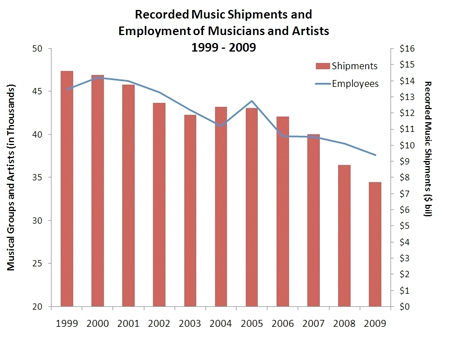
Insufficient enforcement of online piracy has led to a reduction in investment of creating new works. The following chart shows how employment in the music industry and new releases both fell at the same time online piracy has grown.

Recorded music shipments and employment of musicians and artists 1999-2009

Additional evidence shows how weak copyright protection reduces investment in new works — harming new and local artists particularly. According to the IFPI’s Digital Music Report 2010:

  • “In Spain, which has one of the highest rates of illegal file-sharing in Europe, sales by local artists in the top 50 have fallen by an estimated 65% between 2004 and 2009;
  • France, where a quarter of the internet population downloads illegally, has seen local artist album releases fall by 60% between 2003 and 2009;
  • In Brazil, full priced major label local album releases from the five largest music companies in 2008 were down 80% from their 2005 level.”

Leveraging Investment

Intermediaries provide much-needed resources and expertise for producing high-quality works. But they perform another function that is just as important: aggregating the risk of producing creative works.

Economists sometimes refer to creative works as “experience goods“. The value of a book, movie, or song is difficult to judge beforehand, unlike other consumer goods. Consumers cannot determine if a particular work will be satisfactory until after they experience it.

Experience goods are thus risky to produce. How risky?

History suggests the risk is quite high. Remarks from several participants in the 1876 Royal Commission on Copyright in the UK cast light on the situation over 130 years ago. One William Smith said that “only one book in four” recoups its expenses, with one Anthony Trollope following up that he had heard from two separate publishers that “not one book in nine has paid its expenses.”2Minutes of the Evidence Taken Before the Royal Commission on Copyright.

These percentages hold true today. In the music industry, only about one in ten record albums sell enough copies to break even on expenses.3“Most RIAA members report that less than 10% of their releases are profitable”, David Baskerville, Music Business Handbook and Career Guide, pg. 339 (Sage, 2006); “A 1980 Cambridge study showed … approximately 84 percent of record albums failed to sell the allotted amount in order to break even”, Patrice L. Johnson, Are Black Entertainers More Likely to Receive Unfair Contract Agreements Than Their White Counterparts? Independent study, 1998. Film is similar—perhaps even worse. One economist has calculated that less than 3% of independent films produced break even.

Yet, creative industries can thrive under these conditions with appropriate copyright protections. And those intermediaries that do build sustainable businesses continue to invest in the next generation of creative works.

According to the IFPI, record labels reinvest around 30% of revenues into developing and marketing artists—$5 billion a year globally:

Recording contracts typically commit artists and labels to work together to produce a series of albums. Artists benefit from heavy upfront investment that would be difficult to secure elsewhere and record labels have the opportunity to recoup their outlay over a period of time.

Achieving commercial hits is the basis of the “circle of investment”, by which music companies plough back the revenues generated by successful campaigns to develop new talent and help fund the next generation of artists.

Continually investing in new talent is a hugely risky business, as only a minority of the artists developed by music companies will be commercially successful in a highly competitive market. Estimates on the commercial success ratio of artists vary between one in five and one in ten.

By aggregating risks, intermediaries—record labels, book publishers, film studios—can leverage their profits on hits toward the creation of a wider variety of new works. The 10 or 20 per cent of projects that break even help fund the creation of the 80 to 90 per cent of projects which don’t. This benefits niche works, works without mainstream appeal, and new creators who have not yet gained an audience.

Cultivating Genius

The expenses of creation include not just money but time too. Writing a book—especially fiction—doesn’t involve much of a financial burden. But it does take a good deal of time—time that is in short supply for many.

More importantly, time is needed for developing creative skills. While people may have some level of natural talent, few if any are born fully-realized artists. Pop economist Malcolm Gladwell famously said it takes 10,000 hours to master a skill.4Check out Ericsson, Roring & Nandagopal, Giftedness and Evidence for Reproducibly Superior Performance: An Account Based on the Expert Performance Framework, 18 High Ability Studies 3 (2007), for some of the research behind Gladwell’s claim.

In Wealth of Nations, Adam Smith writes:

And thus the certainty of being able to exchange all that surplus part of the produce of his own labour, which is over and above his own consumption, for such parts of the produce of other men’s labour as he may have occasion for, encourages every man to apply himself to a particular occupation, and to cultivate and bring to perfection whatever talent or genius he may possess for that particular species of business.

Copyright provides that certainty that encourages the investment of time to cultivating creative talents.

The alternative—relying only on innate motivation to drive development of creative talents—is not as attractive to a society that values creativity and culture. British historian Thomas Babington Macaulay recognized this as long back as 1841.

You cannot depend for literary instruction and amusement on the leisure of men occupied in the pursuits of active life. Such men may occasionally produce compositions of great merit. But you must not look to such men for works which require deep meditation and long research. Works of that kind you can expect only from persons who make literature the business of their lives. Of these persons few will be found among the rich and the noble. The rich and the noble are not impelled to intellectual exertion by necessity. They may be impelled to intellectual exertion by the desire of distinguishing themselves, or by the desire of benefiting the community. But it is generally within these walls that they seek to signalise themselves and to serve their fellow-creatures. Both their ambition and their public spirit, in a country like this, naturally take a political turn. It is then on men whose profession is literature, and whose private means are not ample, that you must rely for a supply of valuable books.

And this idea continues to be recognized today:

It has been said that people would create entertainment without being paid to do so, and I have no doubt some would. But everyone has to buy groceries and pay the rent. So the universe of those who would create for free would be limited to amateurs and the independently wealthy. Unless we’d be satisfied with their meager output, we need some way to provide financial incentives that permit people to create entertainment professionally, for a living.5Lionel Sobel, Why the Digital Piracy War has to be Fought, November, 2002, DGA Magazine.

Again, notice no one is saying that without copyright, no one would invest in developing their talents in creative fields. What’s being said is that because of the “public goods” nature of expressive works, the amount of people able to make that investment is limited without copyright.

The copyright incentive increases the ability of creators to invest time in perfecting their skills, allowing a wider range of voices to be heard and a higher quality of works created.

Journeyman Hierarchy

Now consider all the ancillary skills that go into producing creative works: the skills of book editors, recording engineers, film crews. Copyright industries in the US employ millions of people beyond what we would consider “primary” creators. Yet their skills, and their mastery of those skills, are just as vital to creating high-quality works.

The idea that innate motivations to create are sufficient to ensure an optimal level of high-quality creative works fails to take into account these ancillary roles. They require even more of an incentive to invest in their development.

A system that protects the rights of creators also supports the ability of those outside the limelight to perfect and master their skills.

In an interview with Chris Castle at Music Technology Policy, Songwriters Guild of America president Rick Carnes calls this a “journeyman hierarchy”, and talks about how it results in higher quality works. He uses the example of Spike Lee, who began with a student film. Based on that success, he was able to get funding for his next film and begin a career as a filmmaker. Along the way, actors such as Denzel Washington got their start and behind-the-scenes workers developed their skills. This continual cycle is what creates the “next generation of art.”

Carnes notes that great films and great music delve into ideas that inspire and challenge. Professionals create these types of works better than anyone else because it’s their job; they do it day in and day out, giving up a great deal of their lives to do so. But if copyright is not properly enforced, than people cannot get a return on their investment; if people cannot get a return on their investment, they’re less likely to invest in the next generation of art.

Bad Literature Drives Out Good

Creators have a variety of incentives to create besides those provided by copyright. The “fallacy of intellectual property” assumes that, in the absence of copyright, these other incentives would ensure a sufficient supply of high caliber works of knowledge and culture. This assumption, however, is doubtful.

“Without copyright protection,” write William Landes and Richard Posner, “there would be increased incentives to create faddish, ephemeral, and otherwise transitory works because the gains from being first in the market for such works would be likely to exceed the losses from absence of copyright protection.”6An Economic Analysis of Copyright Law, 18 Journal of Legal Studies 325, 332 (1989). Think more “Reality TV”, less Mad Men. More remakes and sequels, less original works.

History shows this principle in action. In Piracy: The Intellectual Property Wars from Gutenberg to Gates, Adrian Johns describes the experience in France during the French Revolution:

Briefly, after 1789 the revolutionaries wanted to see enlightenment spread from Paris by its own natural force. They therefore abolished literary property … What ensued was an experiment in whether print without literary property would help or hinder enlightenment … This was a revolutionary utopianism of the commons … But as utopias do, it turned rotten. The craft of printing did expand rapidly—the number of printers quadrupled—but what it produced changed radically too. The folio and the quarto were dead. Reprints became legitimate, then dominant … [Printers] employed whatever secondhand tools they could lay their hands on, worked at breakneck speed with whatever journeymen they could get, and ensured a rapid turnover by issuing newspapers and tracts with an immediate sale. What books were still published were largely compilations of old, prerevolutionary material. In other words, a literary counterpart to Gresham’s Law took hold, and the triumph of the presses grises led to disaster.7Pg. 53, University of Chicago Press, 2009.

Investment of time and money in creators and their works leads to a wider variety and higher quality of expression that enriches all our lives. Copyright, when it is properly enforced, provides an incentive to make that investment.

References

References
↑1 Mark Lemley, The Economics of Improvement in Intellectual Property Law, 75 Texas Law Review 989 (1996).
↑2 Minutes of the Evidence Taken Before the Royal Commission on Copyright.
↑3 “Most RIAA members report that less than 10% of their releases are profitable”, David Baskerville, Music Business Handbook and Career Guide, pg. 339 (Sage, 2006); “A 1980 Cambridge study showed … approximately 84 percent of record albums failed to sell the allotted amount in order to break even”, Patrice L. Johnson, Are Black Entertainers More Likely to Receive Unfair Contract Agreements Than Their White Counterparts? Independent study, 1998.
↑4 Check out Ericsson, Roring & Nandagopal, Giftedness and Evidence for Reproducibly Superior Performance: An Account Based on the Expert Performance Framework, 18 High Ability Studies 3 (2007), for some of the research behind Gladwell’s claim.
↑5 Lionel Sobel, Why the Digital Piracy War has to be Fought, November, 2002, DGA Magazine.
↑6 An Economic Analysis of Copyright Law, 18 Journal of Legal Studies 325, 332 (1989).
↑7 Pg. 53, University of Chicago Press, 2009.
By , January 03, 2011.

I would like to wish a happy new year to all my readers and fellow bloggers. I hope everyone had a warm and happy holiday season. Here’s to a new year filled with happiness.

Just a few notes from around the blogosphere:

  • Entertainment attorney Lionel Sobel has a new blog — Entertainment Law Reporter. Sobel covers a wide variety of topics in the entertainment law realm; the blog is a great addition to anyone’s reading list.
  • The Washington Legal Foundation runs a blog with some great in-depth analysis of different issues. They’ve recently devoted a couple posts to copyright. Check out Video Game “Bot” Provides Platform for Latest Judicial Pronouncement on Copyright & Software, about the recent World of Warcraft case, and The Supreme Court Left Most Copyright Litigants Wanting in 2010, for a review of the copyright cases that the Court heard (or passed on) in the previous year.
  • Chris Castle’s Music Technology Policy recently posted the third part of its thorough (and thoroughly entertaining) four part analysis of Google’s recently announced anti-piracy initiative. Well worth a read.
  • Finally, this video has been making the rounds. Musician Mike Lombardo responds to a blog post titled “Filesharing will go down in history as the greatest thing ever to happen to music,” a sort of “best of” listing of anti-copyright arguments (example: creating art doesn’t cost anything).

    A tad long, but worth the watch:

    [youtube]EwAiLICevc4[/youtube]

By , December 30, 2010.

On December 9, the US filed a complaint for civil forfeiture in the Southern District of New York against the seven domain names seized this past summer as part of Operation in Our Sites.

I just came across this and haven’t seen it elsewhere, so I’ve posted a copy of the complaint below.

Pursuant to the Federal Rules of Civil Procedure, the US has also posted notice of the forfeiture action at http://www.forfeiture.gov/ViewNotice.aspx?n=36666&a=0.

[scribd id=46049509 key=key-vvb2xfebd3m55cjwac0]

***update***

The forfeiture.gov link seems to have changed several times. I’ve updated it to a correct link as of 1/4/2011, but if it doesn’t work for you, you can do a “notice search” on forfeiture.gov for “tvshack” to see the notice.

By , December 28, 2010.

A month ago, as many readers are aware, the US federal government seized a number of domain names for sites engaged in counterfeiting and infringement. The seizures were applauded by many working in the creative industries.

In my previous post on the subject, I responded to criticisms that the seizures violate due process (they don’t) and the First Amendment (they don’t).

A new round of criticisms have sprung up recently when a copy of the seizure warrant for several of the domain names — specifically, those alleged to be facilitating copyright infringement as opposed to counterfeiting — appeared online. You can see the warrant and affidavit here.

The criticisms have been spearheaded primarily by Techdirt, where a series of posts have alleged “technical and legal errors” in the warrant and affidavit. 1See Homeland Security Presents ‘Evidence’ for Domain Seizures; Proves it Knows Little About the Internet — Or the Law; Full Homeland Security Affidavit to Seize Domains Riddled With Technical and Legal Errors; More and Bigger Mistakes Discovered in Homeland Security’s Domain Seizures.

Are there errors in the affidavit? If so, do they even matter? The answer is no. The confusion comes from misunderstanding the nature and purpose of warrants and the meaning of “probable cause.”

Probable Cause

A seizure of property for a forfeiture proceeding is very much like an arrest of a person for a criminal trial. The trial or forfeiture proceeding is where guilt or innocence is determined. All that is needed for a seizure or arrest is some basis for starting a trial or forfeiture proceeding against the person or property.

In the US, the Fourth Amendment establishes that basis as “probable cause.” Probable cause does not mean prima facie evidence of guilt — evidence that, as the Supreme Court said over 200 years ago, “would justify condemnation.” 2Locke v. United States, 11 US 339, 348 (1813). Instead, it means only that it is probable that a crime has been committed. Probable cause requires only a “reasonable ground for belief of guilt.”

Most often, probable cause is established by a warrant. The investigating officer writes up an affidavit describing the facts and circumstances that lead him to believe a crime has been committed and submits it to a neutral judge. The judge reviews the warrant and signs off on it if satisfied that probable cause has been established.

Recognizing the distinction between the standard of probable cause and the standard required to prove guilt is important to seeing why the criticisms of this warrant are baseless.

In 1949, the Supreme Court explained the distinction:

Guilt in a criminal case must be proved beyond a reasonable doubt and by evidence confined to that which long experience in the common-law tradition, to some extent embodied in the Constitution, has crystallized into rules of evidence consistent with that standard. These rules are historically grounded rights of our system, developed to safeguard men from dubious and unjust convictions, with resulting forfeitures of life, liberty and property.

However, if those standards were to be made applicable in determining probable cause for an arrest or for search and seizure, more especially in cases such as this involving moving vehicles used in the commission of crime, few indeed would be the situations in which an officer, charged with protecting the public interest by enforcing the law, could take effective action toward that end. Those standards have seldom been so applied.

In dealing with probable cause, however, as the very name implies, we deal with probabilities. These are not technical; they are the factual and practical considerations of everyday life on which reasonable and prudent men, not legal technicians, act. The standard of proof is accordingly correlative to what must be proved. 3Brinegar v. United States, 338 US 160, 174-76 (1949).

The Court could not be more clear on this last point. It has reiterated many times that probable cause is a preliminary and tentative determination, the affidavits accompanying warrants need not be “ironclad” or airtight, and magistrates should use common sense when deciding whether to issue a warrant, not focus on hypertechnicalities. 4See Brinegar; Spinelli v. US, 393 US 410, 419 (1969); Beck v. Ohio, 379 U. S. 89, 96 (1964); McCray v. Illinois, 386 U. S. 300, 311 (1967); United States v. Ventresca, 380 U. S. 102, 108 (1965); Barber v. Page, 390 U.S. 719, 725(1968).

The Court’s reasoning for giving warrants such leeway is based on the realities of law enforcement. As it said in US v. Ventresca (1965):

[T]he Fourth Amendment’s commands, like all constitutional requirements, are practical and not abstract. If the teachings of the Court’s cases are to be followed and the constitutional policy served, affidavits for search warrants, such as the one involved here, must be tested and interpreted by magistrates and courts in a commonsense and realistic fashion. They are normally drafted by nonlawyers in the midst and haste of a criminal investigation. Technical requirements of elaborate specificity once exacted under common law pleadings have no proper place in this area. A grudging or negative attitude by reviewing courts toward warrants will tend to discourage police officers from submitting their evidence to a judicial officer before acting. 5380 US 102, 108 (1965).

Sixteen years earlier, the Court said this common-sense approach that favors warrants but leaves room for reasonable mistakes properly balances the constitutional rights of individuals with the necessities of law enforcement:

These long-prevailing standards seek to safeguard citizens from rash and unreasonable interferences with privacy and from unfounded charges of crime. They also seek to give fair leeway for enforcing the law in the community’s protection. Because many situations which confront officers in the course of executing their duties are more or less ambiguous, room must be allowed for some mistakes on their part. But the mistakes must be those of reasonable men, acting on facts leading sensibly to their conclusions of probability. The rule of probable cause is a practical, nontechnical conception affording the best compromise that has been found for accommodating these often opposing interests. Requiring more would unduly hamper law enforcement. To allow less would be to leave law-abiding citizens at the mercy of the officers’ whim or caprice. 6Brinegar v. United States, 338 US 160, 176 (1949).

Bottom line: seizures and forfeiture proceedings serve different purposes, like arrests and trials. The warrant is a preliminary instrument whose function is to establish probable cause of a crime. Actually proving guilt or innocence comes later. The realities of enforcing law require a lot of leeway in a warrant: it’s enough for probable cause that the facts and circumstances in the affidavit would lead a reasonable man to conclude that there is a likelihood that a crime was committed.

The Errors?

One of the “errors” alleged by Techdirt is the inclusion of statistics about the effects of online piracy in the affidavit. These statistics were likely added to provide context or background to the investigation for the judge reviewing the warrant. The “error” is that Techdirt disputes the validity of the statistics. But whether or not you agree with the accuracy of the statistics cited in the warrant is irrelevant: probable cause for copyright infringement doesn’t depend on the scope of the harm in the aggregate.

Other “errors” pointed out include the use and definition of certain terms. For example, the classification of Torrent-finder as a “bit torrent website” is disputed because it “hosts no tracker” and “hosts no infringing content.” But the terms are only descriptive, irrelevant to whether or not probable cause of a crime exists. Even if the terminology is technically incorrect, this is the type of “error” that the law doesn’t care about in warrants.

I’m not even sure the terminology used here is even wrong in the first place. BitTorrent is a protocol, so there’s an accepted, technical definition for that — but is there an accepted, technical definition for a “bit torrent website”? Wikipedia lists sites similar to Torrent-finder at Comparison of BitTorrent sites: sites that search through multiple torrent search engines but do not host trackers or infringing content themselves.

Some of the other “errors” found in the seizure warrant include what amount to possible defenses against criminal copyright infringement — for example, the operator of one of the sites whose domain name was seized claims that several of the songs available to download that had been identified in the warrant were authorized to be shared for promotional purposes. If true, this would of course mean that there was no infringement of those specific songs. But that’s an issue for the forfeiture proceeding, not the probable cause determination.

The Supreme Court has “flatly rejected the idea that the police have a standing obligation to investigate potential defenses before finding probable cause.” 7Acosta v. Ames, 386 F. 3d 5, 11 (1st Circuit, 2004), citing Baker v. McCollan, 443 U.S. 137, 145-46 (1979). Possible defenses and claims of innocence are issues for the judge and jury, not law enforcement officials. Yes, this means that sometimes property is seized or people are arrested that later are found not guilty. That is the purpose of the trial — to determine innocent or guilt. But “the Constitution does not guarantee that only the guilty will be arrested” and “due process does not require that every conceivable step be taken, at whatever cost, to eliminate the possibility of convicting an innocent person.” 8Baker v. McCollan
at 145.

Conclusion

An actual legal challenge to this warrant would not likely be successful, but I doubt that is the goal of those pointing out the “errors” they’ve found. It’s not as though if some of the technical definitions were worded differently, or alternate statistics were used, critics would have no problem with the seizures.

Their problem is disagreement with fundamental copyright laws, so any attempts to enforce those laws are attacked any way they can. Critics seem to want an exception from these rules of probable cause and procedure — rules that apply to pretty much every other law, both federal and state — for piracy. A “balanced” copyright law, it seems, is one that places all the burden on the copyright holder — from creating and investing in new works to policing and enforcing the rights in those works — while requiring that “every conceivable step be taken, at whatever cost, to eliminate the possibility of convicting” a torrent search engine. 9Quote taken from Baker v. McCollan, where it was used in the context of describing what due process does not require.

References

References
↑1 See Homeland Security Presents ‘Evidence’ for Domain Seizures; Proves it Knows Little About the Internet — Or the Law; Full Homeland Security Affidavit to Seize Domains Riddled With Technical and Legal Errors; More and Bigger Mistakes Discovered in Homeland Security’s Domain Seizures.
↑2 Locke v. United States, 11 US 339, 348 (1813).
↑3 Brinegar v. United States, 338 US 160, 174-76 (1949).
↑4 See Brinegar; Spinelli v. US, 393 US 410, 419 (1969); Beck v. Ohio, 379 U. S. 89, 96 (1964); McCray v. Illinois, 386 U. S. 300, 311 (1967); United States v. Ventresca, 380 U. S. 102, 108 (1965); Barber v. Page, 390 U.S. 719, 725(1968).
↑5 380 US 102, 108 (1965).
↑6 Brinegar v. United States, 338 US 160, 176 (1949).
↑7 Acosta v. Ames, 386 F. 3d 5, 11 (1st Circuit, 2004), citing Baker v. McCollan, 443 U.S. 137, 145-46 (1979).
↑8 Baker v. McCollan
at 145.
↑9 Quote taken from Baker v. McCollan, where it was used in the context of describing what due process does not require.
By , December 21, 2010.

As scholars, interest groups, and bloggers criticize copyright, many turn to the first amendment to add heft to their arguments. The nature and scope of copyright law is not just bad, they argue, it is unconstitutional.

The “free-speech critique of copyright” 1A phrase coined by law professor David McGowan in Some Realism About the Free Speech Critique of Copyright. seems appealing, at first glance. For starters, it sounds a lot better to say you’re defending the Constitution rather than complaining about having to pay for music and movies.

But this criticism of copyright law suffers in a number of respects. In Artistic Expression, the First Amendment, and Copyright, I showed how the free speech critique of copyright fails to take into consideration the free speech rights of creators. In this sense, the free speech critique isn’t about upholding the values of the first amendment where they’ve been previously ignored — it’s about playing favorites with first amendment values: the free speech rights of those who make creative or even consumptive uses of existing expressive works should be protected at the expense of the free speech rights of those who actually created the works in the first place.

When we discuss the relationship between the first amendment and copyright, it’s important to recognize that creators have free speech interests too. Earlier this month, I took a look at how copyright law helps protect the free speech rights of creators. Copyright is the “engine of free expression” that provides an incentive to invest in the creation and dissemination of ideas and expression. Piracy — the unauthorized distribution of near-exact copies of a work — creates a chilling effect on the speech of creators.

But copyright law does more than just promoting the creation and dissemination of new expression. It also helps to protect the free speech rights of creators after a work has been created.

David McGowan explores this point in Some Realism About the Free Speech Critique of Copyright.

Audiences understand works in light of a cluster of facts and circumstances we call context. Contexts change, so meanings can change. People may understand a work in different ways at different times. One way a meaning can change is for one person to take a work and place it in a new context of their own creation, trading on its meaning and thereby imbuing the work with their own perceptions.

[…]

The changeability of meaning is fundamental to the relationship between copyright and speech. Take whatever collective description of free-speech activity you prefer: the development of common culture, democratic civil society, or what have you. Call it “speech.” Because meanings can change, an author’s contribution to speech may end when a work is published, but it does not have to. If the law gives her the power, an author can keep on trying to manage the meaning of a work over time.

This point is not lost on the free speech critics of copyright. In fact, for some, it forms the basis for their argument.

For example, in Parchment, Pixels, and Personhood: User Rights and the IP (Identity Politics) of IP (Intellectual Property), John Tehranian classifies copyright infringement as something akin to a fashion statement. Just as some people choose to express themselves through the clothes they buy and how they wear them, some people choose to express themselves through the music they listen to and through remixing or mashing up existing works.

What’s unclear is why copyright law stands in the way of this expression, and what’s even less clear is how the first amendment requires copyright law to get out of the way more than it does now.

It doesn’t. The free speech criticism of copyright fails on this point because it neglects the creator’s free speech interests in managing the meaning of a work. As McGowan explains:

[W]hen one speaker wants to use another’s work, the relevant legal rules embody a choice between two speech interests. Because meanings can change, and because authors may affect that change, this choice is not a choice between an author who has had his say and one who wants to speak. It is between two people who would like to try to make people see a certain work a certain way.

So there is good news and bad news. The good news is that whichever of these rules, or any combination of them, the law adopts, a speech interest will be advanced. The bad news is that whichever rule it adopts, a speech interest will be harmed. Whether you consider it good news or bad, this fact means that no notion of speech, and no theory of the freedom of speech, provides a premise for preferring one rule over the other.

Now we can see what the Supreme Court means when it says “copyright law has built-in First Amendment accommodations.” 2Eldred v. Ashcroft, 537 US 186, 219 (2003). The copyright incentive spurs the creation and dissemination of new ideas and expression, while the distinction between ideas and expression (copyright protects only expression, not ideas) means users and downstream creators can use and build on these new ideas. Fair use allows others to use even the expression in existing works without permission in certain situations — situations such as criticism 317 USC § 107. and parody, 4Campbell v. Acuff-Rose, 510 US 569 (1994. where the use is valuable, but it is unlikely for a copyright owner to grant permission.

But any free speech critique of copyright that ignores or neglects the free speech rights of creators does a disservice to the values enshrined in the first amendment. Creators should not be asked to sacrifice their speech rights just because nonconstitutional arguments against copyright have faltered.

References

References
↑1 A phrase coined by law professor David McGowan in Some Realism About the Free Speech Critique of Copyright.
↑2 Eldred v. Ashcroft, 537 US 186, 219 (2003).
↑3 17 USC § 107.
↑4 Campbell v. Acuff-Rose, 510 US 569 (1994.
By , December 10, 2010.

A common criticism of copyright law or its enforcement is that it doesn’t adequately protect first amendment rights. Activist groups like the EFF, Public Knowledge, and the Center for Democracy & Technology are  quick to raise the issue at the first sign of any proposal or effort to protect copyright rights. I’ve previously addressed such arguments as they related specifically to COICA and domain name seizures.

The “free speech critique” of copyright can essentially be summed up as this: “Copyright law restricts speech: it restricts you from writing, painting, publicly performing, or otherwise communicating what you please.” 1Mark Lemley & Eugene Volokh, Freedom of Speech and Injunctions in Intellectual Property Cases, 48 Duke Law Journal 147 (1998). The past few decades have seen a ton of academic scholarship devoted to this critique. 2Just a few of the articles: Paul Goldstein, Copyright and the First Amendment, 70 Columbia Law Review 283 (1970); Melville Nimmer, Does Copyright Abridge the First Amendment Guarantees of Free Speech and Press?, 17 UCLA Law Review 1180 (1970); Lionel Sobel, Copyright and the First Amendment: A Gathering Storm?, 19 Copyright Law Symposium 43 (1971); Robert Denicola, Copyright and Free Speech: Constitutional Limitations on the Protection of Expression, 67 California Law Review 283 (1979); L. Ray Patterson, Free Speech, Copyright, and Fair Use, 40 Vanderbilt Law Review 1 (1987); Diane Zimmerman, Information as Speech, Information as Goods: Some Thoughts on Marketplaces and the Bill of Rights, 33 William & Mary Law Review665 (1992); Neil Netanel, Copyright and a Democratic Civil Society, 106 Yale Law Journal 283 (1996); Mark Lemley & Eugene Volokh, Freedom of Speech and Injunctions in Intellectual Property Cases, 48 Duke Law Journal 147 (1998); Eugene Volokh & Brett McDonnell, Freedom of Speech and Independent Judgment Review in Copyright Cases, 107 Yale Law Journal 2431 (1998); Yochai Benkler, Free as the Air to Common Use: First Amendment Constraints on Enclosure of the Public Domain, 74 New York Univ. Law Review 354 (1999); Alan E. Garfield, The First Amendment As a Check on Copyright Rights, 23 Hastings Communication and Entertainment Law Journal 587 (2001); Jed Rubenfeld, Freedom of Imagination: Copyright’s Constitutionality, 112 Yale Law Journal 1 (2002); Wendy Seltzer, Free Speech Unmoored in Copyright Safe Harbors, Harvard Journal of Law and Technology (2010). By and large, the consensus is that the restriction exists, and something needs to be done about it.

What’s missing from these arguments, however, is any discussion about the free speech rights of copyright owners. 3One exception is David McGowan, Some Realism About the Free Speech Critique of Copyright, 74 Fordham Law Review 101 (2005). Today I want to take a closer look at this discussion, one I broached before in Artistic Expression, the First Amendment, and Copyright.

Free Speech Rights of Copyright Owners

“Once it is decided … that the First Amendment operates in the copyright arena, it should be realized that it is a two-way street, for the copyright owner also has First Amendment rights.” 4William Patry, The Fair Use Privilege in Copyright Law, 469-70 (1985).

So says William Patry, one of the leading experts in the US on copyright law. He recognizes what many free speech critics of copyright don’t: free speech interests lay on both sides of the copyright owner-copyright user divide. And rather than standing in contradiction to each other, the first amendment and copyright law work in tandem to protect the free speech interests of both sides.

While this point is lost to free speech critics, US courts recognize it — first amendment defenses to copyright infringement actions are consistently rejected in lawsuits. “It should not be forgotten that the Framers intended copyright itself to be the engine of free expression,” wrote the Supreme Court in Harper & Row v. Nation Enterprises. Copyright and the first amendment co-exist to allow new ideas to be created and disseminated. Copyright provides an incentive to encourage the spread of new expression, while the first amendment removes roadblocks in the way of dissemination. What’s more, first amendment safeguards are built into copyright law: protection only extends to expression, not the underlying ideas; fair use allows criticism, commentary, and transformative uses without the permission of the copyright owner; and statutory exceptions exist for certain educational, library, and other “public” uses without permission to enhance access and dissemination of these works.

Copyright critics who raise first amendment concerns completely overlook the free speech rights of creators. One would think that the free speech rights of those who create original expression should, at the very least, be equal to the free speech rights of those who build upon existing works. But under the prevailing view, it seems that the free speech rights of creators of original expression are in fact subservient to subsequent users of that expression.

Even if we accept the notion that some people’s first amendment rights are more important than others, the copyright critic’s ranking doesn’t make sense. Why should we value the free speech rights of those who add new expression to the marketplace of ideas less than the free speech rights of those who build upon or reproduce that new expression?

As David McGowan writes in Some Realism About the Free Speech Critique of Copyright,

The free-speech critique wants courts to favor one type of speaker over another. It plays favorites. It therefore is at odds with any conception of free speech that prohibits judges from playing favorites among speakers, as both current doctrine and the most cogent speech theories do.

The Chilling Effect of Online Piracy

First Amendment doctrine cautions against laws that place a “chilling effect” on speech. Laws aimed at unprotected categories of speech (like libel or child pornography) that are not narrowly tailored may cause self-censorship or stifling of protected speech out of a fear of risking penalties or liability.

In the same vein, copyright infringement has a stifling effect on the creation and dissemination of new creation. Ineffective enforcement against infringement or undue burdens on copyright owner’s abilities to protect their rights reduces the incentive to continue to create new expression.

Essentially, copyright infringement creates a “chilling effect” on the free expression rights of creators.

This chilling effect is very real, as creators have attested to. Indie film producer Ellen Seidler recognized it while she was endeavoring to protect her rights. When submitting DMCA notices to Google to remove links to unauthorized version of her film, she was told copies of her notices would be posted to the Chilling Effects website. “The implication therein is that by asserting my rights and sending a DMCA to request the removal of infringing content I am somehow ‘chilling’ a pirate’s right to ‘free speech,’ she says. “Really?  In my view the only thing being ‘chilled’ is our right to make a living.”

Comic artist Colleen Doran describes first-hand how the chilling effect of online piracy affects her:

I spent the last two years working on a graphic novel called Gone to Amerikay, written by Derek McCulloch for DC Comics/Vertigo. It will have taken me 3,000 hours to draw it and months of research. Others have contributed long hours, hard work and creativity to this process. But due to shrinking financing caused by falling sales in the division, these people are no longer employed.

The minute this book is available, someone will take one copy and within 24 hours, that book will be available for free to anyone around the world who wants to read it. 3,000 hours of my life down the rabbit hole, with the frightening possibility that without a solid return on this investment, there will be no more major investments in future work.

Freelance photographer Seth Resnick adds his perspective:

Copyright is the very basis of my existence and the existence of every freelance photographer in the country. As a freelancer, I exist only by the value of the intellectual property I am able to create. I have to control and license that property. If I don’t control the licensing I am unable to place any value on my art form of photography. Without the ability to license my intellectual property I simply can’t stay in the marketplace. A photographer or any artist who can’t stay in the market, can’t produce work which is a very part of our American culture.

Disputing the Chilling Effect of Online Piracy

Free speech critics may dismiss concerns about the “chilling effect” online piracy has on copyright holders as lacking in evidence or unworthy of attention. Yet they are quick to warn about the dangers to free speech that removing, say, a video of a dancing baby from one of numerous video sharing sites has. In the end, this argument is simply a choice between two speech interests — one that says some people’s rights are more important than others. And chilling effects are, by their definition, difficult to measure. But just as it’s not alright to say “censhorship is ok as long as no one actually ends up in jail,” it’s not alright to say “piracy is ok as long as no one actually files for bankruptcy.”

Concerns might also be dismissed by saying creators aren’t really concerned about their right to speak, they just want more money. But this type of thinking ignores the fact that copyright incentives benefit everybody. Society benefits from the creation of new works, authors and artists are encouraged to continue creating new works. All piracy does is remove the benefit from those creating the new works. As Ellen Seidler notes, with piracy, “Everyone is making money, it seems, except those who own the rights”.

Finally, it might be argued that the chilling effect of copyright infringement is no longer an issue since digital technology has somehow made copyright incentives irrelevant. The happy thoughts that everyone else benefits from the content you create will make up for the incentive copyright provides; merchandising and personal appearances are enough to recoup the expenses of devoting time to creating that content. I realize this argument warrants enough attention for an entirely separate article, but for purposes of this article, it suffices to say that the argument doesn’t justify infringing on free speech rights, and it flies in the face of reality. How many people are flocking to see news photographers in person? How many t-shirts can authors of educational books sell? The quality of the creative work doesn’t matter as much as the marketing skills of the creator, or how good she looks on camera. This same idea has certainly worked well in politics, right?

Parting Thoughts

Recognizing the “chilling effect” that infringement has on the free expression rights of copyright owners is just one strand in unraveling the free speech critique of copyright. In the future, I hope to look at some of the other issues involved in the critique — why courts have categorically denied first amendment defenses in cases of infringement, and why this approach makes sense, for example.

However, I don’t mean to imply that freedom of expression is somehow not important. The first amendment reflects the importance of this freedom in our society. It is precisely because of this importance that there is a responsibility to take everyone’s freedom of expression rights into consideration. Favoring one group’s free speech interests over another’s runs counter to the values enshrined in the first amendment and the copyright clause.

References

References
↑1 Mark Lemley & Eugene Volokh, Freedom of Speech and Injunctions in Intellectual Property Cases, 48 Duke Law Journal 147 (1998).
↑2 Just a few of the articles: Paul Goldstein, Copyright and the First Amendment, 70 Columbia Law Review 283 (1970); Melville Nimmer, Does Copyright Abridge the First Amendment Guarantees of Free Speech and Press?, 17 UCLA Law Review 1180 (1970); Lionel Sobel, Copyright and the First Amendment: A Gathering Storm?, 19 Copyright Law Symposium 43 (1971); Robert Denicola, Copyright and Free Speech: Constitutional Limitations on the Protection of Expression, 67 California Law Review 283 (1979); L. Ray Patterson, Free Speech, Copyright, and Fair Use, 40 Vanderbilt Law Review 1 (1987); Diane Zimmerman, Information as Speech, Information as Goods: Some Thoughts on Marketplaces and the Bill of Rights, 33 William & Mary Law Review665 (1992); Neil Netanel, Copyright and a Democratic Civil Society, 106 Yale Law Journal 283 (1996); Mark Lemley & Eugene Volokh, Freedom of Speech and Injunctions in Intellectual Property Cases, 48 Duke Law Journal 147 (1998); Eugene Volokh & Brett McDonnell, Freedom of Speech and Independent Judgment Review in Copyright Cases, 107 Yale Law Journal 2431 (1998); Yochai Benkler, Free as the Air to Common Use: First Amendment Constraints on Enclosure of the Public Domain, 74 New York Univ. Law Review 354 (1999); Alan E. Garfield, The First Amendment As a Check on Copyright Rights, 23 Hastings Communication and Entertainment Law Journal 587 (2001); Jed Rubenfeld, Freedom of Imagination: Copyright’s Constitutionality, 112 Yale Law Journal 1 (2002); Wendy Seltzer, Free Speech Unmoored in Copyright Safe Harbors, Harvard Journal of Law and Technology (2010).
↑3 One exception is David McGowan, Some Realism About the Free Speech Critique of Copyright, 74 Fordham Law Review 101 (2005).
↑4 William Patry, The Fair Use Privilege in Copyright Law, 469-70 (1985).
By , December 08, 2010.

There’s this idea that online piracy is somehow “different” from real-world or traditional piracy. It’s like nothing the world has ever seen before — a paradigm shift that fundamentally changes how content is created and consumed and calls into question the very notion of copyright law.

Online piracy is defended by many and even celebrated by some. Terms like “innovation” are applied frequently to those who discover faster and easier ways to ensure everyone benefits from content except those who spend the time and money creating it. In November, for example, music blog Hypebot asked, “Does litigation drive innovation in music piracy?”

On a sidenote, it’s important to distinguish between real innovation and “false innovation.” An airline might be able to cut costs by foregoing maintenance, but we wouldn’t call that move “innovation.”

It’s not hard to find examples of this sort of revelry in “piracy 2.0.”

Last month, a group released a “Pirate Edition” of the file-sharing program Limewire after a court injunction shut down the original version of the software. Those responsible celebrated both the difficulty the content industries have in enforcing their copyrights and the ease in which pirates can recover from any setbacks.

“A horde of piratical monkeys climbed aboard the abandoned ship, mended its sails, polished its cannons and released it FREE to the community to help keep the Gnutella network alive,” say the coders.

“Speaking for myself, the motivation is to make RIAA lawyers cry into their breakfast cereal. I hope the other monkeys have nobler intentions,” says the project leader.

The idea that piracy is a noble cause now that it has moved online, or that this new generation of pirates are more clever than the bootleggers of the past for figuring out ways to evade the law and take all the benefits of the copyright incentive for themselves is silly.

As long as there has been copyright, there has been copyright infringement. And though dissemination of creative works has moved from print to digital, pirates use the same techniques to stay one step ahead of the law.

Nothing illustrates this better than the following selection from Edward Cutler’s 1905 book, A Manual of Musical Copyright Law. (I previously posted a different section in Enemies of Monopoly of Brain-product). Cutler describes a particular method of piracy seen in England over a century ago:

The piracy in recent years of copyright musical compositions and the musical anarchy which, unfortunately, still reigns in this respect, form a disgraceful epoch in the history of English jurisprudence.

Abuses have arisen which would be impossible in any other civilised state, and which hold Great Britain up to derision throughout the civilised world.

In the closing years of the last century some unscrupulous person invented a scheme for robbing the proprietors of copyright (whether composer or publisher) of their just gains.

Wretchedly-got-up versions of songs, carefully chosen from among those which have gained popular favour, are secretly printed and secretly stored in cellars. A few copies are handed out to irresponsible hawkers and are offered for sale by them at a penny or twopence a copy in populous thoroughfares. If interfered with, the dozen or so copies which each hawker has with him are given up. The loss to the thief is inconsiderable. Another hawker in the next street renews the stock and the same game is played out daily.

Another form of the fraud is the house-to-house distribution of lists of pieces of music, from which the householder can choose, and the supply of the pieces chosen at low prices. No printers name or address is found on any of the pieces sold. The people who are responsible for the transaction remain in the background, and in this way many thousands of copies of any popularised pieces of music are got rid of and the legitimate sale of the publication almost, if not entirely, ceases. There appears to be an idea in many people’s minds that these pirates deserve some sort of questionable credit for their ingenious evasion of the law, thereby defeating a vicious monopoly. It is time to undeceive them in this respect. Audacious lying; concealment of addresses, and scuttling away are the laudable means by which these street buccaneers carry out their ends. Ingenious evasion or device there is none, and their boldness would not have succeeded but for the supineness of the Government, the unreasoning sympathy which appears to exist in the minds of a few short-sighted politicians, and the dishonesty of purchasers who knowingly buy the spurious articles. The effect of this wholesale robbery is disastrous.

The publishers (leaving out of the question the most wealthy and old established houses, whose capital enables them to stand the brunt of the competition on unequal terms) are many of them hardworking tradesmen who have invested their small capital in getting together a business, and in purchasing the copyright of one or two songs which offer a probability of success, and they are ruined wholesale. They pay singers to bring their songs before the public, and advertise very largely, only to find that they have been spending their money for the benefit of a pack of thieves, who filch the whole of their profits and entirely stop their sales. Unfortunately the votes of these deserving, but politically insignificant, sufferers can be treated as a “quantité negligeable.”

The parallels between what Cutler is describing and the recent targeting of the domain names of infringing websites are particular acute. Under the DMCA, a website dedicated to infringing activities can continue to operate while each individual copyright owner who finds her work on the site is limited to requesting removal file by file or link by link. The loss to the site is indeed “inconsiderable.”

Executive efforts like Operation in Our Sites and legislative efforts like COICA are more effective at disrupting these types of sites. Obviously, they won’t put an end to piracy: just as people were infringing during Cutler’s time, they will find ways to infringe 100 years from now. And absolutely the content industries must continue to adapt to technological changes and rely primarily on the quality of their work and the attractiveness and convenience of the services they offer.

But, as with every industry, the law plays a necessary role. It’s silly to think the law shouldn’t evolve along with technological changes in order to remain effective against widespread, consumptive infringement.

Special bonus: the next section of Cutler’s book is eerily reminiscent of the events surrounding COICA:

The copyright bill discussed before Lord Monkswell’s Committee contained a clause inserted by the writer conferring upon the owner of copyright power to seize pirated copies of his works. It also gave him power, without applying to any Court, to authorise a police constable to seize the pirated copies which might be taken before a Court of summary jurisdiction and destroyed.

The writer’s clause also contained words enabling the Court to act ex parte; (that is, on the evidence of the complainant alone, without the necessity of summoning the alleged infringer); to make an order for destruction in the absence of the latter. The clause also contained a Provision inflicting a penalty for every piratical sale. Had these two last provisions been allowed to remain, the whole mischief caused by the street pirates would have been remedied; but the words inflicting penalties and giving power to make ex parte orders were struck out, and the Bill eventually became law in a form which is useless. The Statute in question is printed verbatim in the appendix. In consequence of the utter failure of this admirable effort of the Legislature, a Bill was prepared and put into the hands of a private member containing clauses necessary to remedy the abuses. The measure was stifled by the efforts of a member for a Scotch district, who utilised the technicalities of Parliamentary procedure to throw the matter over another session. After endless efforts on the part of those who wished to see justice done, a Parliamentary Committee sat upon the matter, the Scotch member being nominated as one of the members; and again the real merits of the case were stifled, both in the proceedings before the Committee and before the House of Commons. In the latter place the procedure which stops short of the application of closure to a Private Members’ Bill enabled the matter in question to be thrown over to yet another session.

By , December 06, 2010.

On November 29, the US Immigrations and Customs Enforcement agency executed seizure warrants on over 80 domain names for sites engaged in counterfeiting and online piracy. This round of seizures, dubbed “Operation In Our Sites v. 2.0”, is part of an ongoing investigation by ICE and follows a similar round of seizures which took place this past summer.

Many have noted similarities between Operation In Our Sites and the pending Combating Online Infringement and Counterfeits Act (COICA), which would create enhanced civil forfeiture mechanisms against websites dedicated to infringing activities. Both the Operation and COICA target the domain name of these websites; both result in blocking the domain name from resolving to the website.

And, like COICA, critics of Operation In Our Sites have raised concerns that these domain name seizures lack due process and violate the First Amendment. I previously addressed these two issues as they relate to COICA; today, I want to take a look at them in the context of these domain name seizures.

Seizure vs. Forfeiture

The first step in understanding what is going on here is making a distinction between seizure and forfeiture. It’s easy to get the two confused, but they are separate concepts, and the government has to play by two different (but sometimes overlapping) sets of rules to stay within constitutional bounds.

Seizure is the act of taking custody of property. Most of us are probably most familiar with seizure of property that is evidence of a crime: when police find the murder weapon during a search, they can seize it — take temporary possession of it — for further examination and for use at trial. But property is also typically seized prior to forfeiture proceedings. 1Most property, that is, as we’ll see later. A court only has authority of property within its territorial jurisdiction, and it can only assert that authority when the property has been taken into its custody. 2Dobbins’s Distillery v. United States, 96 US 395 (1878).

The US Constitution lays out specifically what is needed for a seizure to be lawful. The Fourth Amendment states that “unreasonable” seizures are prohibited, and property may only be seized when accompanied by a warrant, issued “upon probable cause” that describes with particularity the “things to be seized.”

Forfeiture is the “involuntary relinquishment of money or property without compensation as a consequence of a breach or nonperformance of some legal obligation or the commission of a crime.” 3West’s Encyclopedia of American Law, edition 2. Property may be forfeited as part of a sentence for a criminal conviction, or the government may seek forfeiture in and of itself through a civil in rem proceeding against the property. Civil forfeiture is limited to those types or classes of property set by statute. In civil forfeiture cases, the government has the burden of proving by a preponderance of the evidence that property was used in or derived from prohibited activities.

In short: property is seized to commence a civil forfeiture proceeding, and it is forfeited if it was used in the commission of a crime. This principle has been followed for centuries: British politician and lawyer John Sadler wrote in 1649, “No forfeiture before conviction; no seizure before indictment.” 4John Sadler, Rights of the Kingdom, pg. 281.

The US government may use civil forfeiture to enforce copyright laws against:

(A) Any article, the making or trafficking of which is, prohibited under section 506 of title 17, or section 2318, 2319, 2319A, 2319B, or 2320, or chapter 90section 2318, 2319, 2319A, 2319B, or 2320, or chapter 90, of this title.

(B) Any property used, or intended to be used, in any manner or part to commit or facilitate the commission of an offense referred to in subparagraph (A).

(C) Any property constituting or derived from any proceeds obtained directly or indirectly as a result of the commission of an offense referred to in subparagraph (A). 518 US Code § 2323(a)(1).

So, contrary to some descriptions of COICA, the authority to initiate forfeiture proceedings against domain names of websites involved in the commission of copyright infringement already exists. COICA merely enhances these forfeiture proceedings (for example, by adding requirements for advertising and financial transaction providers to take reasonable measures to block their services from forfeited domain names). However, whether the government pursues civil forfeiture against domain names under COICA, should it pass, or under existing law, the first step in that process would still involve what occurred on November 29th: the seizure of those domain names.

Seizure and Due Process

Most of us generally don’t question the authority of the government to seize property that is evidence in a criminal trial. If police have a warrant to look for a murder weapon, and they find it, they can bag it up and remove it from the owner’s possession.

But as mentioned above, property may also be seized pursuant to a warrant to be forfeited in and of itself. While some may find this practice troubling — especially if the government is seen as too aggressive in seizing property — the constitutional requirements for this type of seizure are largely the same as seizing property for evidence.

When it comes to the practice of seizing domain names, the question is: should the same rules that govern the seizure of ordinary property apply, or do domain names present special circumstances that require stricter rules of due process for their owners?

In making the claim that domain names present special circumstances, critics of the seizures seem to want to have their cake and eat it too. They say these seizures are unconstitutional — they should be subject to higher standards of due process because owners of domain names are being deprived of something more than owners of all other types of property subject to seizure. But at the same time, they say these seizures are ineffective because the owners aren’t being deprived of anything — they still have their content and servers, their sites can still be accessed by IP address, and in many cases, the owners have registered new domain names for their sites within hours of the seizures.

Let’s see whether the case for treating domain names differently than ordinary property hold up.

The Fifth Amendment states that “No person shall … be deprived of life, liberty, or property, without due process of law.” Generally, “due process” requires notice and a hearing. When it comes to seizure, the question boils down to whether the notice and hearing must occur before the government seizes property, or whether the hearing can occur after.

For most of history, the Supreme Court has held that notice and hearing after property is seized is sufficent; the Fourth Amendment requirements of probable cause and specificity for seizures satisfies due process. However, the Court has carved out exceptions to this principle. In 1993, in a forfeiture case involving real estate, the Court stated that the Fourth Amendment “does not provide the sole measure of constitutional protection that must be afforded property owners in forfeiture proceedings” — forfeiture proceedings must also comply with “well-settled jurisprudence under the Due Process Clause.” US v. James Daniel Good Real Property held that the government must provide notice and hearing before seizing real estate it wishes to forfeit.

The reasons for this exception were provided by the Court. “The practice of ex parte seizure … creates an unacceptable risk of error.” The government’s interest in this practice must be balanced with this risk. Primarily, the Court noted that since real estate can’t move, courts can establish jurisdiction over it without seizure. Thus, there is no pressing need to delay notice and hearing until after real estate is seized.

Notably, three justices dissented from this holding, noting that there was no basis in existing case law for the Court to look beyond the Fourth Amendment in seizure cases and no logical reason to distinguish real estate from personal property:

“Our historical treatment of civil forfeiture procedures underscores the notion that the Fourth Amendment specifically governs the process afforded in the civil forfeiture context, and it is too late in the day to question its exclusive application. As we decided in Calero-Toledo v.Pearson Yacht Leasing Co., 416 U. S. 663 (1974), there is no need to look beyond the Fourth Amendment in civil forfeiture proceedings involving the Government because ex parte seizures are `too firmly fixed in the punitive and remedial jurisprudence of the country to be now displaced.'”

Nevertheless, when it comes to real estate, due process typically requires a hearing before the property is seized.

Domain names are not real estate, and the reasons in James Daniel Good Real Property for requiring a pre-seizure hearing are not applicable to the seizure of domain names. The “risk of error” involved in seizing domain names is no higher than those involved in the seizure of personal property: the content and servers are still available to the owner, the site can still be accessed through the IP address, and it is relatively easy for the owner to acquire a new domain name — something many of those affected did within hours of having their domains seized.

Also, like personal property, domain names can be “moved” or “destroyed” as those terms are understood in the jurisdictional context. The situs of domain names is the location of the domain name registrar where the domain name is registered. As mentioned above, it is relatively easy for a website owner to register a new name overseas, removing the domain name from the court’s territorial jurisdiction.

Thus, the forfeiture of domain names present the same considerations that the Supreme Court has held justify postponing notice and hearing until after seizure in Calero-Toledo. The seizure permits the US “to assert in rem jurisdiction over the property in order to conduct forfeiture proceedings, thereby fostering the public interest in preventing continued illicit use of the property and in enforcing criminal sanctions”, domain names “could be removed to another jurisdiction, destroyed, or concealed, if advance warning of confiscation were given”, and “seizure is not initiated by self-interested private parties”, but by federal officials.

Seizure and the First Amendment

The argument is also made that these domain name seizures violate the First Amendment. Websites contain speech; ex parte seizure of websites, before a judicial determination that the content is not protected by the First Amendment (as is the case with infringing content) may be considered a prior restraint on speech. As we’ll see, the seizure of these domain names do not run afoul of First Amendment protections for many of the same reasons they do not run afoul of due process protections.

The Supreme Court has addressed the implications of the First Amendment in seizures most often under laws prohibiting obscenity. Obscenity is not protected by the First Amendment. Seizure of obscene materials, whether to use as evidence in a criminal trial or to initiate forfeiture proceedings, requires a close look by courts because of the risk that nonobscene, protected speech might end up being blocked.

In Quantity of Copies of Books v. Kansas, the Court reiterated its warning that “if seizure of books precedes an adversary determination of their obscenity, there is danger of abridgment of the right of the public in a free society to unobstructed circulation of nonobscene books.” This danger does not foreclose all seizures concerning speech, however. It merely means that the law requires certain procedural safeguards to protect against the abridgment of  speech rights.

First, as the Court stated in Stanford v. Texas, “the constitutional requirement that warrants must particularly describe the “things to be seized” is to be accorded the most scrupulous exactitude when the “things” are books, and the basis for their seizure is the ideas which they contain.” There is no question that the government has met this requirement; the seizures were made pursuant to valid, specific warrants issued by a neutral, impartial judge.

Second, “because only a judicial determination in an adversary proceeding ensures the necessary sensitivity to freedom of expression, only a procedure requiring a judicial determination suffices to impose a valid final restraint.” 6Heller v. New York, 413 US 483, 489 (1973). This does not mean that a judicial determination must occur before seizure. The Court in Heller v. New York said that it “has never held, or even implied, that there is an absolute First or Fourteenth Amendment right to a prior adversary hearing applicable to all cases where allegedly obscene material is seized.” Rather, “a judicial determination need only occur ‘promptly so that administrative delay does not in itself become a form of censorship.'” In effect, the Court recognizes the danger that too long of a temporary restraint on speech-related items can have the effect of a final restraint.

The Court, however, upheld the seizure in Heller, and I think the reasoning is applicable to the seizure of these domain names:

In this case, of course, the film was not subjected to any form of “final restraint,” in the sense of being enjoined from exhibition or threatened with destruction. A copy of the film was temporarily detained in order to preserve it as evidence. There has been no showing that the seizure of a copy of the film precluded its continued exhibition. Nor, in this case, did temporary restraint in itself “become a form of censorship,” even making the doubtful assumption that no other copies of the film existed. A judicial determination of obscenity, following a fully adversary trial, occurred within 48 days of the temporary seizure. Petitioner made no pretrial motions seeking return of the film or challenging its seizure, nor did he request expedited judicial consideration of the obscenity issue, so it is entirely possible that a prompt judicial determination of the obscenity issue in an adversary proceeding could have been obtained if petitioner had desired. Although we have refrained from establishing rigid, specific time deadlines in proceedings involving seizure of allegedly obscene material, we have definitely excluded from any consideration of “promptness” those delays caused by the choice of the defendant. In this case, the barrier to a prompt judicial determination of the obscenity issue in an adversary proceeding was not the State, but petitioner’s decision to waive pretrial motions and reserve the obscenity issue for trial.

The seizure of domain names is even less like a form of final restraint than the seizure of the film in Heller. Neither any content or servers containing the content were temporarily detained. The purpose of seizing these domain names is to establish and preserve in rem jurisdiction for forfeiture proceedings. The seizure doesn’t preclude access to the web sites or amount to a “form of censorship” — as stated above, one can access the site by IP address, and it is relatively easy for a site owner to set up a new domain name. Finally, domain name owners have full opportunity to challenge the seizures themselves through pretrial motions or a prompt judicial determination at a forfeiture proceeding.

Conclusion

The seizure of these 82 domain names satisfy both due process and the First Amendment. Criticism of this strategy on constitutional grounds is thus shaky. Critics may still question the rightness of the seizures, but as the Supreme Court pointed out over a century ago, “If the laws here in question involved any wrong or unnecessary harshness, it was for Congress, or the people who make congresses, to see that the evil was corrected. The remedy does not lie with the judicial branch of the government.” 7Springer v. United States, 102 US 586, 594 (1881).

As far as their effectiveness or necessity, I’m inclined to agree with Patrick Ross’s take:

The U.S. government has an obligation to ensure that U.S. copyright law is enforced in all markets, physical and online. Operation In Our Sites is but one example of many of how the Obama Administration recognizes the critical role copyright industries play in our economy, and individual artists and creators play in our economy and our culture.

I’m sure there will be some out there who criticize the seizure of these domains, just as there are those who criticize a bipartisan effort by lawmakers to facilitate the disruption of these for-profit online theft centers. Their criticism will begin with an assertion of the importance of copyright protection, then immediately be followed by a big “but.” (Any image that comes to mind from those last two words is wholly on you.)

Instead of constantly saying what they don’t like, maybe those critics could say that copyright enforcement is important, and follow with an “and,” i.e., “and we think the federal government should do x, y, and z to ensure successful enforcement.” If you don’t hear that “and” it’s probably because they weren’t sincere in the part before the “but.”

References

References
↑1 Most property, that is, as we’ll see later.
↑2 Dobbins’s Distillery v. United States, 96 US 395 (1878).
↑3 West’s Encyclopedia of American Law, edition 2.
↑4 John Sadler, Rights of the Kingdom, pg. 281.
↑5 18 US Code § 2323(a)(1).
↑6 Heller v. New York, 413 US 483, 489 (1973).
↑7 Springer v. United States, 102 US 586, 594 (1881).
By , November 29, 2010.

Last week, I’ve been taking a close look at the proposed Combating Online Infringement and Counterfeiting Act (COICA), which was unanimously approved by the Senate Judiciary Committee on November 18th. On Monday, I examined what the bill does, and on Wednesday I addressed due process criticisms.

Today I want to take a look at the most serious criticism: that COICA amounts to “censorship.” It’s a little tough, actually, to find discussion of COICA online that doesn’t mention censorship. Much of the criticism centers around the characterization of the COICA proceedings as a “prior restraint.” Others have expressed concerns that the bill would be “overbroad.”

Prior Restraint

The First Amendment says “Congress shall make no law … abridging the freedom of speech.” The Supreme Court has held that:

[P]rior restraints on speech and publication are the most serious and the least tolerable infringement on First Amendment rights. A criminal penalty or a judgment in a defamation case is subject to the whole panoply of protections afforded by deferring the impact of the judgment until all avenues of appellate review have been exhausted. Only after judgment has become final, correct or otherwise, does the law’s sanction become fully operative. A prior restraint, by contrast and by definition, has an immediate and irreversible sanction. If it can be said that a threat of criminal or civil sanctions after publication “chills” speech, prior restraint “freezes” it at least for the time. 1Nebraska Press Assn. v. Stuart, 427 US 539, 559 (1976).

The general rule regarding prior restraints, as restated by Mark Lemley and Eugene Volokh, is that “Speech may not be restrained until a final judicial determination that it’s unprotected by the First Amendment.” 2Freedom of Speech and Injunctions in Intellectual Property Cases, 48 Duke Law Journal 147 (1998). In practice, this means that courts are reluctant to grant preliminary injunctions in cases involving speech (permanent injunctions, however, are fine, since they come after a final judicial determination that the speech at issue is unprotected). But when it comes to copyright infringement cases, as Lemley and Volokh point out,

[P]reliminary injunctions are granted pretty much as a matter of course, even when the defendant has engaged in creative adaptation, not just literal copying. How can this be? True, the Supreme Court has held that copyright law is a constitutionally permissible speech restriction; though copyright law restricts what we can write or record or perform, the First Amendment doesn’t protect copyright-infringing speech against such a restraint.

COICA provides that a domain name may only be blocked after an in rem proceeding is commenced and a court issues an injunction — preliminary or otherwise. As such, under current law, COICA’s provisions are no more a prior restraint than the preliminary injunctions routinely ordered in infringement cases. Now, one may argue that preliminary injunctions shouldn’t be available in copyright infringement cases as a whole, that despite case law to the contrary, they amount to constitutionally prohibited prior restraints. This is the argument made by Lemley and Volokh. However, even accepting such an argument, there is one exception: “piracy and other ‘easy’ cases.” 3This is one example of why I think it’s important to draw distinctions between “creative” and “consumptive” uses of copyrighted works. Lemley and Volokh explain that “most obvious cases of copyright infringement won’t implicate the prior restraint rule at all”:

The danger of preliminary injunctions is that they may temporarily suppress speech that ultimately proves to be protected. If a judge can, at the time of the preliminary injunction hearing, make a reliable finding that the speech is constitutionally unprotected, rather than just that it might be unprotected, then there should be no problem with issuing the preliminary injunction.

This could happen whenever the defendant has made identical or nearly identical copies of the plaintiff’s works, and there is no claim of fair use, but only some other copyright defense (such as that defendant has a supposedly valid license, or that plaintiff’s copyright wasn’t properly renewed, or something along those lines). Most cases alleging outright piracy, as well as most claims that the defendant has exceeded the boundaries of its license, would fall within this category.

In this situation, the defendant’s conduct is not constitutionally protected speech, even if the defendant ultimately proves that it’s not a copyright infringement. Harper & Row, as we read it, divides uses of another’s work into two areas: on the one hand, use of another’s idea or facts, or fair use of another’s expression, which is constitutionally protected; on the other hand, use of another’s expression that’s not a fair use, which falls within the “copyright exception” to the First Amendment. So long as Congress and the courts restrict speech that’s within this copyright exception, there’s no First Amendment problem. And while the First Amendment imposes certain limits on copyright law — the requirement of copying, the idea-expression dichotomy, and some aspects of the fair use doctrine — it does not constitutionalize every nuance of the Copyright Act.

COICA’s provisions are targeted at these obvious cases of copyright infringement. The language of the bill reflects this: blocking only applies to sites “dedicated to infringing activities,” which include sites “primarily designed” to offer infringing works “in complete or substantially complete form” and only when “such activities are the central activities” of the site (emphasis added).

In Center for Democracy & Technology v. Pappert (CDT v. Pappert), a District Court case cited by several law professors in their letter in opposition to COICA, a Pennsylvania state law allowing websites to be blocked for containing child pornography was struck down as unconstitutional because it amounted to a prior restraint. 4F. Supp. 2d 606 (ED Pa, 2004). The case has been used because of the similarities between the PA law and COICA in blocking internet sites based on content. However, the similarities end there. The Pennsylvania law provided substantially different procedures than COICA does, and it was specifically those procedures that led to the court’s conclusion.

As the court in CDT v. Pappert explains:

The Act and Informal Notice process are not prior restraints in the traditional sense. They do not prevent speech from reaching the market place but remove material already available on the Internet from circulation. However, they are administrative prior restraints as that term has been interpreted by the Supreme Court. According to the Court, “only a judicial determination in an adversary proceeding ensures the necessary sensitivity to freedom of expression, only a procedure requiring a judicial determination suffices to impose a valid final restraint.” Thus, if material protected by the First Amendment is removed from circulation without these procedural protections, the seizure is invalid as a prior restraint. The Court used the term to describe a Rhode Island Commission’s practice of sending letters to book distributors that asked the distributors to remove books from circulation in Bantam Books v. Sullivan, 372 U.S. 58 (1963) and a procedure that allowed courts to order pre-trial seizure of films alleged to be obscene in Fort Wayne Books, Inc. v. Indiana, 489 U.S. 46, 51-52 (1989).

Based on the decision in Bantam Books and Fort Wayne Books, this Court concludes the procedural protections provided by the Act are inadequate. These cases require a court to make a final determination that material is child pornography after an adversary hearing before the material is completely removed from circulation. Under the Act, a judge is only required to make a finding of probable cause, he can make this determination ex parte, and there is no requirement that the publisher or distributor receive notice or an opportunity to be heard. [Citations removed] 5CDT at 656-57.

Unlike the Pennsylvania law, COICA requires the government to prove by a preponderance of the evidence that a particular site is dedicated to infringing activities, an in rem proceeding is not an ex parte proceeding, and the registrant of the domain name does receive notice and an opportunity to be heard. 6See my previous post, COICA: Due Process. Thus, any comparisons between COICA and the law in CDT v. Pappert are inapposite and superficial at best.

Overbreadth

Besides the claim that COICA would act as a prior restraint, critics contend that the bill also violates the First Amendment because it would “suppress vast amounts of protected speech containing no infringing content whatsoever.” 7Law Professors’ Letter in Opposition to S. 3804 (Combating Online Infringements and Counterfeits Act). In other words, even though copyright infringement isn’t protected under the First Amendment, other speech that is protected will be affected when the domain name for the entire site is blocked.

Any law aimed at nonprotected speech, no matter how well written, can potentially reach protected speech. To reflect this reality without leaving lawmakers powerless to address harms of nonprotected speech or conduct, the Supreme Court has developed the “substantial overbreadth” doctrine: “particularly where conduct and not merely speech is involved, we believe that the overbreadth of a statute must not only be real, but substantial as well, judged in relation to the statute’s plainly legitimate sweep” — if it is, the law is void on its face. 8Broadrick v. Oklahoma, 413 US 601, 615 (1973).

A law that is not substantially overbroad on its face may nevertheless be found unconstitutionally overbroad if a substantial amount of protected speech is affected by the law as it is applied. Laws affecting speech must be narrowly tailored so that even if they are not substantially overbroad on their face, a defendant engaged in protected speech does not find himself within the laws scope. 9For simplicity’s sake I’m purposely avoiding discussion of the different levels of scrutiny that are involved in First Amendment analysis by courts.

A court may find a law not narrowly tailored if less restrictive means exist to accomplish the legitimate sweep of the law. 10See, for example, United States v. Playboy Entertainment Group, Inc., 529 US 803, 813 (2000). In CDT v. Pappert the District Court took the less restrictive means test to mean that “if a statute regulating speech provides distributors of speech with alternatives for compliance and the majority of distributors reasonably choose an alternative that has the effect of burdening protected speech, the statute is subject to scrutiny as a burden on speech.” 11CDT at 652.

Courts are reluctant to declare laws substantially overbroad on their face. “[The overbreadth doctrine] has been employed by the Court sparingly and only as a last resort. Facial overbreadth has not been invoked when a limiting construction has been or could be placed on the challenged statute.” 12Broadrick v. Oklahoma, 413 US 601, 613 (1973). The court in CDT v. Pappert, for example, held that the law allowing a website to be blocked for providing access to child pornography was not overbroad on its face; it did not prohibit nor chill protected speech. 13CDT at 648-49.

COICA is not substantially overbroad on its face as well. It targets only websites dedicated to infringing activities — conduct that is not protected by the First Amendment. Like the statute in CDT v. Pappert, it does not prohibit nor chill protected speech.

It is doubtful that COICA would also be overbroad as applied. The language of the bill — specifically the requirement that a website’s infringing activities must amount to the “central activities” of the site — limits the breadth of COICA to unprotected speech by definition. No doubt some protected speech would end up being blocked, but the First Amendment is not a shield for copyright infringement, and courts have little sympathy for defendants in situations like this who create an “all-or-nothing” predicament like this. 14See, for example, Dr. Seuss Enterprises, LP v. Penguin Books, 109 F. 3d 1394, 1406 (9th Cir, 1997).

That’s not to say that COICA would result in no cases where a substantial amount of protected speech may be blocked. No bill operates outside the constraints of the Constitution; the First Amendment is available to everyone no matter what law is at issue. It’s possible that a specific case could arise where a specific defendant’s freedom of speech is infringed by COICA. That doesn’t mean, however, that COICA itself is unconstitutional, and it certainly doesn’t mean COICA is a vehicle of censorship. 15See, for example, Virginia v. Hicks, 539 US 113, 123-24 (2003).

References

References
↑1 Nebraska Press Assn. v. Stuart, 427 US 539, 559 (1976).
↑2 Freedom of Speech and Injunctions in Intellectual Property Cases, 48 Duke Law Journal 147 (1998).
↑3 This is one example of why I think it’s important to draw distinctions between “creative” and “consumptive” uses of copyrighted works.
↑4 F. Supp. 2d 606 (ED Pa, 2004).
↑5 CDT at 656-57.
↑6 See my previous post, COICA: Due Process.
↑7 Law Professors’ Letter in Opposition to S. 3804 (Combating Online Infringements and Counterfeits Act).
↑8 Broadrick v. Oklahoma, 413 US 601, 615 (1973).
↑9 For simplicity’s sake I’m purposely avoiding discussion of the different levels of scrutiny that are involved in First Amendment analysis by courts.
↑10 See, for example, United States v. Playboy Entertainment Group, Inc., 529 US 803, 813 (2000).
↑11 CDT at 652.
↑12 Broadrick v. Oklahoma, 413 US 601, 613 (1973).
↑13 CDT at 648-49.
↑14 See, for example, Dr. Seuss Enterprises, LP v. Penguin Books, 109 F. 3d 1394, 1406 (9th Cir, 1997).
↑15 See, for example, Virginia v. Hicks, 539 US 113, 123-24 (2003).