By , October 18, 2010.

On October 11, The Irish High Court ruled that it did not have the authority to order Irish internet service provider UPC to implement a graduated response solution – a so-called “three strikes” approach – to reduce online piracy. The four major record labels – Warner Music, Universal Music Group, Sony BMG, and EMI – had sought the injunction after successfully getting Irish ISP Eircom to adopt a similar solution in a settlement agreement earlier this year.

Canadian attorney and blogger Barry Sookman has a thorough write-up on the case that I highly recommend, EMI Records v UPC – the case for legislative solutions to illegal file sharing, which includes links exploring the issue of graduated response solutions to online piracy in more detail.

Since I’m in the US, my familiarity lies with US copyright law. However, this case does highlight some issues relevant to the distinction I made previously on this site between creative and consumptive infringement. Copyright critics frequently lump their concerns with both types of infringement together to create one big copyright bogeyman. But this conflation only hinders discussion of copyright policy.

Discussion of creative infringement centers upon internally substantive aspects of copyright law – for example, how do you draw a line between acceptable transformative use of a copyright work and infringing transformative use. When you talk about consumptive infringement – verbatim, substitutive use of a work – there’s very few substantive copyright issues to consider. Instead, the discussion centers around procedural and enforcement issues.

Case in point is the opinion from this case. While the case concerns the enforcement of copyrights, it isn’t so much a copyright case as it is a separation of powers case.

Reading the case, and paying attention to the language used, you can see that the Court fully accepts the positive value of copyrighted works and the damage online piracy causes. Justice Charleton seems highly sympathetic to the record label’s struggle against “Internet piracy.” He noted that piracy is not only a “grave economic wrong against copyright holders” but that copyright is a constitutionally protected right for creators under Irish law.

In the end, however, as much as Justice Charleton wants to help the record labels, he simply can’t. To see how he reached that conclusion, 1And because I want to share my fascination with what many feel are the boring parts of law. let’s take a quick trip down remedy lane to injunction junction.

Injunctive Relief and its Limitations

An injunction is simply a “court order commanding or preventing an action.” 2Black’s Law Dictionary. The modern remedy of injunctions developed in the equity courts of medieval England. Back then, the court system was divided between two separate court systems: courts of law and courts of equity. Courts of law were rigid and formal; plaintiffs were typically limited to receiving money to compensate for damages or injuries. Courts of equity, however, were more flexible and afforded a broader array of remedies to plaintiffs. 3James B. Stoneking, Injunctions and Equitable Remedies, Oxford Companion to the Supreme Court of the United States (Kermit L. Hall, ed., Oxford University Press, 2005).

The reasoning behind equitable remedies is that there are certain situations where monetary compensation is thought to be inadequate – inadequate in the sense that a money award is incommensurate with the injury. An example of such a situation is a neighbor who cuts across your lawn to get to his property. If you don’t like him doing this, and take him to court, money damages will probably be inadequate. The trespass results in only a nominal injury – a court will likely only award nominal damages, if it awards any damages at all. Even if it does, the neighbor can continue to trespass, forcing you to continue to sue. An injunction – a court order prohibiting your neighbor from further trespass – is a more adequate remedy, as it more directly addresses the result you want.

The separate courts of law and courts of equity have largely merged in common law countries, though the distinction between legal and equitable remedies remains.

As you might imagine, injunctions are a powerful remedy – and with great power comes great responsibility. Common law countries like the US and Ireland – both of which count English common law as an ancestor – generally recognize a legislature’s power to place limits on equitable remedies through statutes. In the US, Congress has limited the availability of injunctions in labor disputes and rate orders of state public utility commissions, for example. 4Congressional Limitation of the Injunctive Power, OneCLE.

Leading the Court Beyond the Threshold of the Judicial Arm

Justice Charleton appears to have been willing to grant an injunction against UPC. He states that the “evidence convinces me that there is no just or convenient solution open to the record labels other than seeking injunctive relief against the service provider.” This evidence also convinced him that the injunctive relief sought by the labels – “detection, warning, and discontinuance” – is “proportionate to the vast scale of the problem.”

However, “courts must defer” to the legislature when the legislature has set out what remedies are available in a specific cause of action. Justice Charleton examines the legislative framework of Ireland relating to copyright thoroughly: examining both the text of the Copyright and Related Rights Act 2000 itself and construing it in light of European law, as well as comparing it to related legislation in other countries. This examination leads to his ultimate conclusion that the court is precluded from ordering the injunction sought by the record labels in this case.

Respecting, as it does, the doctrine of separation of powers and the rule of law, the Court cannot move to grant injunctive relief to the recording companies against Internet piracy, even though that relief is merited on the facts.

The Future of Graduated Response in Ireland

The decision appears to be only a setback for the music industry in Ireland. The Irish Times reports that “representatives of the music industry, internet service providers and the Government will now meet” to discuss new approaches to combating online piracy in light of the ruling.

An interesting twist in this case is that Justice Charleton was the same judge who presided over the record labels’ earlier lawsuit against Eircom. In that case, Eircom agreed to implement a graduated response procedure as part of a settlement agreement with the labels, so it is a bit unclear how the UPC decision will affect that agreement.

Charleton addresses the issue in the UPC ruling, stating that the previous judgment is both “correct” and “unaffected” by this case. However, there are suggestions that Eircom is exploring its options regarding its settlement agreement in response to this decision.

Aside from that, this decision is unlikely to have too much effect in the near future. Content industries in other countries continue to favor some sort of graduated response solution. But those efforts are largely being pursued through legislation – as has already happened in France – or through voluntary agreements with ISPs.

References

References
↑1 And because I want to share my fascination with what many feel are the boring parts of law.
↑2 Black’s Law Dictionary.
↑3 James B. Stoneking, Injunctions and Equitable Remedies, Oxford Companion to the Supreme Court of the United States (Kermit L. Hall, ed., Oxford University Press, 2005).
↑4 Congressional Limitation of the Injunctive Power, OneCLE.
By , October 13, 2010.

Many critics of current copyright doctrine believe its problems stem largely from an infusion of “property talk” into policy discussions. William Patry writes in Moral Panics and the Copyright Wars, “By describing copyright as a private property right, proponents of the description hope to get policy makers and courts to believe that only private, and not public rights are implicated.”1Moral Panics, pg. 107 (Oxford University Press, 2009). Later, he adds, “The effort to describe copyright as property is intended to invoke ancient entitlement to powerful rights of exclusion, rights granted automatically as a member of the oldest families.”2Moral Panics, pg. 113 (Oxford University Press, 2009).

A similar argument is made by Steve Collins in “‘Property Talk’ and the Revival of Blackstonian Copyright“:

The possessiveness and exclusion that accompany “property talk” are difficult to reconcile with the utilitarian foundations of copyright. Transformative uses of copyrighted materials such as mashing, sampling and appropriative art are incompatible with a propertarian approach, subjecting freedom of creativity to arbitary licensing fees that often extend beyond the budget of creators (Collins). “Property talk” risks making transformative works an elitist form of creativity, available only to those with the financial resources necessary to meet the demands for licences.

This view is shared by many copyright critics online. Mike Masnick, at TechDirt, consistently argues that copyright is not property, and can in fact be viewed as “anti-property.” Boingboing blogger Cory Doctorow says,

Trying to shoehorn knowledge into the ‘property’ metaphor leaves us without the flexibility and nuance that a true knowledge rights regime would have.
…

Copyright – with all its quirks, exceptions and carve outs – was, for centuries, a legal regime that attempted to address the unique characteristics of knowledge, rather than pretending to be just another set of rules for the governance of property. The legacy of 40 years of “property talk” is an endless war between intractable positions of ownership, theft and fair dealing.

But is this necessarily true?

Transformation in Property and Copyright

Legal Theory Blog points to a new paper by Christopher M. Newman that argues many of the problems in current copyright doctrine – specifically relating to how it treats creative uses rather than consumptive uses of existing works – may be better addressed by treating copyright more like property rather than less.

Transformation in Property and Copyright is available at SSRN, and I second Legal Theory Blog’s recommendation. The abstract reads:

Copyright requires us to distinguish between two different ways of transforming a “work of authorship”: “derivative works” and “transformative fair uses.” The absence of a clear line results in a tendency to assign all value arising proximately from a work to copyright owners. Many people blame this expansionist tendency on a “propertarian” understanding of copyright, and argue that the solution is to abandon any notion of copyright as property. I agree that current copyright doctrine often gives excessively broad scope to the exclusive rights of copyright owners, but argue that this may be a result of copyright not being “propertarian” enough. Property is an attempt to coordinate resource use through a system of in rem rights whose content can be understood by third parties without reference to the subjective use preferences of others. Traditional property law dealing with the transformation of mundane objects uses objective, socially intelligible tests of identity to determine when an owner’s rights in a thing have been extinguished, thus preventing owners from asserting subjective use preferences as a means of extracting value from transformed objects created by others.

Far from implying “absolutist” authorial rights, an in rem approach to copyright requires that we place clear boundaries around the identity of the “work of authorship.” This means moving away from the notion that disembodied fragments of “protected expression” can be owned separately from the “work of authorship” of which they are a part. I show how this might be done, proposing to define a “work of authorship” in terms of a coherent expressive experience designed by an author. Putative “copies” that are not tailored to facilitate beneficial use of the work as conceived by the author, but rather to communicate second-order information, or to give rise to expressive experiences radically discontinuous from the ones the author designed, therefore fall outside the author’s right to exclude altogether. Such a “propertarian” approach could be both clearer and more protective of free speech than current doctrine, because limits on the scope of the author’s rights would be defined intrinsically, obviating the need to resort to fair use doctrine with its value-laden weighing of social worth.

Essentially, Newman argues that copyright doctrine needs a better theory to sort out the age-old question of “which ‘further purposes’ authors should control, and which they shouldn’t.” Along the way, he touches on a number of situations in which current copyright doctrine finds infringing use where many would argue noninfringing use: unauthorized sequels (like The Wind Done Gone), “fictional facts” (at issue in the lawsuit against the Seinfeld Aptitude Test), and uses of a work to convey second order information (for example, incidental captures of copyrighted works in film scenes). Newman convincingly argues that his “propertarian” approach would sort out infringing and noninfringing uses that are better aligned to the underlying goals of copyright law.

It’s definitely worth a read. Those outside the legal and academic fields may find it long (it’s just under 80 pages) and technical at times, but there’s plenty of good stuff inside.

Newman’s article builds upon a number of previous works, but I wanted to specifically point out two that are worth reading if you’re interested in this area of the copyright debates. The first is Adam Mossoff’s Is Copyright Property? and the second is Richard Epstein’s Liberty versus Property? Cracks in the Foundations of Copyright Law, both available at SSRN.

Upon reading Newman’s article, I was reminded of an earlier article by David Fagundes, Crystals in the Public Domain. Newman argues along much the same lines as Fagundes, as you can see in the abstract:

The law increasingly treats copyright as if it were any other form of property, and numerous writers decry this trend. In particular, scholars who express solicitude for the public domain fear that the propertization of copyright means an inevitable accretion of private rights in information at the expense of the public domain. This Article critiques this conventional view, arguing that the propertization of copyright has unappreciated advantages for users of public information goods. The conventional view relies on an overly narrow view of what propertization means. The treatment of copyright as a form of property generally entails not only reduction of entitlements to private ownership, but also the bounding of those entitlements with clearly demarcated, or crystalline, borders. Although many writers prefer muddy entitlements that create fluidity regarding the extent of the public domain, this Article argues instead that it is this very fluidity that is at fault for excessive accretion of private rights in information. Uncertainty about the extent of public entitlements in information allows well-capitalized private actors lay claim to resources whose public/private status is at all ambiguous, and then deter the public’s claims through threats of litigation. By contrast, a public domain characterized by crystalline rule structures would benefit users, not only owners, by allowing them to better comprehend the extent of their entitlements and thus exploit common resources without fear of suit. By way of illustration, this Article provides three examples of how copyright law could be reformed to create user-friendly crystalline entitlement structures. It then concludes by situating the propertization of copyright law, and this critique of the dominant narrative about that trend, in the context of current debates in property law more generally.

Fagundes’s article includes several specific proposals to copyright law as a way of incorporating his arguments.

The cries that “copyright is not property!” embrace not only a simplistic idea of “property” but also ignore the benefits that taking a more “propertarian” approach to copyright doctrine may provide. The idea that “property talk” is a pretext for exerting “sole and despotic dominion” over all uses of a copyright does not hold weight upon closer examination. Newman’s article provides one such examination, and I highly recommend giving it a read.

References

References
↑1 Moral Panics, pg. 107 (Oxford University Press, 2009).
↑2 Moral Panics, pg. 113 (Oxford University Press, 2009).
By , October 11, 2010.

“They make me madder than a yak in heat.” – Marge Simpson

A little over a month ago, I wrote a post titled Is Copyright Infringement Theft? The post sparked several other thoughtful articles and many comments – most notably a response by Mike Masnick at the popular TechDirt blog, Why It’s Important Not to Call Copyright Infringement Theft.

This is one of those ongoing debates, along the lines of “Mac vs. PC” and “Kirk vs. Picard.” 1The truly geek would answer “Linux” and “Jack O’Neill.” Not surprisingly, many comments responded as if I had actually said “copyright infringement is theft.”  But the title of the post was merely a question, and in the body I explicitly said “I’m not going to answer that question today.”

I want to continue the discussion today. I think the debate serves as a launching point for many different discussions involving copyright law and the law in general. I obviously can’t cover all of those different discussions in one post, but hopefully I can highlight a few that I find interesting.

At the end of the day, I still think arguing over “theft” or “not theft” is a semantic sticking-point, but unlike Masnick, I think the foreclosure happens on both ends. He thinks “if you are seeking to understand what is happening and how to respond to it, calling it ‘theft’ immediately shuts the door on a variety of important points.” I think the same is true from the perspective of the creators and businesses in the creative industries: if you’re seeking to understand what is happening to them as we continue to move to a digital environment and how to respond to it, decrying anything but complete acceptance to widespread piracy – down to the very language they choose to use to describe it – shuts the door on a variety of important points.

Metaphor

Copyright infringement as theft is a metaphor. According to Masnick, calling copyright infringement “theft is wrong.” Why? “Because it’s wrong at an absolute level.”

When is a metaphor wrong? It’s a curious question. Over at the Legal Profession Blog, Jeff Lipshaw succinctly describes the role of metaphor in meaning using the example of subatomic particles. He says, “What thinking about electrons as billiard balls does is to give them a meaning by analogy to other things, and we base our view of the coherence of the explanation (not its rightness or wrongness) on how it compares to other explanations we already view as coherent.”

I included the Simpsons quote above to illustrate the difficulties in answering the question of the correctness of a metaphor. A yak in heat may very well exhibit aggressive behavior, making the comparison apt. But the comparison is at the very least a clumsy one; many of us are presumably unfamiliar with yak behavior, so the metaphor is more a non sequitur than a useful explanation.

“Love is like an onion, and you peel away layer after layer until you’re just … weeping over the sink.” – Pete Hornberger

The use of metaphor in language is very flexible. Its success in contributing to understanding is context-dependent. Saying you are “madder than X” aids the listener only if they have some knowledge of X. The metaphor itself does not depend on a literal comparison – computing the relative anger-level of you and X. Indeed, we tend to laugh at anyone who rebuffs a metaphor on literal grounds – imagine correcting Hamlet because troubles clearly don’t exist in liquid form. 2From Hamlet, Act 3, Scene 1, “Whether ’tis nobler in the mind to suffer The slings and arrows of outrageous fortune, Or to take arms against a sea of troubles And, by opposing, end them.”

And yet that is one of the arguments used by those against the idea of copyright infringement as theft: the comparison is wrong in a descriptive sense. I addressed the fallacy in this argument in my first post. Based on the response to that post, I wanted to explore it further today. The idea that the comparison is wrong in any sort of descriptive sense has no basis in logic, language, or history.

The other argument against equating infringement with theft has to do with metaphor in framing – comparing the two in a prescriptive, or normative sense. The idea is that the language one uses reflects the result one wants to achieve. This argument, by far, is the more salient of the two. I touched on this argument briefly in my first post. Some of the responses to that post have explored this argument, so I’d like to flesh it out a little bit more today.

Comparing Apples to Oranges

Masnick concludes his article by calling to mind the idea that comparing copyright infringement to theft is like comparing “apples to oranges”. Even here you can see the challenges with talking about the rightness and wrongness of metaphors – even our metaphor for describing incomparable concepts is flawed! 3Check out “apples and oranges” on Wikipedia for an introduction into this curious cliche. One is a round, tasty fruit that grows on trees, while the other is – wait…

The argument against a descriptive comparison between infringement and theft fails logically, historically, and legally.

Logical

Perhaps the best illustration of the logical argument against equating copyright infringement to theft can be found in the following YouTube video:

[youtube]IeTybKL1pM4[/youtube]

Cute. But it misses the point on several levels. If you steal a bike and your friend has to ride the bus, you’re certainly a thief. But if your friend sneaks on the bus without anyone noticing and gets a free ride, what do we call that? 4A millennia old problem is what we call it.

Our concept of “property” is not based on inherent characteristics of physical objects – you can’t look at a bicycle under a microscope and deduce who owns it. It’s better to think of “property” as a set of relationships between people and tangible or intangible things. Property in this sense requires a recognition by law and/or society of the rights, duties, privileges, etc. that connect any given individual with any given thing. 5The genesis of this line of thought is often attributed to Wesley Hohfeld in Some Fundamental Legal Conceptions as Applied in Judicial Reasoning, 23 Yale Law Journal 16 (1913).

The reasoning displayed in the video above is that (1) theft requires deprivation of possession, (2) reproducing a copyrighted work does not result in deprivation of possession, (3) thus, infringement is not theft. This argument begs the question, however, that the definition of theft is limited to deprivation of possession. The argument only works if you insist on restricting the definition of “theft” to that of common law larceny. This is an overly prescriptive restriction on the term. The idea is that the comparison is wrong not just on a literal level, but an arbitrarily narrow application of the literal meaning of “theft.”

It’s easy to reconcile infringement with theft using the broader view of property rights as a set of legal relationships between individuals and things. “Possession” is only one of the relationships recognized by law and society. “Theft” in its colloquial sense – the definition commonly used over time – involves some deprivation of a recognized right. “Theft” of a physical object typically means the deprivation of the exclusive right of possession. Copyright, by statute, secures the exclusive right to copy, among other rights. Copying without permission thus deprives the author of that exclusive right.

Historical

The above video is an example of “linguistic peeving.” In one sense, it is a latching onto a specific usage one believes is right, while proclaiming all other usages to be wrong. But when it comes to the use of language, we can compare claims of “peevery” against actual usage throughout history. “Lingustics is descriptive, not prescriptive.”

The debate over the words used in discussing copyright is nothing new. William St. Clair notes that “the language of stealing” became the main metaphor for copyright infringement at the end of the seventeenth century. 6William St. Clair, Metaphors of Intellectual Property, Privilege and Property: Essays on the History of Copyright (Open Book Publishers). Infringement was, at that time, “frequently equated with theft,” “shoplifting, letter-picking, purse-cutting, highway robbery, burgling a house, plundering a hospital. And piracy.” 7Privilege and Property, pg 388.

New terms continue to be termed to describe the relationship between infringement and theft. Among hip-hop artists, the term “beat-jacking” – a derivation of carjacking – is used to describe the deliberate use without permission, or a false claim of authorship, of another writer’s instrumental. 8See, e.g., M.O.P. Denies Beat Jacking, Beatjacking or Fair Game?

This language usage is not hard to find among people within the creative fields. One of the responses to my initial post comes from friend and PlagiarismToday blogger Jonathan Bailey, who notes that while he limits the use of the term “theft” in connection with copyright infringement, he has no issue with its casual use in this context for three reasons: (1) It’s a common term, (2) It’s not meant to be literal, and (3) It’s not the only misnomer. Bailey’s site is aimed at content creators of all stripes, both large and small, and the terminology reflects to some extent the feelings these creators express when they see others copy their work.

Legal

In my first post, I specifically pointed out the fallacy in relying on the Supreme Court’s opinion in Dowling for “not theft” proponents, and included a quote from the Court in MGM v. Grokster equating unlawful copying to “garden-variety theft.” The first example illustrated the problems with misapplying judicial language to prove a point; the second, to show the comfort that the highest court in the land has in using the language at issue in a colloquial sense. This colloquial use of “theft” in the copyright context was not, however, an isolated incidence.

  • In the 1974 Supreme Court case Teleprompter Corp. v. Columbia Broadcasting System, Justice Douglas and Chief Justice Burger wrote in their dissent, “A CATV that builds an antenna to pick up telecasts in Area B and then transmits it by cable to Area A is reproducing the copyrighted work, not pursuant to a license from the owner of the copyright, but by theft.” 9415 US 394, 417.
  • Judge Patel began his opinion in the District Court ruling in A & M Recordings v. Napster, “The matter before the court concerns the boundary between sharing and theft, personal use and the unauthorized world-wide distribution of copyrighted music and sound recordings.” 10114 F. Supp. 2d 896, 900.
  • In 1980, the Second Circuit wrote in Iowa State University v. American Broadcasting, “The fair use doctrine is not a license for corporate theft, empowering a court to ignore a copyright whenever it determines the underlying work contains material of possible public importance.” 11621 F. 2d 57, 61.

One could find examples of this language from branches of government outside the judiciary. Among other usages of describing copyright infringement as theft, I can point to:

Perhaps most strikingly, the case can be made that copyright preemption shows a similarity between infringement and theft. In the comments of his response, Masnick says the point of refraining from using “theft” language in the copyright context is that the two are not “analogous.”

The Copyright Act explicitly preempts “all legal or equitable rights that are equivalent to any of the exclusive rights within the general scope of copyright” (emphasis added). In other words, you can’t bring a cause of action in a state or local court if the rights at issue fall within the scope of copyright law. Among the causes of action which have been found by courts to be preempted by copyright law: conversion – the “wrongful exercise of dominion and control over tangible, physical objects”; 12Patry on Copyright 18:34 theft of services; 13See, eg, Orth-O-Vision v. HBO, 474 F. Supp. 672. and theft of satellite signals. 14Patry on Copyright 18:52

According to Wiktionary, “analogous” means “Having analogy; corresponding to something else; bearing some resemblance or proportion.” “Equivalent” means “similar or identical in value, meaning or effect; virtually equal.” If causes of action like conversion and theft of services – species of theft – are “equivalent” under the doctrine of preemption, than the argument that they are not analogous – that they don’t bear some resemblance or proportion – fails.

It’s simply disingenuous to say that a metaphor which has been commonly used for centuries by individuals of all stripes, courts, legislators, and governments is “wrong.” Legally and logically, the metaphor holds up. To say that copyright infringement is not theft on a descriptive level only demonstrates ignorance.

Ought Copyright Infringement be Considered Theft

I mentioned earlier that the more salient argument in the “theft” debate has to do with “framing.” The self-ascribed camps of ‘pro-life’ and ‘pro-choice’ in the abortion debates illustrate precisely the power of framing in shaping the character of the debate. Within highly contentious debates, the question matters as much as the answer.

The heart of the issue about equating copyright infringement to theft is not whether it is theft, but whether it ought to be considered theft. That is, it is not important whether we can look to the past and see the metaphor as an accepted linguistic usage, but it is important to consider the effects that using the metaphor has on lawmakers, judges, and policy makers as they craft responses to future problems. 15I want to point out Interpretation and Coherence in Legal Reasoning at the Stanford Encyclopedia of Philosophy for further insights into this area.

One quick note about plagiarism. Nandita Saikia springboarded off my post to consider whether plagiarism should be equated to theft. The issue of plagiarism is distinct from, but overlaps with, copyright infringement. Nevertheless, it warrants mentioning here. Jonathan Bailey points to recent research involving children and plagiarism. And generally, there has been an increase in the prevalence of plagiarism in the past several years. 16See, eg, Danielle Kanclerz, Internet to Blame for Increase in Plagiarism Cases. I think the issue of plagiarism is unequivocally a moral issue, but one that can be addressed outside the confines of copyright law. At the same time, discussions of plagiarism do inform some discussions of copyright law.

Back to copyright infringement in general, and also from India, Amlan Mohanty briefly discusses my piece in the larger context of Indian copyright law. Mohanty gets at the heart of the issue about framing, saying “The term ‘theft’ carries with it significant ethical connotations, is regarded as moral turpitude, and involves considerable value-judgement.”

In this sense, the question over whether infringement should be equated to theft comes down to whether infringement should carry the same moral considerations as theft is said to carry. The debate is over whether this metaphor – this use of language – accurately describes society’s and the law’s response to copyright infringement.

Fortuitously, John Locke, the philosophical godfather of American legal theory, actually used the term “stealing” as an example of how language aids in our understanding of the ideas behind laws: 17John Locke, An Essay Concerning Human Understanding, Book II, Chap. XXVIII (1690). Google Books link

16. The denominations of actions often mislead us. But because very frequently the positive idea of the action, and its moral relation, are comprehended together under one name, and the game word made use of to express both the mode or action, and its moral rectitude or obliquity: therefore the relation itself is less taken notice of; and there is often no distinction made between the positive idea of the action, and the reference it has to a rule. By which confusion of these two distinct considerations under one term, those who yield too easily to the impressions of sounds, and are forward to take names for things, are often misled in their judgment of actions. Thus, the taking from another what is his, without his knowledge or allowance, is properly called stealing: but that name, being commonly understood to signify also the moral pravity of the action, and to denote its contrariety to the law, men are apt to condemn whatever they hear called stealing, as an ill action, disagreeing with the rule of right. And yet the private taking away his sword from a madman, to prevent his doing mischief, though it be properly denominated stealing, as the name of such a mixed mode; yet when compared to the law of God, and considered in its relation to that supreme rule, it is no sin or transgression, though the name stealing ordinarily carries such an intimation with it.

One may note that both theft and copyright infringement are against the law. If the problem with equating the two is that theft is immoral because it is contrary to the law, than the discussion is moot. Either one will subject you to civil liability; either one may subject you to criminal penalties. We “know” at an early age that garden-variety theft is illegal, and anyone who has seen an FBI warning on a movie or paid attention to the recent record label’s litigation campaign “knows” that copyright infringement is illegal.

In fairness, the pushback against equating the two is based on relative morality – copyright infringement is not as bad as theft – sussing out dichotomous forms of copyright infringement, 18See my post on Creative vs Consumptive Infringement for an introduction on this subject. and the importance of countervailing goals in copyright law beyond securing exclusive rights to authors.

These are not tiny bases. One could devote entire books to them – something William Patry has done as I noted in my first post.

William St. Clair describes the use of “theft” language in the copyright context as “literary knockabout.” 19Privilege and Property, pg 391. The historical effects have largely remained within the rhetorical arena. This metaphor is neither recent, nor solely attributed to the largest stakeholders – individual, amateur, and small-time creators typically make use of it. We can talk about whether or not the language has influenced the copyright debates in the wrong direction, but foreclosing the term “theft” in the copyright arena hinders the debate as much as using it puts up “a wall to understanding.”
References

References
↑1 The truly geek would answer “Linux” and “Jack O’Neill.”
↑2 From Hamlet, Act 3, Scene 1, “Whether ’tis nobler in the mind to suffer The slings and arrows of outrageous fortune, Or to take arms against a sea of troubles And, by opposing, end them.”
↑3 Check out “apples and oranges” on Wikipedia for an introduction into this curious cliche.
↑4 A millennia old problem is what we call it.
↑5 The genesis of this line of thought is often attributed to Wesley Hohfeld in Some Fundamental Legal Conceptions as Applied in Judicial Reasoning, 23 Yale Law Journal 16 (1913).
↑6 William St. Clair, Metaphors of Intellectual Property, Privilege and Property: Essays on the History of Copyright (Open Book Publishers).
↑7 Privilege and Property, pg 388.
↑8 See, e.g., M.O.P. Denies Beat Jacking, Beatjacking or Fair Game?
↑9 415 US 394, 417.
↑10 114 F. Supp. 2d 896, 900.
↑11 621 F. 2d 57, 61.
↑12 Patry on Copyright 18:34
↑13 See, eg, Orth-O-Vision v. HBO, 474 F. Supp. 672.
↑14 Patry on Copyright 18:52
↑15 I want to point out Interpretation and Coherence in Legal Reasoning at the Stanford Encyclopedia of Philosophy for further insights into this area.
↑16 See, eg, Danielle Kanclerz, Internet to Blame for Increase in Plagiarism Cases.
↑17 John Locke, An Essay Concerning Human Understanding, Book II, Chap. XXVIII (1690). Google Books link
↑18 See my post on Creative vs Consumptive Infringement for an introduction on this subject.
↑19 Privilege and Property, pg 391.
By , October 05, 2010.

Update: the title of this post refers to the season (as in “the summer of savings!”). I inexplicably hadn’t thought of the more common meaning of ‘fall’ when I wrote it (d’oh!), and this post is not meant to imply that I think file-sharing is going away anytime soon.


This is the fall of file-sharing. With negotiations on the ACTA wrapping up and legislation like the Combating Online Infringement and Counterfeits Act making their way through Congress, I thought it would be a good time to take stock of “the state of online piracy”, as it were. Call it what you will – file-sharing, digital theft, copyright infringement – the ease and speed that unauthorized reproduction and distribution of creative works over the internet has caused content industries and creators much consternation over the past decade or so.

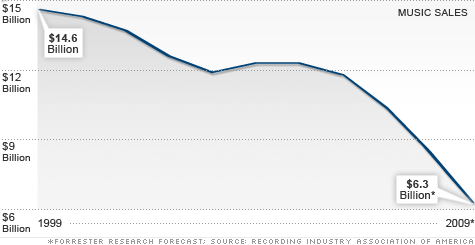
The recording industry, by way of example, has seen its sales cut in half in ten years:

Nearly every other creative industry has felt the pinch, from book publishers to film studios, television producers, photographers, and newspapers. But music file-sharing is often thought of as the “canary in the coal mine” of online piracy because of small file sizes and the nature of consumption habits. It’s not surprising then that the recording industry has been one of the first to respond to online piracy, and its actions have garnered the bulk of the attention in the copyright debates.

From 2003-2008, record labels engaged in a campaign to sue individuals for downloading and uploading music online. Although they filed around 35,000 lawsuits, only two of those cases went to trial. Those cases are still not completely settled.

Today, I want to take a look at where these cases stand. What do industry groups think about this strategy? Recent interviews shed some light on this question. Finally, what role does online piracy play in the dive in sales illustrated by the graph above? I sum up the research to date.

File-sharing Litigation Developments

Last year, the only two defendants to make it to trial in the record labels campaign against individual file-sharers were found liable for copyright infringement and faced considerable damages. In both cases, the damages were subsequently reduced on different grounds and the outcomes challenged. A separate defendant never made it to trial but is seeking Supreme Court review of her verdict.

The third trial for Jammie Thomas-Rasset is set for November 1. Thomas-Rasset was first sued in 2006 by several record labels for downloading and uploading music using the P2P software KaZaa. A jury found her liable for copyright infringement and awarded damages of $222,000. The judge sua sponte ordered a new trial after he determined there had been an error in the jury instructions. 1Ben Sheffner, The Jammie Thomas Re-trial: Frequently Asked Questions, June 10, 2009. In 2009, Thomas-Rasset was found liable again by the jury, this time awarding damages of $1,920,000. A few months later, the judge reduced the award to $54,000 using the common-law doctrine of remittitur. After Thomas-Rasset rejected a settlement offer of $25,000, the record labels rejected the remittitur and opted for a new trial – one concerning only damages.

Also making its way through the courts is an appeal in the Tenenbaum file-sharing case. Last year a jury found Joel Tenenbaum liable for downloading and uploading music and awarded damages of $675,000. Tenenbaum subsequently moved for a reduction in damages. This past July, the court granted his motion and reduced damages to $67,500 – on constitutional grounds rather than under the doctrine of remittitur as in the Thomas-Rasset case. The record labels appealed the reduction; briefing and oral arguments will likely begin in the next couple months.

There are hints that the Supreme Court may take up an issue raised in a third file-sharing lawsuit, albeit one that did not make it to trial. A district court ruled on cross-motions for summary judgment that Whitney Harper was liable for copyright infringement but, as an “innocent infringer“, qualified for mitigated statutory damages of $200 per infringed work. 2It is a common misconception that “innocent infringement” is a defense to copyright infringement, but that is not the case. A plaintiff in a copyright suit may seek statutory damages in lieu of actual damages. If a defendant is found liable of copyright infringement, a court may award between $750 and $30,000 per infringed work. If statutory damages are sought, a defendant can make a showing that he was as not aware and had no reason to believe that his or her acts constituted an infringement of copyright” – if successful, the court has discretion to reduce the minimum statutory damages to $200 per infringed work. In February, the Fifth Circuit reversed the court’s ruling on innocent infringement. Harper subsequently petitioned for Supreme Court review of the Fifth Circuit’s ruling, a petition the Court is currently considering.

The RIAA and MPAA Speak Out

As industry groups that represent the bulk of companies that produce and distribute movies and music, the RIAA and MPAA are on center stage of the copyright debates. Perhaps more than any other event, the RIAA member label’s litigation campaign against individual downloaders has pushed copyright law into the public conscious.

Recently, representatives of both industry groups have talked online about internet piracy, shedding some light on their reactions and approaches. In August, RIAA President Cary Sherman spoke with Vice Magazine. While it’s clear the interviewer doesn’t side with the RIAA, 3The article begins, “Many, many people believe that the Recording Industry Association of America is a giant hairy tumor on the neck of the music business. Many people further feel that this disgusting malignancy has slowly spread its cancerous wrath across the public domain in recent years.” Sherman provides insights into the enormity of the problems online piracy poses to the recording industry and its response to it:

A few years ago the RIAA switched tactics. Instead of high-profile prosecutions of people who pirated music, you decided to put the onus on the ISPs. How successful was that transition?
The time had come to shift over to a strategy that would be more effective. The lawsuits were obviously controversial in the media, but the reality was that most people had no idea that what they were doing was illegal at the time of those lawsuits. We did all sorts of surveys. We tried PR firms. We did everything to look at how to begin to change the culture of using illegal P2P. We realized that 1) none of the messages resonated, and 2) most people had no idea that what they were doing was illegal, let alone thought it was wrong. That completely flipped overnight when we started the lawsuits. It made an enormous impression and we were constantly generating dinner conversations about what you may or may not do with your computer. We think it would be very good if there were more such conversations about all the other things that can be done inappropriately with a computer. So we think it had a tremendous impact by very clearly searing in the minds of the public that maybe getting all of this stuff for free isn’t legal after all.

Just yesterday, Copygrounds posted an interview with MPAA representatives Fritz Attaway and Craig Hoffman. Like the interview with Sherman, the piece covers many topics relating to the state of online piracy today. In particular, Attaway compares the MPAA’s response to online piracy with the RIAA’s:

We have used slightly different tactics than RIAA in part because of the nature of our respective works. There are certainly other reasons as well but MPAA has filed end user lawsuits like RIAA has. However, they are very expensive and we have determined that there are other routes that provide a better return; among them education, working with intermediaries like ISPs to discourage infringing activity, and one, that is probably the most important, is encouraging the development of new business models that provide legitimate alternatives. All of these avenues we are pursuing very aggressively. Because for a number of reasons RIAA has focused on end-user suits and that makes sense for them. It is absolutely necessary we would agree that there be consequences to infringing behavior. If bad behavior does not result in consequences pretty soon no one thinks it’s wrong. And that is not a good thing. So we agree that it is helpful to establish that there are consequences for infringing behavior but there are also a number of other things that can be done to discourage bad behavior and we are pursuing those as well.

Effects of Online Piracy

Surprisingly, there are some who oppose the industry’s response to online piracy, but the idea that online piracy harms sales itself. These beliefs are bolstered by a 2004 paper by researchers Olberholzer-Gee and Strumpf which concluded that the net effect of online piracy on sales is “statistically indistinguishable from zero.” The paper was widely hailed among the file-sharing crowd as conclusive proof that online piracy is justified.

However, this crowd missed the news that this past June, Olberholzer-Gee and Strumpf announced a new paper that found up to 20% of the recording industry’s decrease in sales is attributed to file-sharing. This conclusion is more consistent with industry estimates and other independent research. Other researchers, most notably Stan Liebowitz, had previously noted deficiencies in the original paper.

The reality is that a number of independent scholars have researched the effect of online piracy on recorded music sales. The consensus hovers around a 15% reduction in music sales directly attributable to file-sharing. I’ve included a summary of as many studies as I’ve come across below.

Conclusion Author Date Report
2.1% reduction of music sales Wu & Sukoco 2007 The Influence of Internet on Music Market – Revisited
13% reduction in CD purchases Michel, Norbert 2006 The Impact of Digital File Sharing on the Music Industry: An Empirical Analysis
“Lost sales amount to a 131% of the legal market” Montoro-Pons & Cuadrado-Garcia 2006 Digital Goods and the Effects of Copying: An Empirical Study of the Music Market
9-10% reduction in reduction in album sales Rob & Waldfogel 2006 Piracy on the High C’s: Music Downloading, Sales Displacement, and Social Welfare in a Sample of College Students, Journal of Law and Economics
14-23% reduction in CD sales Zentner, Alejandro 2005 File Sharing and International Sales of Copyrighted Music: An Empirical Analysis with a Panel of Countries
33% of the total reduction in recorded music sales Hong, Seung-Hyun 2004 The Effect of Internet Piracy on CD Sales: Cross-section EvidenceThe Effect of Napster on Recorded Music Sales: Evidence from the Consumer Expenditure Survey
10% reduction in CD sales Paetz & Waelbroeck 2004 The Effect of Internet Piracy on CD Sales: Cross-section Evidence
20-25% reduction in music revenues Liebowitz, Stan 2003 Will MP3 Downloads Annihilate the Record Industry? The Evidence so Far
7.8-14.5% reduction in music sales Zentner, Alejandro 2003 Measuring the Effect of Online Music Piracy on Music Sales

Along the same lines as the question “does online piracy hurt sales” is the question “does managing piracy help sales.” Research suggests that it does. A study by David Blackburn concluded that a 30% reduction in file-sharing across the board would increase music sales by 10%. Analysis of the litigation campaign by RIAA record labels also show a positive benefit:

The RIAA’s litigation efforts against direct infringers have led to an initial decrease infile-sharing on P2P networks, have prompted universities to adopt copyright policies and initiate negotiations with legitimate sites, and have increased the appeal of legitimate sites. In addition,album sales increased for the first time in several years by 4.7 percent in the last quarter of 2003. In January 2004, sales showed a 10.4 percent increase since January of the previous year. Total sales in 2004 are predicted to exceed those in the last two years, although the rate of increase has slowed.

The Fall of File-sharing

The upcoming weeks and month will no doubt show a lot of movement within the law on issues relating to online piracy. Expect the copyright debates to continue at a fevered pitch. In the meantime, if you have any stories or topics you’d like to see covered here, drop a message or comment.

References

References
↑1 Ben Sheffner, The Jammie Thomas Re-trial: Frequently Asked Questions, June 10, 2009.
↑2 It is a common misconception that “innocent infringement” is a defense to copyright infringement, but that is not the case. A plaintiff in a copyright suit may seek statutory damages in lieu of actual damages. If a defendant is found liable of copyright infringement, a court may award between $750 and $30,000 per infringed work. If statutory damages are sought, a defendant can make a showing that he was as not aware and had no reason to believe that his or her acts constituted an infringement of copyright” – if successful, the court has discretion to reduce the minimum statutory damages to $200 per infringed work.
↑3 The article begins, “Many, many people believe that the Recording Industry Association of America is a giant hairy tumor on the neck of the music business. Many people further feel that this disgusting malignancy has slowly spread its cancerous wrath across the public domain in recent years.”
By , October 04, 2010.

Copyright protection vests automatically when a work is created and currently lasts for the life of the author plus 70 years. The duration of copyright protection is frequently cited as one of the major problems in current law – one critic says “copyright protection lasts absurdly long,” a not uncommon view. 1See, eg, New York Times, Free That Tenor Sax, editorial, August 21, 2010: “That time period has been criticized as too long;” Techdirt, The Economist on Why Copyright Needs to Return to its Roots, April 20, 2010. Concerns over the length of protection are not universally held, however; see, eg, Mark Helprin, A Great Idea Lasts Forever. Shouldn’t its Copyright? New York Times, May 20, 2007.

Most commonly, arguments against copyright’s duration stem from the fact that all creative works, to some extent, build upon existing works. Too long of a time keeps new works from entering in the public domain, where they can be used without risking liability. There are also concerns that less-popular works may be lost forever due to the ravishes of time – archivists and librarians wary of preserving or displaying them without permission.

It would seem, then, that the length of copyright protection is an easy target for reform – indeed, many proponents of copyright reform address duration. However, several factors make copyright duration resistant to simple solutions. It’s easy to say “copyright lasts too long, make it shorter.” Taking on the subject is challenging; today, all I want to do, is give a broad introduction to copyright duration. I want to give a sense of the law as it stands now, then briefly survey some of the research and proposals regarding copyright duration.

Copyright Duration and the Law

The US Constitution gives Congress the power

To promote the progress of science and useful arts, by securing for limited times to authors and inventors the exclusive right to their respective writings and discoveries [emphasis added] 2Article I, section 8.

The Constitution adopts the utilitarian model of copyright: government grants a limited monopoly in expressive works to authors that eventually expires, placing the works in the public domain. This is in contrast to the perpetual, “natural rights” model of copyright. The idea is that society and future creators benefit the most when expressive works aren’t locked up forever. But there’s a long time between now and forever; how long is a “limited time”?

History shows a gradual expansion of the limited time of copyright protection. The first copyright law, the Copyright Act of 1790, set the duration of protection at 14 years, dependent upon registration, with an optional renewal of 14 additional years. The initial period of protection was increased to 28 years in 1831. The renewal period was increased to 28 years in 1909, for a possible total of 56 years of protection (28 + 28). The Copyright Act of 1976 dispensed with the need for formalities in securing copyright protection (as well as the need for renewal) and set the term of protection to the life of the author plus 50 years. Finally, the Copyright Term Extension Act of 1998 (CTEA) increased the term to the life of the author plus 70 years. 3Anonymous works, pseudonymous works, and works made for hire received protection for 100 years after creation or 75 years after publication, whichever occurs first, under the 1976 Act; that increased to 120 years after creation or 95 years after publication under the CTEA. In addition, the 1976 Act extended the renewal period for works created under the 1909 Act from 28 to 47 years, increased to 67 years under the CTEA.

The Supreme Court has only once addressed whether the Constitution places limits on copyright’s term, in the 2003 case Eldred v. Ashcroft (537 US 186). 4Craig Dallon, Original Intent and the Copyright Clause: Eldred v. Ashcroft Gets it Right, 50 St. Louis Univ. Law Journal 307 (2006).  Even then, it did not answer “how long is too long.” In a constitutional challenge to the CTEA, both sides conceded that “life plus 70” is a “limited time.” 5Eldred at 199. The question the Court answered was far narrower – whether the Constitution’s “limited time” language prohibited Congress from extending the term of protection for existing copyrighted works. The Court said there was no such prohibition, despite the argument that Congress could effectively create an unlimited copyright term by repeatedly passing extensions.

Lawrence Lessig, who argued against the CTEA in Eldred, subsequently tried direct challenges against the constitutionality of the “life plus 70” term itself. The argument was raised and rejected by both the 9th Circuit – in Kahle v. Gonzales – and the 10th Circuit – in Golan v. Gonzales. Both courts accepted that Eldred did not directly address whether “life plus 70” was outside the bounds of the Copyright Clause’s “limited times,” but ultimately held that the Supreme Court had implied that it was not, foreclosing Lessig from succeeding in his claim.

International agreements also govern copyright duration. The Berne Convention – of which currently there are 164 member nations – mandates a minimum term of life of the author plus 50 years. 6Berne Convention, Article 7. TRIPs, an international agreement administered by the World Trade Organization, requires member parties to adhere to those provisions of Berne that include minimum copyright duration. 7TRIPs, Article 9.

Copyright Duration and Economics

Given the economic justification that US copyright law subscribes to, it follows that we would use economics to see how well the law is meeting its goal. An “optimal” term of copyright protection should be one that best balances all the costs and benefits to creators and society. But, economists have struggled with answering the question of what constitutes the “optimal” term of copyright protection.

Justice Breyer cites an amicus brief filed by 17 economists in his argument in his dissent in Eldred that the CTEA’s “life plus 70” was unconstitutional. 8Eldred at 255. Those economists conclude that the costs of the CTEA’s copyright duration outweighed any benefits realized by creators. However, economists Stan Liebowitz and Stephen Margolis, in a direct response to the 17 economists’ brief, note that existing empirical research doesn’t definitively conclude what length of protection provides the maximum benefit proportional to creators and society. 9Liebowitz & Margolis, Seventeen Famous Economists Weigh in on Copyright: The Role of Theory, Empirics, and Network Effects, 18 Harvard Journal of Law and Technology 435 (2005).

In light of these arguments, a few researchers have attempted to tackle the question of optimal copyright duration. One example is Rufus Pollock, who concludes that the optimal copyright term is 15 years. 10Forever Minus a Day? Some Theory and Empirics of Optimal Copyright (2007). Others have examined what effect term extensions have had, such as Png and Wang, who found an 8.5-10% increase in movie production in 19 countries which had extended copyright protection from “life plus 50” to “life plus 70.” 11I.P.L. Png & Qiu-Hong Wang, Copyright Duration and the Supply of Creative Work (2006).

Proposals

Many people have proposed shortening copyright term from its current length. The proposals vary in length but are typically a set number of years. Also common are proposals that reintroduce registration formalities to copyright, tied in to a fixed initial term and combined with optional renewal periods.

The best known example of this type of proposal is Lessig’s Public Domain Enhancement Act, introduced in Congress in 2003 and 2005 with little success. The bill would have set an initial period of 50 years of protection, with a fee of $1 every ten years to maintain copyright protection afterward. Failure to pay the maintenance fee would result in the expiration of copyright protection.

Joseph Liu proposes an alternative to reducing the length of copyright protection that addresses some of the concerns of its critics. 12Joseph Liu, Copyright and Time: A Proposal (2002). He argues that courts should expressly consider how old a copyright is in their fair use analyses – giving more latitude to creators who make transformative use of older copyrighted works than newer ones. He notes:

[O]ver the course of the copyright term, the impact of protection on copyright incentives wanes, as does an author’s moral claim to the fruits of his or her labor. At the same time, the societal interest in ensuring widespread access to works and in encouraging re-use and adaptation of copyrighted works increases. By considering time in fair use analysis, courts can adjust the scope of copyright protection to respond more dynamically to these changes in copyright interests over the length of the copyright term. 13Liu at 412

While not directly related to the issue of copyright duration, I would include proposed legislation regarding “orphan works” here. Orphan works are those works where the creator is difficult or impossible to find – foreclosing even authorized use of a work without risking liability. Libraries and archives especially confront the problem of orphan works. The current length of copyright protection (and the removal of formalities) has resulted in a vast number of older works which cannot be utilized by these institutions. Orphan works legislation had been highly anticipated to pass through Congress in 2006 and 2008 but ultimately failed. The US Copyright Office has a comprehensive report detailing the problem and outlining its proposal.

Drawbacks to Proposals

As noted above, copyright duration is governed not only by US law, but through several international agreements. In addition, the Berne Convention prohibits formalities as a prerequisite for copyright protection, a feature numerous proposals share. Any proposals to reduce the copyright term below the minimums of these treaties would either require (1) amending the treaty, (2) withdrawing from the treaty, or (3) running afoul of the treaty and accepting the consequences. Patrick Ross of the Progress & Freedom Foundation notes that these proposals tend to fail to consider the implications any of these courses of action would entail.

Besides the complexities of international law, many of the proposals also ignore the complexities of economics. Copyright is a lightening rod for outrage, and copyright duration seems an easy target for reform, so it’s natural that a simple solution like “copyright is too long, make it shorter” would be attractive. The 14 year term of the first Copyright Act operates as a model. After all, the Framers were smart enough to make the Constitution, so it follows that they would be smart enough to make a copyright law that works in today’s world.

Professor Thomas Nachbar advises caution when following this logic though, saying it would be a mistake to assume “the Framers faced the same copyright-related problems that we face today.” 14Thomas B. Nachbar, Constructing Copyright’s Mythology (2002). “Given how profoundly the markets for intellectual property have changed since the time of the framing, we should be wary of historically based arguments that the Constitution speaks to the modern problems of intellectual property law,” he notes. “It would be nice if the Framers had possessed the super-human prescience and intelligence to do so, but we shouldn’t rush to embrace myths that tell the story of how they did.”

Conclusion

No doubt, the duration of copyright protection will continue to occupy a central place in the copyright debates. I will most likely explore the topic in more detail in future posts, with this article serving as merely an introduction. Arguments and proposals concerning term length touch on many different areas and involve a complex array of factors. For now, I can only say that I share Nachbar’s cautionary approach – addressing copyright duration doesn’t provide any “easy answers” to the multitude of criticisms aimed at copyright law in general.

References

References
↑1 See, eg, New York Times, Free That Tenor Sax, editorial, August 21, 2010: “That time period has been criticized as too long;” Techdirt, The Economist on Why Copyright Needs to Return to its Roots, April 20, 2010. Concerns over the length of protection are not universally held, however; see, eg, Mark Helprin, A Great Idea Lasts Forever. Shouldn’t its Copyright? New York Times, May 20, 2007.
↑2 Article I, section 8.
↑3 Anonymous works, pseudonymous works, and works made for hire received protection for 100 years after creation or 75 years after publication, whichever occurs first, under the 1976 Act; that increased to 120 years after creation or 95 years after publication under the CTEA. In addition, the 1976 Act extended the renewal period for works created under the 1909 Act from 28 to 47 years, increased to 67 years under the CTEA.
↑4 Craig Dallon, Original Intent and the Copyright Clause: Eldred v. Ashcroft Gets it Right, 50 St. Louis Univ. Law Journal 307 (2006).
↑5 Eldred at 199.
↑6 Berne Convention, Article 7.
↑7 TRIPs, Article 9.
↑8 Eldred at 255.
↑9 Liebowitz & Margolis, Seventeen Famous Economists Weigh in on Copyright: The Role of Theory, Empirics, and Network Effects, 18 Harvard Journal of Law and Technology 435 (2005).
↑10 Forever Minus a Day? Some Theory and Empirics of Optimal Copyright (2007).
↑11 I.P.L. Png & Qiu-Hong Wang, Copyright Duration and the Supply of Creative Work (2006).
↑12 Joseph Liu, Copyright and Time: A Proposal (2002).
↑13 Liu at 412
↑14 Thomas B. Nachbar, Constructing Copyright’s Mythology (2002).
By , October 01, 2010.

Proposed anti-piracy legislation is currently making its way through Congress and causing quite a stir online. Called the Combating Online Infringement and Counterfeits Act (COICA), the bill, like nearly every proposed IP legislation in the last decade, will, according to its opponents, surely result in a 1984-style government where all of our rights are harshly crushed by a freedom-hating police state. It has been described as “fundamentally a censorship bill” by the president of the Computer and Communications Industry Association. It “will risk fragmenting the Internet’s global domain name system,” according to a group of 80 internet engineers, and “create an environment of tremendous fear and uncertainty for technological innovation.”1 HuffPo warns it “would be a tremendous blow to free speech on the Internet.” The EFF agrees: “This is a censorship bill that runs roughshod over freedom of speech on the Internet” and “is designed to undermine basic Internet infrastructure.”

Maybe I’m not cynical enough to accept these apocalyptic predictions at face value. Maybe I don’t think the government is hellbent on shredding the Constitution at any opportunity it gets. And maybe, just maybe, I don’t think the creators who devote their lives to entertaining, enlightening, and enriching us, the millions of technical and administrative workers who help them, and the businesses that aid in disseminating their works around the world are ready to destroy the Internet to get a couple more bucks.

Let’s take a closer look at this bill and see if we can’t separate the rhetoric from the reality.

COICA

The Combating Online Infringements and Counterfeits Act was introduced in the Senate on September 20, 2010, by Patrick Leahy, along with six Republican and nine Democratic cosponsers. The bill was subsequently amended, but debate was postponed until after Congress’s current recess.

Supporters of the bill include the US Chamber of Commerce, IATSE, Screen Actors Guild, Directors Guild of America, American Federation of Television and Radio Artists, Viacom, and the Motion Picture Association of America. This past week, Jeff Price, Founder and CEO of TuneCore – a service dedicated to providing digital distribution to independent artists – publicly added his support to COICA.

COICA, as its name suggests, addresses the challenge of managing widespread piracy online. It creates a streamlined procedure for in rem actions against the domain names of sites “dedicated to infringing activities.” When first introduced, the bill provided for the creation of a list of infringing sites by the Attorney General; that provision has been removed from the most recent amended version.

Domain Names

I’m hardly a computer expert, so what follows is the first-grade version of domain names. Domain names are those website addresses we’re all familiar with: www.facebook.com, www.youtube.com, www.copyhype.com, etc. – what you type into your browser to get to a particular site. Every computer that connects to the Internet is given a numerical IP address. Domain names make it easier to connect to the site you want without having to know the specific IP address of the server or computer that the site is hosted on at the moment. This is made possible by domain name registries, which keep a database of domain names and their corresponding IP addresses.

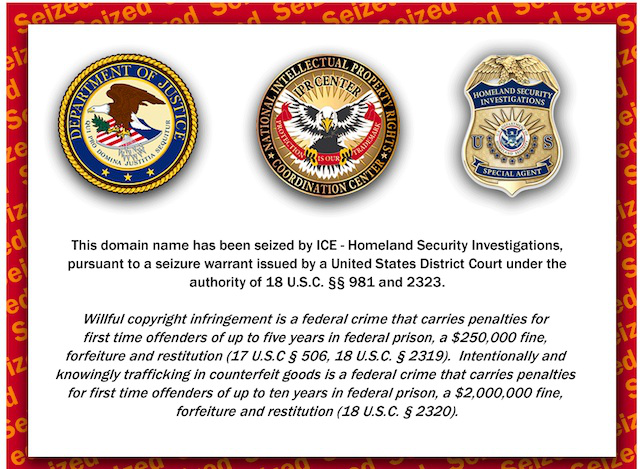
Remove the domain name from the registry and anyone who tries to go to the site gets an error message, or something that looks like this:

Civil Forfeiture

As the illustration above indicates, domain names are treated as any other property that can be seized and forfeited as a matter of law. Asset forfeiture is an important tool in law enforcement. A bank robber can, as part of his sentence, be required to hand over his loot. This type of forfeiture can be referred to as an in personam order – the order to forfeit the assets is a result of a case against a specific person. Less familiar, but perhaps equally as important, is civil forfeiture.

In a civil forfeiture case, the objectives are the same: to recover the proceeds of the crime and the property used to facilitate it; but the procedure is different. Instead of bringing an action against a person (in personam) as part of a criminal case, the action is brought against the property (in rem). In other words, it is a civil case in which the Government is the plaintiff, the property is the defendant, and the persons objecting to the forfeiture are intervenors called “claimants.” This is why civil forfeiture cases — in the United States at least — have such unusual names, such as United States v. $160,000 in U.S. Currency, or United States v. Contents of Account Number 12345 at XYZ Bank Held in the Name of Jones.2

Civil forfeiture against domain names makes sense in addressing online piracy. In many cases, the owner of the domain may be unclear due to the ease of falsifying registration information, or the owner may be difficult to find. Criminal prosecution against the site owners may not be in the interests of justice. And often, these sites are nothing more than their domain name and a collection of links – quick to setup and easy to operate. Traditional criminal prosecution is too costly and ineffective against this widespread digital piracy.

Old Dog, New Tricks

The most ironic part of the complaints that this bill will censor or break the Internet is that in rem procedures against domain names are nothing new. The image above shows one example of a domain name being removed. The in rem action this bill describes is not something the DoJ could not do before. All this bill does is streamline the process. It specifies how to determine issues like the situs of a domain name, the proper jurisdiction for bringing these actions, and appropriate venue – issues that have largely developed through case law.3

Contrary to fears that this bill will result in the takedown of YouTube4 or any number of other sites,5 COICA is aimed only at the most egregious pirate websites, like the ones taken down during this past summer’s anti-piracy initiative Operation In Our Sites – sites which were replaced with the graphic shown above. Fears that the MPAA or RIAA could muscle the DoJ into expanding the definition of sites “dedicated to infringing activity” past the plain meaning of the statute’s text are unfounded; one need only look at the history of criminal copyright prosecution to see there is no evidence that this bill would be used against anything other than the most clearly infringing sites.

In short, the ease and scale of online piracy requires more effective legal tools to manage. The rhetoric against COICA is overblown; the reality is that it offers improvements on one such tool that may better protect the rights of creators.

By , September 29, 2010.

The Supreme Court is set to hear oral arguments in Costco v. Omega on November 8, 2010. 1Recordings of the arguments will be available by the end of the week at www.supremecourt.gov thanks to the Court’s new policy. The issue before the court is a rather narrow one – and probably boring to a good deal of the public – but the stakes are high, and a wide variety of interests are keeping a close eye on the case.

Take a look at the lineup of industry groups who have submitted amicus briefs in the case:

In support of Costco

  • Retail Industry Leaders Association
  • National Association of Chain Drug Stores
  • Amazon.com
  • Gamestop Corp
  • Quality King Distributors
  • Sam’s West
  • Target Corp
  • Public Citizen
  • Entertainment Merchants Association
  • National Association of Recording Merchandisers
  • American Library Association
  • Association of College and Research Libraries
  • Association of Research Libraries
  • Public Knowledge
  • American Association of Law Libraries
  • American Free Trade Association
  • Electronic Frontier Foundation
  • Medical Library Association
  • Special Libraries Association
  • Ebay
  • Google
  • NetCoalition
  • Computer and Communications Industry Association
  • Internet Commerce Coalition
  • Intel Corp

In support of Omega

  • The United States of America
  • Association of American Publishers
  • Intellectual Property Owners Association
  • American Watch Association
  • Business Software Alliance
  • American Bar Association
  • Fujifilm
  • Seiko Epson
  • Epson America
  • Epson Portland
  • Software & Information Industry
  • Motion Picture Association of America
  • Recording Industry Association of America

Some pretty big names up in there. So what’s going on in Costco v. Omega? As Joe Mullin at Law.com points out, this case “doesn’t involve the kind of cutting-edge issues that copyright lawyers usually grapple with in the digital age.” Instead, it deals with getting a good deal on watches.

Omega manufactures and sells watches around the world. Like most companies in international markets, it engages in “geographical price discrimination.” Basically, it can’t sell the same watch in, say, Paraguay as it can in the US. So, a company like Omega will sell the same product at different prices in different markets, making less profit in some areas to gain market access and making up for it in markets that can support a higher price.

Costco and similar companies in the “secondary” market can take advantage of these different prices. If, after factoring in shipping and transportation, the cost to purchase legitimate products in another country is less than purchasing them in the US, they can buy the product in a country where it costs less and sell it in a country where it costs more.

The secondary market, also known as the “gray” market, is huge – generating tens, if not hundreds, of billions of dollars in all industry sectors worldwide. 2The Seattle Times cites $58 billion as the size of the secondary market in technology industry alone. And hopefully you can see the tension here, between manufacturers who want to disseminate their products as widely as possible while turning a profit and retailers engaged in legitimate arbitrage and free trade.

Since these are not counterfeit products, trademark law provides little recourse to manufacturers to control such parallel imports. But can copyright law? That’s the question the Supreme Court is set to answer.

When is a ‘Sale’ a ‘First Sale’?

In the US, under the “first sale” doctrine, a copyright owner can not control further sale or use of a legitimate copy once it has been lawfully sold. The new owner obviously doesn’t have the right to make additional copies, but he is generally free to do what he wants with the copy he has. The sale is said to have “exhausted” the copyright owner’s right to control the copy.

Here’s where things get tricky. “Exhaustion” only applies to the extent a nation’s laws says it does. 3TRIPS – the international agreement on intellectual property that governs the majority of the world’s countries – leaves the point at which exhaustion occurs up to each individual nation. Some countries allow for international exhaustion, meaning an authorized sale anywhere in the world exhausts a copyright owner’s right to control. Other countries follow the principle of national exhaustion: Only an authorized sale within the national boundaries constitutes a “first sale”; an authorized sale outside the country doesn’t, meaning a copyright owner can prevent parallel imports. The Supreme Court must decide whether the Ninth Circuit was correct when it held that US copyright law follows the principle of national exhaustion, or whether US copyright law doesn’t allow copyright owners to prevent importation of authorized copies manufactured outside its borders.

One quick note: the temptation is to think international exhaustion is more beneficial to consumers. “Omega is just greedy, why shouldn’t I be able to get cheaper watches at Costco?” The reality is far more complex:

There is considerable debate concerning whether granting IPR holders the power to segregate markets is good or bad from various perspectives – economic, social, political and cultural. From the standpoint of those favouring open markets and competition, it may appear fundamentally inconsistent to permit intellectual property to serve as a mechanism to inhibit trade. Yet IPR holders argue that there are positive dimensions to market segregation, and corollary price discrimination. 4UNCTAD-ICTSD, Resource Book on TRIPs and Development, Exhaustion of Rights.

Hard Cases (Bad Law?)

Costco v. Omega is about the scope of the first sale doctrine as it relates to a copyright owner’s exclusive right of distribution concerning importation; both parties make extensive use of statutory interpretation canons, existing precedence, legislative history, and public policy to make their case. The case is not, as Forbes blog has stated, about the “power of a manufacturer to use copyright law – normally thought to protect creative works like books and movies – to ‘protect’ a tiny logo affixed to an expensive Swiss watch.”

We do normally think of copyright as protecting creative works, not “useful articles” such as watches. It strikes many as odd, then, that Omega can claim copyright protection for its watches by registering a copyright on its logo – and placing a tiny version of the logo on the back of the watch.

The Supreme Court has been “‘careful to caution against misuse or over-extension’ of trademark and related protections into areas traditionally occupied by patent or copyright.” The concern is that allowing copyright-esque claims to be heard under trademark law “would create a species of mutant copyright law that limits the public’s ‘federal right to ‘copy and to use’ ‘ expired copyrights'”, for example. 5Dastar Corp. v. Twentieth Century Fox Film Corp., 539 US 23, 34 (2003). But Omega has cleverly sidestepped this issue entirely by obtaining an ostensibly valid copyright on its logo, essentially turning something traditionally considered a trademark into a copyrighted work and bringing the dispute wholly within the confines of copyright law.

However worrisome this pretextual use of copyright law by manufacturers is, it is not the issue the Supreme Court is faced with. The question it is presented with treats Omega’s copyright as a given. The Ninth Circuit made no mention of the validity of Omega’s copyright, and as far as I can tell, the issue did not come up during the District Court proceedings. But the issue does raise concerns in the blogosphere. The conventional wisdom – Omega shouldn’t even have copyright protection in the first place, thus, it shouldn’t succeed in its actual claim.

And therein lies the problem. No matter how unsympathetic Omega is, or how improperly it has extended copyright law, the Supreme Court’s decision in this case will apply equally to the core copyright industries – book publishers, film studios, record labels, etc. The policy considerations for these industries differ in many ways from those of consumer goods manufacturers and resellers.

The amicus brief filed by the RIAA and MPAA devotes considerable time to discussing how market segmentation benefits both creators and consumers while ensuring wide dissemination of new works. The latter benefit is especially relevant to copyright policy, as dissemination is one of the inherent goals of the law.

These industries increasingly rely on foreign markets to recoup the costs of creation. Professional screenwriter William Martell notes (in one of his characteristically humorous and fascinating posts) that the average US film makes around 60-70% of its money outside the US and Canada.

I doubt the Court will fail to consider that any decision it makes will impact the core copyright industries. What I don’t doubt, though, is that as this case progresses we will see less discussion about the actual issue of the case and more discussion about Omega’s extension of copyright law – with the accompanying hue that Omega’s actions implicate all creators and industries who rely on copyright.

References

References
↑1 Recordings of the arguments will be available by the end of the week at www.supremecourt.gov thanks to the Court’s new policy.
↑2 The Seattle Times cites $58 billion as the size of the secondary market in technology industry alone.
↑3 TRIPS – the international agreement on intellectual property that governs the majority of the world’s countries – leaves the point at which exhaustion occurs up to each individual nation.
↑4 UNCTAD-ICTSD, Resource Book on TRIPs and Development, Exhaustion of Rights.
↑5 Dastar Corp. v. Twentieth Century Fox Film Corp., 539 US 23, 34 (2003).
By , September 26, 2010.

Wow, I can’t believe it’s been nearly two months since I began this blog!

Today’s post will be brief. I want to welcome all the new readers and subscribers who have found this site over the last few weeks. I hope to continue to provide the same quality of content that brought you here in the future.

Since this is a relatively new site, there are still a few wrinkles. For example, the commenting procedure is still on the WordPress default mode, meaning I have to manually approve all comments before they appear. The good news is, I believe that once you’ve had a comment approved, future comments are automatically approved. For now, I have it this way to keep out spam comments, and even a new site like this attracts quite a bit of spam! But bear in mind that if you’re a first time commenter, your remarks won’t show up immediately.

Also, be sure to check out the sites on my Blogroll if you haven’t already: the 1709 Blog, Copyright Litigation Blog, Copyrights & Campaigns, Music Think Tank, Plagiarism Today, and The Cynical Musician – they all consistently provide excellent articles about copyright and the content industries, from a variety of perspectives. The list will likely be growing in the  next couple weeks as there are plenty of great sites out there.

I did want to point out a couple of new – and “new to me” – sites that may be of interest to my readers:

Clannco: Art and Law is a blog devoted to exploring the relationship between art and law written by Sergio Muñoz Sarmiento, an artist and a lawyer. I originally came across the site after seeing Sergio’s response to my piece on artistic expression, the first amendment, and copyright law. The rest of the site provides an insightful look at issues and topics which don’t often garner much attention on other sites.

Copygrounds is an “academic discussion forum” maintained “through the collective effort of Brett Caraway and students from the Department of Radio-Television-Film at The University of Texas at Austin.” The site is set apart by its attraction of some notable guest bloggers so far. Be sure to check out the latest posts from Matt Oppenheim, former VP at the RIAA and plaintiff’s attorney at the Joel Tenenbaum trial, discussing the Tenenbaum trial and statutory damages in P2P cases.

John Degen, Literature Officer for the Ontario Arts Council, has a personal blog I recently came across. He’s one of many Canadians who have noticed that online discussion of Canadian copyright law is heavily dominated by one particular law professor; his blog covers a variety of issues from a creator’s perspective.

What other good sources of information about copyright and the digital world are there? And what topics would you like to see covered here?

Let’s make this an “introduce yourself” slash “open thread” entry. Plug yourself, plug your work, or just say “hi” in the comments. I’d like to hear from everyone reading!

By , September 24, 2010.

The First Amendment is perhaps the most famous part of the Constitution. Defending People’s blogger Mark Bennett ran a tally of how many times each article and amendment (of the ten included in the Bill of Rights) in the Constitution was specifically mentioned in the week leading up to Constitution Day; the First Amendment was mentioned by bloggers nearly as many times as all others combined. In the words of the Oxford Companion to the Supreme Court of the United States, the Amendment “reflects vital attributes of the American character,” “is the cornerstone of the nation’s liberty,” and “is known and cherished by virtually all citizens.”

It may come as a surprise then, that very few cases concerning the First Amendment arose in the first hundred or so years of its existence. It wasn’t until after World War I that the Supreme Court began to develop many of the free speech doctrines we see today. 1The Oxford Companion cites Justices Holmes’ and Brandeis’ dissent in Abrams v. United States (1919) as sowing the “kernels of modern free speech doctrine.”

What does this have to do with copyright? Well, if you take a closer look, you can see an inherent tension between the First Amendment and copyight law. The First Amendment prevents the government from restricting freedom of speech; copyright restricts the ability of a person to “speak” using the words of another. 2I use the terms ‘speak’ and ‘words’ here in a very broad sense, as copyright protection extends to subject matter beyond the written word.

Like the development of modern free speech doctrines, this recognition of a conflict between the First Amendment and copyright law is a relatively recent phenomenon. It wasn’t until about the 1960s when the idea began to receive attention from legal scholars. 3See, e.g., Melville Nimmer, Does Copyright Abridge the First Amendment Guarantees of Free Speech and Press?, 17 UCLA L. Rev. 1180 (1969); Lionel Sobel, Copyright and the First Amendment: A Gathering Storm?, 19 Copyright Law Symposium (ASCAP) 43 (1971) (predicting a “coming clash between ‘free speech and press’ principles and copyright clause exclusive-rights principles.” It wasn’t until 1985 that the “kernels” of the modern doctrines addressing the tension between the First Amendment and copyright law were sown by the Supreme Court, in Harper & Row v. Nation Enterprises. In 2003, in Eldred v. Ashcroft, the Court fleshed out the current state of the law concerning the relationship between the First Amendment and copyright.

Simply put, the Court said, First Amendment concerns are adequately addressed by “copyright’s built-in free speech safeguards.” It noted two of those safeguards: the “idea/expression dichotomy” and the doctrine of fair use. It also suggested that there are supplemental safeguards, like copyright law’s exceptions for libraries and archives.

Criticisms of this approach began in earnest after Harper & Row and multiplied in the wake of Eldred. 4See footnote 2 of Alan Garfield, The Case for First Amendment Limits on Copyright Law, for a sampling of several dozen books and articles exploring the subject. The overall theme is that copyright’s safeguards are not, in fact, adequate to address First Amendment concerns – specifically in cases of what I label “creative infringement.” 5One such example of the relevance of this distinction regarding the First Amendment and copyright is provided by Mark Lemley and Eugene Volokh, who agree that “there’s no First Amendment problem” for preliminary injunctions in “piracy and other ‘easy’ cases” of copyright infringement. Freedom of Speech and Injunctions in Intellectual Property Cases (1998). But free speech concerns have also been raised in cases of “consumptive infringement” – albeit on issues outside the scope of copyright law. ((See the EFF’s amicus brief in Achte-Nuente v. Does for one such example.

But something is missing in the discussion about copyright and the First Amendment. For all the attention given to the First Amendment concerns of alleged infringers, there is scant attention devoted to the First Amendment concerns of infringees – artists and creators.

Artistic Expression and the First Amendment

Part of this lack of attention stems from how the subject matter of copyright – artistic expression – is viewed. As constitutional scholar Sheldon Nahmod states, “Artistic expression has been assigned a derivative and second-class status in the views of many first amendment thinkers, the Supreme Court, and other courts.” 6Nahmod, Artistic Expression and Aesthetic Theory: The Beautiful, the Sublime and the First Amendment, Wisconsin Law Review (1987). Much First Amendment scholarship focuses on protection of political speech, with other forms of speech – like artistic expression or commercial speech – relegated to the margins of the discussion.

This slighting of artistic expression in First Amendment theory is not historically unusual; many philosophic schools of thought have placed relatively little importance on the role of art in society. Some have been downright skeptical of artistic expression. Nahmod notes that, “According to Plato, the state must control art for the good of the society as a whole. Otherwise, art threatens the stability of the state.” 7Nahmod, p. 227 He adds that contemporaries of Marx, too, “are so convinced of art’s influence that they view art as an appropriate subject for state control.” 8Nahmod, p. 224

Artistic expression has been subjected to censorship in the US throughout its history, with restrictions largely aimed at sexual content. Book bans are not unheard of; the film industry has a storied past involving first local government ratings boards and, later, voluntary industry ratings systems. Industry groups play a role in protecting the slighted First Amendment rights of artists and creators. The RIAA states that part of is its mission is working to protect the “First Amendment rights of artists and music labels”; lest the more cynical readers think this is just PR lip-service, I point out the amicus brief filed just last week by the MPAA, RIAA, and other industry groups arguing that California’s recent law prohibiting the sale of violent video games to minors is unconstitutional.

But artistic expression can serve other purposes that make it, even absent any objectionable content, unworthy of more than second-class status in scholarly discussion. It can often be used as entertainment, a diversion from the drudgery of ordinary life. Here, we can draw analogies between artistic expression as entertainment and other forms of entertainment throughout history to see that this low opinion of artistic expression is not an anomaly. Sports have, at various times, been the subject of regulation or outright banning by governments. In England during the Middle Ages, soccer, bowling, golf, and other sports were the subject of bans at various times. Often, these bans reflected the idea that these sports diverted young men’s energy away from military training and were thus a threat to law and order. 9Andrew Pittman, The Interaction of Sport and Law: Where Has it Been, Where is it Now, and Where is it Going?, 2 Journal of Legal Aspects of Sport 64 (1992).

Despite its at-times uncomfortable fit within First Amendment theory and a general snubbery throughout history, artistic expression flourishes in the US. Movies and television shows created here are watched around the world. Jazz, rock and roll, and hip-hop have all arisen within the US. As a result of all of this, artistic expression in the US can sometimes find itself in an odd position. For example, in the late 80s and early 90s, several record store clerks were arrested for selling 2 Live Crew albums to minors; 10Steve Jones, Ban(ned) in the USA: Popular Music and Censorship, 15 Journal of Communication Inquiry 73 (1991). in 1994, the highest court in the US upheld that same group’s right to release a ribald, dirty parody of Roy Orbison’s Pretty Woman as fair use. 11Campbell v. Acuff-Rose Music, 510 US 569 (1994).

Artistic Expression, the First Amendment, and Copyright

Attention to artistic expression’s place within First Amendment theory remains underdeveloped. However, within discussions of copyright law, the role of artists’ First Amendment rights is practically ignored.

What do I mean by the role of artists’ First Amendment rights within copyright law? Courts that have addressed the tension between the First Amendment have, as I stated above, said that copyright law has built in safeguards to protect the First Amendment rights of those who make use of copyrighted works. But there’s another side of the coin. In Harper & Row – repeated later in Eldred – the Supreme Court declared that “the Framers intended copyright itself to be the engine of free expression.” 12471 US 558 The metaphor adopted by the court explains how copyright and the First Amendment accomplish the same goal – the dissemination of new ideas – through distinct means. Copyright pushes the dissemination – by providing an incentive to create new expression – while the First Amendment removes the obstacles in the way of that dissemination.

In many ways, the copyright incentive provides the most free method to spread new ideas. We don’t have to rely on the wealthy to fund whatever expression captures their fancy. We don’t have to rely on government to fund whatever expression it deems serves the state. Instead, we have a society where the values of artistic expression – as beauty, sublime, frivolity, or entertainment – and the value of artistic expression is determined solely by its members and the market. Patrick Ross, of the Progress and Freedom Foundation, puts it this way:

Our culture is remarkably vibrant and expressive, and is consumed around the world (even if many of those global consumers enjoy deriding our culture while consuming it). We embrace freedom of expression. We don’t burn down buildings when someone publishes a cartoon we find offensive. A bookstore can display the latest David McCullough biography beside a paperback collection of bathroom jokes. In fact, our culture seems pretty indestructible (we’ve survived the lip-synching scandals of Milli Vanilli and Ashlee Simpson, after all). While there will always be those who appoint themselves guardians and protectors of our culture, we can recognize that they aren’t truly needed. That is, they aren’t needed as long as artists retain their longstanding role in the culture. Artists, through the flexible exercise of their rights bundles, allow the culture to be enriched. No corporation can lock that culture down, and no p2p pirate can significantly erode that culture, as long as society collectively thanks its artists by respecting property rights.

But you won’t find much discussion of copyright’s role in the dissemination of new ideas when First Amendment concerns are raised in the context of copyright law. The “engine of free expression” metaphor is mentioned only in passing, ignored, or even dismissed as a “judicial sound bite.” 13Michael D. Birnhack, The Copyright Law and Free Speech Affair: Making-Up and Breaking-Up, Idea: Journal of Law & Technology 43 (2003): 233. That’s just wrong. In any case of “creative infringement,” there are two sides to the “free expression” coin. Any discussion of free expression rights which focuses on the rights of only one side (the alleged infringer) while ignoring the other (the infringee) is incomplete.

References

References
↑1 The Oxford Companion cites Justices Holmes’ and Brandeis’ dissent in Abrams v. United States (1919) as sowing the “kernels of modern free speech doctrine.”
↑2 I use the terms ‘speak’ and ‘words’ here in a very broad sense, as copyright protection extends to subject matter beyond the written word.
↑3 See, e.g., Melville Nimmer, Does Copyright Abridge the First Amendment Guarantees of Free Speech and Press?, 17 UCLA L. Rev. 1180 (1969); Lionel Sobel, Copyright and the First Amendment: A Gathering Storm?, 19 Copyright Law Symposium (ASCAP) 43 (1971) (predicting a “coming clash between ‘free speech and press’ principles and copyright clause exclusive-rights principles.”
↑4 See footnote 2 of Alan Garfield, The Case for First Amendment Limits on Copyright Law, for a sampling of several dozen books and articles exploring the subject.
↑5 One such example of the relevance of this distinction regarding the First Amendment and copyright is provided by Mark Lemley and Eugene Volokh, who agree that “there’s no First Amendment problem” for preliminary injunctions in “piracy and other ‘easy’ cases” of copyright infringement. Freedom of Speech and Injunctions in Intellectual Property Cases (1998). But free speech concerns have also been raised in cases of “consumptive infringement” – albeit on issues outside the scope of copyright law. ((See the EFF’s amicus brief in Achte-Nuente v. Does for one such example.
↑6 Nahmod, Artistic Expression and Aesthetic Theory: The Beautiful, the Sublime and the First Amendment, Wisconsin Law Review (1987).
↑7 Nahmod, p. 227
↑8 Nahmod, p. 224
↑9 Andrew Pittman, The Interaction of Sport and Law: Where Has it Been, Where is it Now, and Where is it Going?, 2 Journal of Legal Aspects of Sport 64 (1992).
↑10 Steve Jones, Ban(ned) in the USA: Popular Music and Censorship, 15 Journal of Communication Inquiry 73 (1991).
↑11 Campbell v. Acuff-Rose Music, 510 US 569 (1994).
↑12 471 US 558
↑13 Michael D. Birnhack, The Copyright Law and Free Speech Affair: Making-Up and Breaking-Up, Idea: Journal of Law & Technology 43 (2003): 233.
By , September 22, 2010.

I’d like to take a step back from discussions about copyright specifics to make a general observation. We can distinguish between two types of copyright infringement – let’s call them “consumptive” infringement and “creative” infringement.

“Consumptive” infringement includes what is generally called “piracy.” 1Noted copyright scholar William Patry defines “piracy” as the “massive, commercial, unauthorized reproduction of copyrighted works.” This is the type of file-sharing that has flourished on the internet, whether we’re talking about music, movies, books, software, images, or any other copyrighted subject matter. Consumptive infringement involves the reproduction and distribution through unauthorized channels of what is generally offered through legitimate ones.

“Creative” infringement, by contrast, involves the use of existing works, without permission, to create new works. It includes transformative uses, derivative works, and works which may be protected by fair use. This category also includes what has been described in academic literature as “remixes” or “mashups.”

I define consumptive infringement in such a way that it is de facto infringing at law. A work has been reproduced, in its entirety, for the sole purpose of substituting a legal use of the work. Creative infringement, however, is a grey area, and can only be declared an infringement by a court. With creative infringement, the line between infringement and non-infringement is necessarily fuzzy and undefined. Inherent in this category is the recognition that all creative works, to some extent, borrow from existing works. Some, like Men at Work’s Down Under, may be determined to have borrowed in a legally infringing manner, while others, like 2 Live Crew’s Pretty Woman, may be determined to have borrowed in a legally acceptable manner.

The doctrines used to determine whether creative infringement exist occupy close to 99% of copyright casebooks and a solid proportion of academic literature. Substantial similarity, fair use, the idea-expression continuum, de minimis – all these have been developed and employed by courts to sort perfectly acceptable uses of existing copyrighted works from those that cross the line into infringement.

I’m certainly not the first to note a distinction between these two types of infringement; I’m not even the first to make use of the term “consumptive infringement.” In Copyright and the Rule of Reason, author and law professor Christopher Sprigman defines “consumptive infringement” as those “forms of infringement involving the reproduction and distribution of copies that are either exact or near enough so that they are almost certain to compete with the original work for patronage.” He goes on to say that this “category of consumptive infringement will apply to a large percentage of copyright cases that plaintiffs will wish to bring. Most copyright violations involve the making and distribution of exact or near-exact copies. Virtually all of the infringement via peer-to-peer networks falls into this category.”

Why bother with this distinction?

While Sprigman makes the distinction between “consumptive” infringement and other types of infringement to propose a new legal standard, my purpose here is to merely note that a distinction exists to aid in our discussion of copyright. As noted above, cases of creative infringement occupy the vast majority of copyright discussion. When is a use fair? Where is the line between an idea and an expression? Consumptive infringement, however, is pretty cut and dry. It competes precisely with the rights that copyright law was designed to protect. Bootlegs and torrents act as displacements for the consumptive offerings of content creators.

The distinction I make is not often noted but apparent in practice. The RIAA lawsuits targeted those who shared those songs that record labels offer for sale. Criminal copyright infringement charges can be brought for any type of infringement, but as far as I can determine, the only cases which have historically been brought have been against those who have engaged in widespread consumptive infringement. And while you can find a flourishing mashup scene online, not a single lawsuit has been brought against a mashup artist, even a commercially successful one like Girl Talk. 2The New York Times notes the lack of legal action against mashup artist Girl Talk. A number of sites offering Danger Mouse’s Grey Album, one of the most famous mashup albums, received cease and desist letters from EMI, but the label never pursued further action. I’ve been able to find only one other report of a cease and desist sent to a mashup artist.

It should not be surprising that the grey areas of a law receive the most analysis while the black and white cases generate the most legal action. Copyright law is no exception. But here’s the problem: the entirety of copyright law has become somewhat of a boogeyman. A good portion of the online public has grown increasingly skeptical of content industries.

As a result, all aspects of copyright law have been placed under a microscope. Any and all deficiencies in court’s applications of substantial similarity, fair use, or the idea expression continuum have been duly noted. The shortcomings of these problems are transposed on discussions involving efforts to manage piracy.

It’s as if content creators are not justified in addressing piracy as long as all these other problems with copyright law remain.

What we need to remember is that any substantive problems with copyright law are independent of the problems of consumptive infringement. I don’t think I’m going too far out on a limb to say that most creators, whether large or small, are primarily concerned about the effects of consumptive infringement.

It’s also fair to say that while creative infringement occupies the vast majority of casebooks and academic literature, consumptive infringement occupies the vast majority of court dockets. Creators of all stripes are rightfully concerned about the effects consumptive infringement has on their livelihood, and shouldn’t have to become apologists for any perceived problems involving creative infringement.

Bottom line, I think it’s important to recognize this distinction between consumptive and creative infringement. Rational discussion of copyright policy is aided by separating the two. I’ve remained deliberately broad and general in this article; it’s my expectation to use this as a launching pad for more detailed topics in the future.

References

References
↑1 Noted copyright scholar William Patry defines “piracy” as the “massive, commercial, unauthorized reproduction of copyrighted works.”
↑2 The New York Times notes the lack of legal action against mashup artist Girl Talk. A number of sites offering Danger Mouse’s Grey Album, one of the most famous mashup albums, received cease and desist letters from EMI, but the label never pursued further action. I’ve been able to find only one other report of a cease and desist sent to a mashup artist.