By , June 25, 2021.

Congressmen Introduce American Music Fairness Act to Compel Radio to Pay Royalties on Recorded Music — “The United States is the only major country in the world where terrestrial radio pays no royalties to performers or recorded-music copyright owners of the songs they play, a situation that is largely due to the powerful radio lobby’s influence in Congress. While the more than 8,300 AM and FM stations across the country pay royalties to songwriters, they have never paid performers or copyright holders, although streaming services do. On Thursday, Reps. Ted Deutch (D-FL) and Darrell Issa (R-CA) introduced the bipartisan American Music Fairness Act, which aims to rectify that situation.”

CJEU rules on platform liability under copyright law, safe harbours, and injunctions — “The early reactions I have seen, likely supported by the rather misleading title of the press release, have been in the sense that the CJEU has ruled that platforms like YouTube and Uploaded do not communicate to the public under Article 3. In turn, this would mean that Article 17 of the DSM Directive is a novel regime that does not at all ‘clarify’ the law (recital 64 of the DSM Directive), but rather changes it. This interpretation is, in my view, incorrect.”

“Oh, the Places You’ll Boldly Go!” dispute won’t go to SCOTUS, justices say — “The high court won’t review the 9th Circuit’s December decision written by U.S. Circuit Judge Margaret McKeown that author David Jerrold and ComicMix LLC’s mashup of ‘Star Trek’ elements with Dr. Seuss’s ‘Oh, the Places You’ll Go!’ didn’t make fair use of Seuss’s work largely because it wasn’t transformative.”

Library of Congress Announces Copyright Public Modernization Committee — “. . . the CPMC is being established by the Library to expand and enhance communication with external stakeholders on IT modernization of Copyright Office systems. Committee members were selected from a pool of applicants for their ability to represent a broad cross section of the copyright community and other interested groups. CPMC members will provide valuable input into the development of the new Enterprise Copyright System (ECS), which includes the Office’s registration, recordation, public records, and licensing IT applications, and will be encouraged to help spread awareness of the Library’s development efforts more broadly.”

Library of Congress to Celebrate the Return of Visitors to the Thomas Jefferson Building in July — “A limited number of free timed entry passes will be available on Thursdays, Fridays and Saturdays between 10 a.m. and 4 p.m., with last entry at 3 p.m. For information on reserving tickets, visit loc.gov/visit – visitors can review ‘Know Before You Go’ guidelines and reserve their free passes. Each visitor must have a printed paper pass or a digital copy of the pass available on a mobile device for entry. All visitors, regardless of age, must have a timed pass for entry, and each visitor will be able to reserve up to (6) passes. Passes will be released on a rolling, 30-day basis, so for visitors planning to visit within the next month, please visit the reservation site for availability.”
By , June 18, 2021.

First Circuit Rules Markham’s Development of ‘The Game of Life’ Was Work Made For Hire Not Subject to Termination Rights — Markham argued that the Supreme Court’s decision in CCNV v. Reid, which interpreted the work for hire provisions of the 1976 Copyright Act, was applicable to works protected under the 1909 act. The First Circuit disagreed, holding that the “instance and expense” test still applied to such works.

Unicolors v. H&M Raises Some Thorny Issues for Copyright Owners — David Newhoff looks at the first copyright case the Supreme Court has agreed to hear for its next term.

Just What Is the Case with the CASE Act? A Brief Overview — “The phrase ‘creators have rights, but no remedies’ is likely familiar to those aware of the current landscape of copyright protection for individual creators and small businesses. While the Copyright Act of 1976 grants a bundle of rights to Creators for the protection of their works, for years Creators have faced an uphill battle enforcing those rights against infringers. There are many who are optimistic, however, that things might soon change with the passage of ‘The Copyright Alternative in Small-Claims Enforcement Act of 2020’ (CASE Act).”

The Beijing Treaty: A step forward in the protection of related rights in audiovisual performances — “For the first time, an international instrument confers express protection to performing artists for fixations of their work on an audiovisual medium, acknowledging their right to decide the time and manner in which their audiovisual works are used abroad, while also receiving a share of the profits obtained from their exploitation, even in the digital environment. Up to now, only sound fixations enjoyed this protection (see the WIPO Performances and Phonograms Treaty – WPPT – approved in 1996 and in force since 2002).”

By , June 11, 2021.

Copyright controversy erupts as prominent scholars urge veto of ALI restatement — “In 2018, Balganesh, Menell and Nimmer asked ALI’s governing council to consider their objection to the restatement’s black letter departures from the language of the Copyright Act. The council, according to Balganesh, referred their concerns to a different ALI committee, but they were never apprised of that committee’s conclusions.” The ALI ignored the concerns and approved the sections of the draft on Tuesday.

How IP Rights Keep Markets Free — Law professor Jonathan Barnett writes in a new policy brief, “weak or nonexistent patents advantage larger integrated firms while disadvantaging smaller firms that have strong innovation but weak commercialization capacities. Rather than advancing the public interest in a robust innovation economy, IP-skeptical policies undertaken by courts, legislators, and regulators may have mostly promoted the private interests of large technology firms that advocated for those policies.”

Leading authors sound alarm over post-Brexit changes to copyright — “Mosse, author of the bestselling Labyrinth and founder of the Women’s prize, said: ‘If we don’t ensure writers remain respected for their work, then many will be forced to leave the industry and Britain’s cultural landscape will suffer hugely. . . . It will become less diverse, less innovative, less inspiring,’ said Mosse. ‘Copyright is the bedrock of authors’ earnings and ensures that everyone – whatever their background, their genre of writing – is properly remunerated for their talent.'”

Record Labels Sue Frontier For Failing to Terminate Persistent Pirates — Torrentfreak’s Andy Maxwell reports, “Holding Frontier liable for contributing to the direct infringements of its customers, the labels say that the ISP was motivated to keep infringing subscribers on board for financial benefit, adding that terminating subscribers would deprive it of revenue and make its service less attractive to existing and prospective customers. Since P2P use consumes lots of data usage, infringing customers were particularly lucrative, the plaintiffs add. Pirates are likely to pay more money for faster connections with greater usage limits, leading Frontier to turn a blind eye to repeat infringement by known specific subscribers.”

Roblox Hit With $200 Million-Plus Lawsuit by Music Publishers Alleging Unauthorized Song Use — Variety’s Todd Spangler reports, “NMPA president/CEO David Israelite announced the lawsuit against Roblox at the trade group’s 2021 annual meeting. He cited Roblox’s massive user base of more than 42 million active daily players and alleged that Roblox has gone to great lengths to avoid paying music creators.”

By , June 04, 2021.

Supreme Court Grants Cert in Unicolors v. H&M to Consider Whether Section 411 Includes Intent-to-Defraud Requirement — The first copyright case to land on the Supreme Court’s 2022 docket arrived this week, with the Court agreeing to decide when copyright registrations with inaccurate information can be invalidated by courts.

Street Artist Kaves Slaps the NYPD With a Lawsuit, Saying It Illegally Whitewashed a New York Mural He Painted With Full Permission — According to Artnet News, “The artist is asking the court to decide whether the NYPD’s policy and practices violate the Visual Artists Rights Act (VARA), which gives artists certain protections for public art projects.”

AAP Vows to Protect Copyright from All Challengers — “In his opening remarks, Napack praised the publishing community for ‘keeping the river of ideas flowing’ during the pandemic, especially as the industry faced threats and challenges from different quarters. He promised that AAP would continue to fight against forces that ‘chip away’ against freedom of expression as well as those who seek to erode copyright protection.”

New EU copyright rules that will benefit creators, businesses and consumers start to apply — From the EU Commission: “This Monday 7 June marks the deadline for Member States to transpose the new EU copyright rules into national law. The new Copyright Directive protects creativity in the digital age, bringing concrete benefits to citizens, the creative sectors, the press, researchers, educators and cultural heritage institutions across the EU. At the same time, the new Directive on television and radio programmes will make it easier for European broadcasters to make certain programmes on their online services available across borders. Furthermore, today, the Commission has published its guidance on Article 17 of the new Copyright Directive, which provides for new rules on content-sharing platforms.”

The American Law Institute Proceeds with its Misstatement of Copyright Project — “Next week, sections of the American Law Institute’s (ALI) Copyright Restatement will be offered for approval for the first time at the ALI’s annual membership meeting. If approved by the full membership, these sections will be made publicly available and may then be cited by attorneys in briefs and used by judges to help decide copyright cases. The problem is that the Restatement project has been plagued from the start with a myriad of substantive and procedural deficiencies that remain unaddressed.”

By , May 28, 2021.

Instagram Embed Feature Sparks Copyright Suit From Users — “Two users on Wednesday sued Instagram, claiming its embed feature is designed to flout copyright laws to make money for its parent, Facebook. ‘Instagram misled the public to believe that anyone was free to get on Instagram and embed copyrighted works from any Instagram account, like eating for free at a buffet table of photos by virtue of simply using the Instagram embedding tool,’ writes attorney Solomon Cera in the complaint,” which is included in the article.

A voice gone viral: Canadian voice actor sues TikTok for using her voice without permission for text-to-speech feature — “Standing first became aware of her voice in TikTok videos in late 2020. Her friend sent a video to her, noticing her voice in the background. In early May, Standing filed a copyright violation claim against ByteDance for using her voice recordings without obtaining permission.”

New Report Examines Changes to Copyright Law for Sound Recordings — The Library of Congress National Recording Preservation Board has published a report that analyzes the Music Modernization Act and its implementation, with a focus on how the law impacts sound recording preservationists. The report includes a number of guides and resources for libraries and archives.

Cox Appeals $1B Piracy Liability Verdict to ‘Save the Internet’ — ISP Cox submitted its opening appellate brief to the Fourth Circuit this week, along with a healthy dose of hyperbole. Cox is appealing the lower court’s holdings on vicarious liability, contributory infringement, and statutory damages. A copy of the brief is included in the article.

Federal Court of Appeal Court Upholds Canadian Pirate Site Blocking Order — Torrentfreak’s Ernesto Van der Sar reports, “Canada’s Federal Court of Appeal concluded today that the country’s first pirate site blocking order can stay in place. The Court dismissed the appeal from Internet provider TekSavvy. According to the Court, site-blocking injunctions don’t violate the Copyright Act, freedom of speech, or net neutrality. While it’s not a perfect remedy, it trumps other available options.”

By , May 21, 2021.

Stages of Grief: What the Pandemic Has Done to the Arts — A compelling and devestating read from William Deresiewicz. “What has been happening across the arts is not a recession. It is not even a depression. It is a catastrophe. There is another thing the rest of us, the audience, do not fully appreciate: the crisis is rooted in the destruction that was visited upon the arts even before the pandemic—that is, in the scandal of free content, which has been going on for more than twenty years and which implicates us all.”

A Bounty of Fair Use: ‘Google v. Oracle’ and ‘Warhol Foundation v. Goldsmith’ — Copyright attorneys Robert Bernstein and Bob Clarida discuss what impact the Supreme Court’s recent decision in Google v. Oracle may have on Warhol Foundation v. Goldsmith, where the Andy Warhol Foundation is currently seeking for rehearing of the Second Circuit’s earlier decision rejecting a fair use defense. And this just in: the Warhol Foundation reply in support of its petition for rehearing, filed yesterday.

German musicians criticize planned copyright reform — “The German federal government is planning its most extensive reform of copyright law within the last two decades, as it faces a June 7 deadline to implement European copyright directives into its national law. The proposed bill has, however, drawn criticism; a recent open letter to the German Bundestag protesting against the reform was signed by 1,145 musicians, bands and singers, including Peter Maffay, Helene Fischer, Herbert Grönemeyer, H.P. Baxxter, Campino and Marteria.”

South Africa’s Parliament starts the process for a new Copyright Amendment Bill — “South Africa’s Trade and Industry Committee at the National Assembly met on 12 May to discuss a new draft of the Copyright Amendment Bill (CAB), which was sent back to the Parliament in June 2020 by President Cyril Ramaphosa due to constitutional concern about the law. . . . The creative community was critical of the scope of exceptions to copyright in the original law through the introduction of a wide-ranging fair use provision. Consumers groups and organisations representing blind people were supportive of the bill.”

The Myth of Internet Exceptionalism: Bringing Section 230 into the Real World — “Offering perhaps the most concrete legal embodiment of Barlow’s internet exceptionalism, Section 230(c)(1) as applied by the courts has exempted platforms from the common law duty of taking reasonable steps to prevent users of their services from causing harm. Ironically—and in many cases tragically—this reduces the likeli­hood platforms will moderate content, the opposite of what Congress intended. Free from potential liability, platforms have a financial interest in minimizing spending on proactive measures to prevent unlawful activity, and even on reactive measures to mitigate further harm when unlawful activity has already occurred. As a result, instead of creating an incentive to moderate content, Section 230 creates a misincentive. Platforms can conserve resources and invest more reck­lessly in growth, giving them a competitive edge over their brick-and-mortar rivals and allowing them to shift onto society the costs of combating (or failing to combat) harm”

By , May 14, 2021.

Holding States Accountable for Copyright Piracy — “This paper identifies how copyright law and sovereign immunity came into conflict recently, explains why this conflict matters, and proposes a solution: Congress should enact new legislation that holds states accountable for when state officials pirate the fruits of creative labors of citizens by stealing their copyrighted works.”

Georgia Governor signs SB 238 into law — This week, the Georgia governor signed into law a bill that would allow the state to continue to offer an annotated code in light of last year’s Supreme Court decision in Georgia v. Public Resource Org. The bill clarifies which parts of the Code have or do not have the effect of law, clarifies the oversight of Georgia’s Code Revision Commission with respect to supplementary content, and revises a provision relating to copyright of the Code.

Goldsmith: The Supreme Court’s Google v. Oracle decision did not alter fair use analysis — Yesterday, the photographer filed her response to the Warhol Foundation’s request for rehearing of the Second Circuit’s decision finding Warhol’s use of Goldsmith’s Prince photo was not fair use. The Warhol Foundation has seven days to file a reply.

US Copyright Office: Notice and Takedown — The US Copyright Office recently published this helpful overview of the DMCA’s notice and takedown process, which copyright owners can use to request removal of infringing content from online services.

By , May 07, 2021.

Perlmutter addresses copyright issues at first House oversight hearing — The head of the US Copyright Office appeared in front of the House Judiciary Committee for the first time since taking the helm as Register of Copyrights last October. Perlmutter discussed the Office’s operations during the pandemic, continued modernization efforts, implementation of the Music Modernization Act and CASE Act, and fielded questions concerning policy issues like DMCA reform, terrestrial radio royalties, and resale royalties.

Foreign Works, US Rights: The 7th Circle of Copyright Hell? — Aaron Moss discusses the thorny issues implicated in a copyright infringement lawsuit filed against Nirvana. “The legal issue, simply stated, is whether a work first published in a foreign country without proper copyright notice is subject to copyright protection in the United States. The answer, unfortunately, isn’t so simple, at least for works first published before 1978. It’s made even more complicated as a result of a controversial Ninth Circuit case, Twin Books v. Walt Disney Co., which involved the novel “Bambi, a Life in the Woods,” first published in Germany in 1923 without copyright notice.”

Copyright reform in Singapore continues release of draft Bill for public consultation — “In February 2021, Ministry of Law (MinLaw) and Intellectual Property Office of Singapore (IPOS) released a draft Copyright Bill (the draft Bill) for public consultation. The draft Bill is significant because it is the first time the existing Copyright Act (the Act) is being restructured and rewritten as a whole.”

By , April 30, 2021.

ABC, CBS, Fox and NBC Battle “Freemium” — “What’s Locast? It’s a digital app that streams over-the-air television stations. Meaning, if a cord-cutter wanted to watch last night’s Oscars on ABC and didn’t have an ol’ rabbit ears antenna handy, this individual could go to Locast.org and sign up to see the local affiliate retransmitted online. It’s free. Well, sorta. A wrinkle may soon play a major role in an important copyright case. Broadcasters are now preparing to ask a federal judge for a sweeping legal victory against Locast. In July 2019, ABC, CBS, Fox and NBC filed a lawsuit over Locast. Nodding to a big Supreme Court decision a few years earlier, the complaint stated, ‘Locast is simply Aereo 2.0, a business built on illegally using broadcaster content.'”

World Book Day: Publishers Call for Canada’s Copyright Law To Be Fixed — “In the flurry of international recognition days in April—Earth Day (Thursday, April 22); World Book and Copyright Day (Friday, April 23); World Intellectual Property Day (Monday, April 26)—Canada’s writing and publishing industries have issued a statement, ‘calling on the federal government in Ottawa to fix Canada’s copyright law to address the systemic exploitation of creators’ and publishers’ works by educational institutions.’”

YouTube TV removed from Roku channel store amid Google contract dispute — “These spats happen regularly between Pay-TV providers and linear TV networks. But in the digital era, this is one of the rare times in which consumers will have a major streaming network removed from their platform’s channel store due to a breakdown in negotiations.”

Instagram is working on creator shops and a ‘branded content marketplace’ for influencers — “Creator Shops would be an extension of the company’s existing shopping features, which allows businesses to sell products. ‘We see a lot of creators setting up shops too, and one part of being a content creator business model is you create great content, and then you can sell stuff, and so having creator shops is awesome,’ Zuckerberg said.”

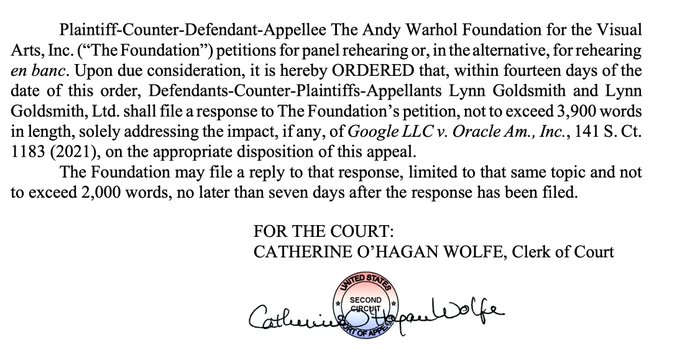
The Second Circuit is teeing up what could be the first decision to consider the impact of the Supreme Court’s decision in Google v. Oracle on the application of the fair use doctrine. This week, it called for briefing “solely addressing the impact, if any” of the decision on the appropriate disposition of the appeal in Andy Warhol Foundation v. Goldsmith.

By , April 23, 2021.

The Authors’ Take – Comment on Andy Warhol Found. for the Visual Arts, Inc. v. Goldsmith — Professor Jane Ginsburg on last month’s Second Circuit decision reversing a finding of fair use by artist Andy Warhol. Writes Ginsburg, “Like other recent decisions, this judgment may signal a taming of ‘transformative use.'”

Recordation: The Vital Back Office of US Copyright — “As the Copyright Office is currently in the midst of a project to build a new and modernized recordation process, I thought it might be useful to write this post about the often-overlooked (and definitely unsexy) work of the Recordation Section and its role in keeping rightsholders, potential licensees, and the general public au courant on the current ownership status (including the issuance of many licenses) of US works registered under copyright.”

Have tech platforms captured the Supreme Court? — Professor Jonathan Barnett discusses the Supreme Court’s decision in Google v. Oracle, which held that Google’s copying of software owned by Oracle was permitted by fair use. Barnett says, “This conclusion relies on a familiar but often false tradeoff between enforcing IP rights on the one hand and preserving access for users and subsequent innovators on the other hand.”

IPA Statement on World Book and Copyright Day 2021 — The International Publishers Association marks today’s celebration of World Book and Copyright Day. “The global copyright framework provides the foundation that publishers depend on to invest in publishing books that educate, enlighten and entertain audiences around the world as well as new technologies to improve their widespread availability and accessibility.”

Chicago Will Turbocharge Its Public Art Budget by 15,000 Percent as Part of a New $60 Million Cultural Recovery Program — “Under the new plan, the city’s current public art budget of $100,000 will increase by $3 million for each of the next five years—marking a 15,000 percent increase in that time. The effort ‘will not only leverage capital improvements to spur local economic development and job creation, but also mark a major advancement in the standard of public asset maintenance, and, consequently, the quality of life and livability of all Chicago communities,’ according to the city’s announcement. “